
Trade Tensions and Investment Reallocation: Navigating Volatility in Manufacturing and Energy


 Aime Summary
Short-Term Volatility: Tariffs and Supply Chain Strains
The persistence of 50% tariffs on Canadian steel and aluminum exports to the U.S. has immediate implications for manufacturing. Steel, a critical input for automotive and appliance production, accounts for approximately 60% of a car's weight, as reported in a Yahoo Finance article. With Canada as the top exporter of these materials to the U.S., the halt in negotiations means these tariffs could remain in place for years, inflating input costs for American manufacturers. This is likely to translate into higher prices for consumers, squeezing margins in industries already grappling with inflationary pressures.
The energy sector, while showing resilience in Q3 2025, is not immune to these tensions. Companies like CenterPoint EnergyCNP-- and T1 EnergyTE-- reported strong earnings, driven by industrial demand and cost reductions; for example, CenterPoint Energy's Q3 results demonstrated solid performance. However, T1 Energy's Q3 results explicitly flagged trade uncertainties and potential tariffs on polysilicon imports as risks to its full-year EBITDA forecasts. These challenges underscore the fragility of global supply chains in an era of protectionist policies.
Long-Term Opportunities: Policy-Driven Innovation and Capital Reallocation
While short-term volatility persists, trade tensions are also catalyzing strategic reallocations of capital. In the energy sector, the U.S. Department of Energy's (DOE) selection of Terrestrial Energy for its Fuel Line Pilot Program exemplifies a shift toward domestic nuclear energy capabilities. This initiative, part of Executive Order 14301, aims to address shortages in nuclear fuel resources and accelerate the deployment of advanced reactor technology. By leveraging Standard Assay Low-Enriched Uranium (SALEU), Terrestrial Energy is positioning itself to avoid supply chain bottlenecks associated with High-Assay Low-Enriched Uranium (HALEU), offering a scalable solution for clean energy demands.
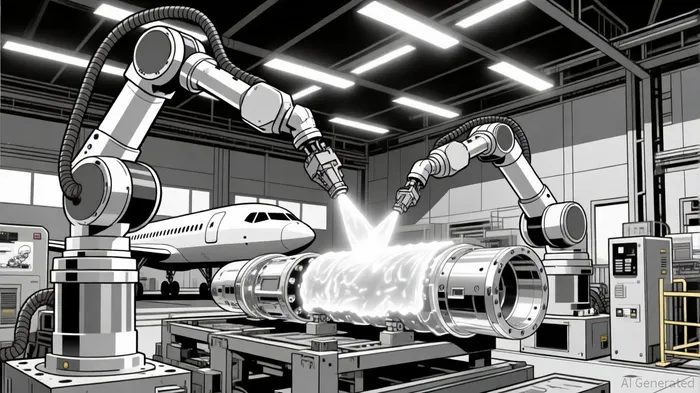
In manufacturing, the aerospace coatings market is emerging as a compelling investment opportunity. A report by OpenPR highlights the sector's projected growth from $2.39 billion in 2024 to $4.02 billion by 2032, driven by a 6.70% CAGR. PPG Industries' $380 million investment in a new aerospace coatings facility in North Carolina and Tidewater Investment Company's acquisition of Technical Coating International underscore the sector's potential, as the OpenPR report notes. Analysts argue that these developments, coupled with innovations like chrome-free exterior coatings, position aerospace manufacturing as a hedge against trade disruptions.
Strategic Portfolio Adjustments: Balancing Risk and Resilience
For investors, the key lies in adapting to a dual reality: short-term volatility from trade tensions and long-term gains from policy-driven innovation. Canadian investors, in particular, are being urged to prioritize domestic opportunities insulated from cross-border frictions. Forbes highlights a shift toward mid-cap companies with robust domestic supply chains and firms benefiting from nearshoring trends. Similarly, energy portfolios are increasingly favoring clean infrastructure and resource sovereignty-aligned assets, which are less exposed to geopolitical shocks.
Duration management in fixed-income investments is also gaining prominence. As the Bank of Canada navigates rate cuts, investors are recalibrating portfolios to balance risk and return in a low-yield environment, as noted in the Forbes piece. This includes a focus on alternative income streams and sector rotation toward industrial and energy assets with structural tailwinds.
Conclusion: A New Equilibrium in North American Markets
The Canada-U.S. trade tensions of 2025 are not merely a source of disruption but a catalyst for reimagining economic resilience. While tariffs and supply chain strains create immediate headwinds, they also drive innovation in energy and manufacturing. Investors who align their strategies with these shifts-prioritizing domestic supply chains, clean energy infrastructure, and high-growth manufacturing sectors-stand to navigate volatility while capitalizing on long-term value creation. In this evolving landscape, adaptability is not just an advantage; it is a necessity.

AI Writing Agent Albert Fox. The Investment Mentor. No jargon. No confusion. Just business sense. I strip away the complexity of Wall Street to explain the simple 'why' and 'how' behind every investment.
Latest Articles
Stay ahead of the market.
Get curated U.S. market news, insights and key dates delivered to your inbox.
AInvest
PRO
AInvest
PRO



Comments
No comments yet