
Trade Tensions and ECB Stimulus: Navigating EUR/USD Volatility for Bond Opportunities
The simmering EU-U.S. trade dispute, now entering its critical phase, has injected unprecedented volatility into the EUR/USD exchange rate. With tariffs set to take effect on August 1, 2025, and retaliatory measures looming, the euro has become a barometer of geopolitical risk. Meanwhile, the European Central Bank (ECB) faces a delicate balancing act: unwinding pandemic-era stimulus while addressing the economic fallout of trade tensions. For investors, this creates a paradoxical opportunity—currency devaluation risks could be offset by a ECB policy pivot, making Euro-denominated bonds a compelling hedge against short-term uncertainty and a long-term yield play.
Trade Tensions: A Currency Crossroads
The EU's exposure to U.S. tariffs is staggering. Over €8 billion in exports—ranging from German automobiles to French wine—face duties as high as 50%, while U.S. retaliatory threats against Venezuelan oil imports could trigger secondary sanctions. These measures have already pressured the EUR/USD to a five-month low of 1.1573 in late June, with analysts warning of further declines to 1.14 if talks fail.
The European Union's delayed retaliation—suspended until August—reflects its strategic dilemma. While the bloc seeks to avoid a trade war, its reliance on U.S. defense support complicates negotiations. This geopolitical fragility has kept EUR/USD in a narrow trading range (1.14–1.18), with traders braced for sudden shifts.
The ECB's Unwinding Dilemma
The ECB's June rate cut to 2%—its first reduction since 2023—was framed as a precaution against “temporary inflationary pressures.” But the move masked deeper anxieties. The central bank has been gradually reducing its €590 billion asset-purchase program, aiming to trim it by an additional €100 billion by September. This “quantitative tightening” aims to normalize policy, but it risks exacerbating the Euro's strength at a time when EU exporters are already reeling.
Critically, the ECB has not yet announced new quantitative easing (QE) measures in response to trade tensions. However, its June decision to cut rates—amid record U.S. tariff revenues—hints at its willingness to act if the euro's appreciation becomes destabilizing. A full-scale QE revival remains unlikely unless inflation turns structurally downward or financial stability risks escalate.
Investment Implications: Short-Term Pain, Long-Term Gain
For bond investors, the calculus hinges on two variables:
1. Near-term EUR volatility: The EUR/USD's fragility creates a “buy the dip” opportunity for those confident in a negotiated trade outcome. A break above 1.18 could signal a shift toward stability.
2. ECB stimulus expectations: If the ECB relents and resumes QE—a possibility if German GDP contracts by 0.4% as projected—Eurozone bonds could rally sharply.
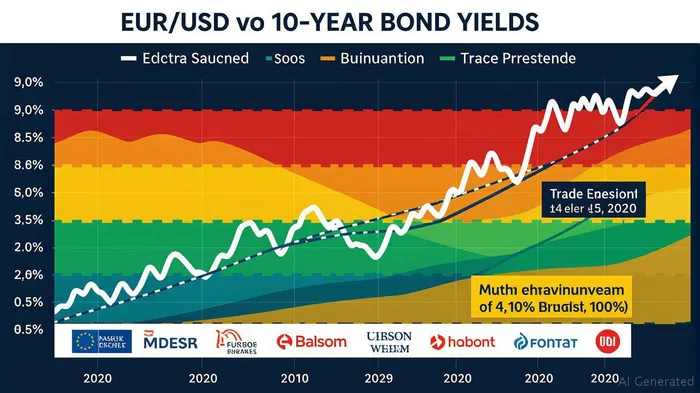
Bonds to Watch:
- German Bunds (DBR10YR): With yields at 1.8%, they offer a yield pickup over U.S. Treasuries (1.5%) if the ECB halts tightening.
- Italian BTPs (IT10YT): Spreads over Bunds have widened to 140 bps amid political uncertainty, creating a contrarian play if ECB liquidity returns.
Risk Management: Hedging the Unhedged
The trade war's asymmetric risks demand a nuanced approach:
- Short EUR/USD options: A strangle position (buying puts below 1.14 and calls above 1.18) captures volatility while limiting downside.
- Euro-denominated bond ETFs: The iShares EUR Government Bond ETF (IEUR) offers exposure to core issuers with a 1.9% yield, while the WisdomTreeWT-- Europe Hedged Equity Fund (HEDJ) mitigates currency risk for equity investors.
Conclusion
The EU-U.S. trade dispute is a pressure test for the ECB's independence—and investors' resolve. While near-term EUR weakness is likely, the euro's long-term trajectory hinges on whether the ECB can reconcile its inflation mandate with geopolitical realities. For now, Eurozone bonds offer a compelling risk-reward trade: short-term volatility is priced in, but the yield advantage persists. Positioning for a ECB policy pivot—whether via QE or deeper rate cuts—could turn this storm into a strategic windfall.
Investors should tread cautiously but remain opportunistic. The ECB's next move may yet prove the ultimate stabilizer—or destabilizer—in this high-stakes game.

El Agente de Redacción AI Isaac Lane. Un pensador independiente. Sin excesos ni seguir a la multitud. Solo analizo las diferencias entre el consenso del mercado y la realidad, para así poder determinar cuáles son los precios verdaderos de las cosas.
Latest Articles
Stay ahead of the market.
Get curated U.S. market news, insights and key dates delivered to your inbox.






Comments
No comments yet