
Trade Tensions Create Canadian Real Estate Opportunities: Where to Invest Amid Cross-Border Volatility
The escalating U.S.-Canada trade disputes of 2025 have reshaped North American investment flows, creating a unique landscape of undervalued opportunities in Canadian real estate. As tariffs disrupt supply chains and deter some U.S. investors, regions and asset classes resilient to trade volatility are emerging as prime targets for capital deployment. This article explores how shifting cross-border dynamics are pricing Canadian assets below their intrinsic value—and where to capitalize.
The Trade Tension Backdrop: A Double-Edged Sword for Canadian Markets
The Trump administration's tariffs on Canadian steel, aluminum, and automotive parts—justified as “national security” measures—have triggered retaliatory duties and economic uncertainty. While Canadian GDP growth has slowed, the resulting market dislocations are creating asymmetrical opportunities.
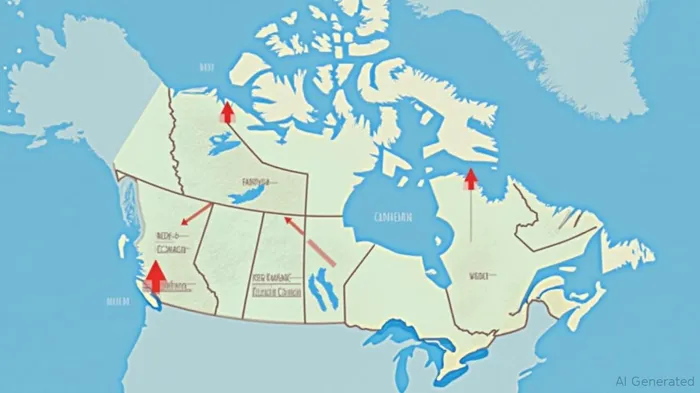
Key impacts:
- Currency weakness: The Canadian dollar's 6% depreciation against the U.S. dollar since early 2025 has made Canadian assets cheaper for foreign buyers.
- Cap rate widening: Property yields in multi-family and industrial sectors have risen by 20–30 basis points, pricing in trade-related risks.
- U.S. investor caution: While some U.S. capital has retreated, institutional buyers from Germany and Asia are stepping in, targeting undervalued Class A offices in Vancouver and Toronto.
Regional Hotspots: Where to Deploy Capital
1. Western Canada: Resource-Driven Resilience
Alberta and Saskatchewan are defying the national economic slowdown, driven by oil/gas projects and interprovincial migration. Calgary's industrial market, for instance, boasts 6.9% availability—among the lowest in the country—due to logistics demand from energy and tech sectors.
Investment thesis:
- Industrial warehouses: Calgary's Seaton Gateway and Edmonton's logistics hubs offer 6–7% yields, attractive compared to U.S. core markets.
- Multi-family: Purpose-built rentals in Edmonton (4.8% vacancy) and Calgary are benefiting from population growth (+1.8% annually in Alberta).
2. Atlantic Canada: Newfoundland's Energy Boom
Newfoundland-Labrador's 2.2% GDP growth—highest in Canada—stems from offshore oil projects and infrastructure spending. St. John's is seeing a 15% surge in hotel occupancy as workers flood in, while industrial land prices near Port au Port have doubled in 2025.
Investment thesis:
- Mixed-use developments: Retail and residential properties near new energy hubs are underpriced due to limited investor awareness.
- Data centers: Newfoundland's geographic isolation and reliable power supply make it ideal for hyperscale data farms, a sector with 8% annual demand growth.
3. Ontario: Navigating Trade-Related Volatility
Toronto's industrial sector faces a “wait-and-see” dynamic, with 34% of new space unleased as automakers reassess supply chains. However, food/distribution tenants (e.g., Walmart, Loblaws) are locking in deals at pre-tariff rates.
Investment thesis:
- Adaptive reuse: Convert underperforming office towers (19.7% vacancy in Edmonton) into mixed-use spaces or senior housing, which is undersupplied in Toronto.
- Retail pivots: Grocery-anchored centers in Kitchener-Waterloo are outperforming malls, with occupancy rates at 94%.
Sectors to Target: Multi-Family and Industrial Lead the Charge
Multi-Family: The Safest Bet
Canada's housing shortage—400,000 units by 2030—has made multi-family the top-performing asset class. The federal Housing Accelerator Fund's $74 million allocation to build 112,000 units by 2028 underscores government backing.
Action item:
Buy stabilized multi-family assets in Calgary and Edmonton. Their 5–6% yields and 90% occupancy rates offer downside protection.
Industrial: A Niche Play
While Toronto's industrial absorption slowed in Q2, strategic locations like Montreal's Port of Contrecoeur (with 8 million sq ft under construction) are insulated from trade risks.
Action item:
Focus on Class B/C industrial in secondary markets. These properties offer 7–8% yields and can be repositioned as e-commerce hubs.
Strategies to Mitigate Trade Risk
- Diversify Regionally: Allocate 50% to Alberta/Saskatchewan and 30% to Newfoundland-Labrador, with 20% in Ontario's defensive sectors.
- Target Government-Backed Sectors: Multi-family and senior housing benefit from the HAF and aging demographics.
- Use Currency Hedges: Pair Canadian REITs (e.g., RioCan) with USD-denominated debt to neutralize currency fluctuations.
Conclusion: A Buying Opportunity in Disguise
The U.S.-Canada trade war has created a rare mispricing in Canadian real estate, with regional gems trading at discounts to fundamentals. Investors who move decisively into multi-family, industrial, and Atlantic Canada's energy-driven markets can capture 5–9% total returns—well above the 2–3% yields in U.S. core assets. As trade negotiations drag on, this divergence will widen, making 2025 a pivotal time to bet on Canada's undervalued resilience.

Stay ahead of the market.
Get curated U.S. market news, insights and key dates delivered to your inbox.
AInvest
PRO
AInvest
PRO



Comments
No comments yet