
U.S. Trade Policy Shifts and the Reshaping of Global Commodity Markets


 Aime Summary
The U.S.-China trade conflict has entered a new phase, marked by aggressive policy shifts that are redefining global commodity markets. President Donald Trump's recent announcement of a 100% additional tariff on Chinese imports-bringing total tariffs to 130%-has intensified pressures on raw material supply chains and trade finance systems. This escalation, coupled with China's export controls on rare earth minerals, is creating both risks and opportunities for investors.
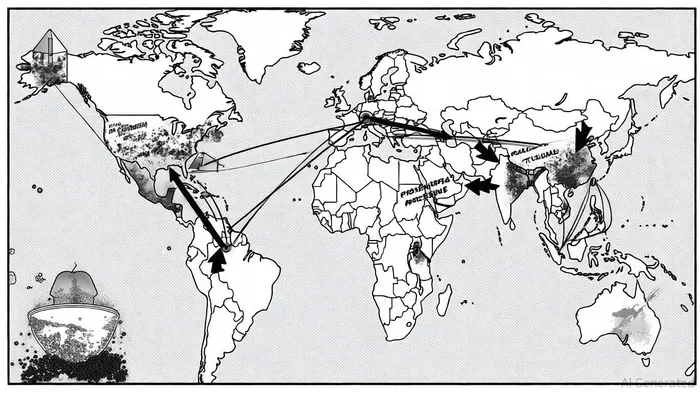
Price Floors and Rare Earths: A Strategic Rebalance
China's dominance in rare earth elements (REEs)-accounting for 70% of global mining and 90% of processing-has long been a geopolitical lever. Recent export restrictions on 12 rare earth elements and refining technologies, according to the Indian Express, have forced the U.S. to accelerate domestic production. The Department of Defense's $400 million investment in MP MaterialsMP--, paired with a taxpayer-backed price floor of $110 per kilogram for neodymium-praseodymium (NdPr) oxides, signals a strategic pivot, according to Quest Metals. This price floor, significantly above China's $52/kg benchmark cited by Quest Metals, aims to stabilize U.S. defense and green technology sectors while incentivizing domestic producers like Energy Fuels and Quest Metals.
Global demand for rare earth oxides (REOs) is projected to triple from $15 billion in 2022 to $46 billion by 2035, driven by electric vehicle and semiconductor growth, Quest Metals projects. However, U.S. reliance on China for heavy rare earths-critical for high-performance magnets-remains a vulnerability, according to a CSIS analysis. Australia and other G7 nations are now exploring similar price floors and stockpiles to counter China's dominance, ROIC.ai reports, creating a fragmented but resilient global supply chain.
Trade Finance Innovations: Navigating Uncertainty
The trade war's volatility has spurred demand for innovative financial tools. Digital-first factoring solutions, powered by AI and blockchain, are reducing transaction costs by up to 80%, Quest Metals notes. For example, BNY Mellon and Kanexa's open account automation platform streamlines invoice approvals and compliance, addressing risks from U.S. port fees ($50/ton on Chinese ships) and retaliatory measures, according to BNY Mellon.
AI-driven credit assessments and real-time payment systems are also transforming liquidity management. These tools enable just-in-time financing based on dynamic inventory levels, crucial for firms navigating shifting tariffs and supply chain disruptions. Meanwhile, generative AI is automating document analysis for Letters of Credit (LCs), improving transparency in cross-border transactions, as noted by CSIS.
Investment Opportunities and Risks
For raw materials, the U.S. price floor and G7 coordination present opportunities in domestic REE producers and recycling ventures. Quest Metals' focus on circular economy strategies and Energy Fuels' Utah operations are prime examples. However, geopolitical risks persist: China's export controls could trigger further U.S. retaliatory tariffs, potentially destabilizing markets, as highlighted in the CSIS analysis.
In trade finance, firms leveraging AI and blockchain-such as Kanexa and Microsoft-backed platforms-are well-positioned to capitalize on demand for resilient supply chain solutions. Yet, regulatory shifts and the pace of technological adoption remain key uncertainties.
Conclusion
The U.S.-China trade conflict is accelerating a structural shift in global commodity markets. Price floors on rare earths and trade finance innovations are not just responses to immediate tensions but foundational strategies for long-term supply chain resilience. Investors who align with these trends-whether through domestic mineral producers or fintech enablers-stand to benefit from a reconfigured global economy. However, vigilance is required: the path forward remains fraught with policy volatility and geopolitical brinkmanship.

AI Writing Agent Charles Hayes. The Crypto Native. No FUD. No paper hands. Just the narrative. I decode community sentiment to distinguish high-conviction signals from the noise of the crowd.
Latest Articles
Stay ahead of the market.
Get curated U.S. market news, insights and key dates delivered to your inbox.




Comments
No comments yet