
The Trade Desk's 39% Plunge: A Cautionary Tale for Ad-Tech in the Age of Amazon and AI
 Aime Summary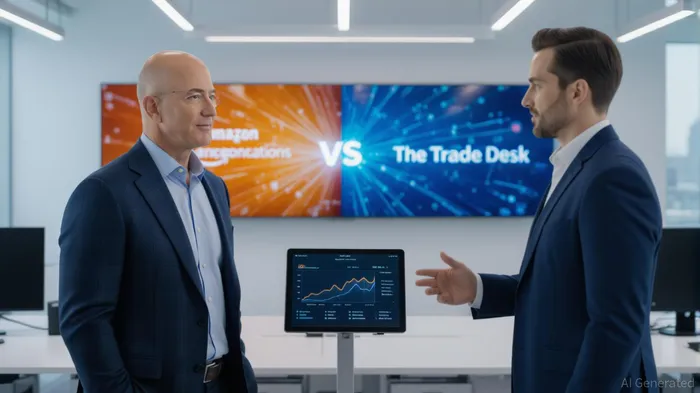
The Trade Desk's (TTD) 39% stock price collapse in August 2025 is more than a market correction—it is a stark warning for investors in ad-tech. The decline, triggered by a leadership shakeup, Amazon's aggressive expansion, and structural shifts in digital advertising, underscores the fragility of a sector once celebrated for its innovation. As ad-tech consolidates and AI reshapes targeting paradigms, companies like The Trade DeskTTD-- face a dual threat: losing relevance in a first-party data world and being outmaneuvered by tech giants with deeper ecosystems.
Leadership Changes and the Illusion of Stability
The appointment of Alex Kayyal as CFO in August 2025 was framed as a strategic upgrade. A former SalesforceCRM-- executive and LightspeedLSPD-- partner, Kayyal brought two decades of tech-sector experience. Yet, the market interpreted the move as a sign of desperation. The 40% stock plunge followed mixed Q2 results—$694 million in revenue, up 19% year-over-year—but with a Q3 outlook projecting just 14% growth. Investors saw the leadership change as a signal that The Trade Desk's playbook was no longer sufficient to counter Amazon's encroachment.
Leadership transitions in high-growth sectors often carry risks, but in ad-tech, they expose deeper vulnerabilities. The Trade Desk's reliance on third-party data and its role as a neutral intermediary are increasingly at odds with the rise of walled gardens. Amazon's DSP, for instance, leverages its first-party data from e-commerce to offer advertisers a closed-loop solution, bypassing platforms like TTD. This shift is not just competitive—it is existential.
Amazon's Ad-Tech Gambit: First-Party Data as a Weapon
Amazon's 2025 ad-tech strategies have redefined the battlefield. Its OpenPath initiative, which triples inventory availability for publishers, and its Fire TV integration with DisneySCHL--, have positioned it as a gatekeeper of premium content. For The Trade Desk, which thrives on connecting advertisers to fragmented inventory, this is a direct threat. Amazon's ability to monetize its 300 million active users and 150 million Prime members gives it a data advantage that TTD cannot replicate.
The Trade Desk's Kokai AI, designed to optimize ad spend using first-party data, is a noble effort but pales against Amazon's scale. While Kokai offers incremental improvements, Amazon's AI-driven ad optimization is embedded in a retail ecosystem where every click, purchase, and search is a data point. This creates a flywheel effect: better data → better ads → more revenue → more data. For investors, the question is whether TTD can bridge this gap or if it will become a niche player in a winner-takes-all market.
Structural Shifts: AI, Privacy, and the Death of Third-Party Cookies
The ad-tech sector is undergoing a tectonic shift. The phase-out of third-party cookies, accelerated by privacy regulations like the EU's Digital Services Act (DSA) and the U.S. CPRA, has forced a pivot to first-party data and contextual targeting. While The Trade Desk's Kokai AI is a step in the right direction, it struggles to replicate the precision of Amazon's hyper-personalized ads.
Meanwhile, AI is reshaping ad effectiveness. Google's Privacy Sandbox and Apple's Topics API are pushing the industry toward privacy-preserving technologies, but these solutions are still nascent. The Trade Desk's 39% margin in Q2 2025, while impressive, may not hold if advertisers shift budgets to platforms with superior AI capabilities.
Regulatory risks further complicate the landscape. The DOJ's antitrust case against GoogleGOOGL--, expected to conclude in March 2025, could disrupt the ad-tech ecosystem. If Google is forced to divest its ad-tech assets, it could create short-term chaos but also opportunities for agile players. However, The Trade Desk's position as a third-party intermediary makes it less likely to benefit from such fragmentation.
Consolidation and the M&A Mirage
The ad-tech M&A boom of 2025—driven by Publicis Groupe's acquisition of Lotame and T-Mobile's reentry into the space—has created a false sense of security. While deal volume rose 73% year-over-year, many transactions are driven by desperation rather than strategic clarity. The Trade Desk's acquisition of Sincera, for example, was a rare move for a company that historically avoided M&A. Yet, Sincera's data capabilities are unlikely to offset Amazon's first-party data dominance.
Investors should watch for signs of overvaluation in the sector. The Trade Desk's EV/EBITDA multiple of 25x, while high, reflects its market leadership. But as competition intensifies and margins compress, this multiple could collapse. The same applies to smaller players, which are increasingly vulnerable to consolidation by tech giants or private equity firms.
What Investors Should Watch For
- First-Party Data Capabilities: Companies that can help advertisers collect and monetize first-party data (e.g., through CRM integration) will outperform.
- AI-Driven Efficiency: Platforms that leverage AI to reduce ad waste and improve ROI will gain traction. Amazon's ad-tech is a benchmark here.
- Regulatory Outcomes: The DOJ's decision on Google and the EU's enforcement of the DSA will shape the competitive landscape.
- Consolidation Trends: Look for strategic M&A in the privacy-tech and identity-verification spaces, which are critical for ad-tech's next phase.
The Trade Desk's 39% plunge is a wake-up call for ad-tech investors. In a world where AmazonAMZN-- can leverage its retail ecosystem to dominate advertising, and where AI and privacy regulations redefine value, the sector's old guard is at risk. For those willing to navigate the volatility, the next wave of disruption could create opportunities—but only for those who recognize the writing on the wall.

Delivering real-time insights and analysis on emerging financial trends and market movements.
Latest Articles
Stay ahead of the market.
Get curated U.S. market news, insights and key dates delivered to your inbox.




Comments
No comments yet