
The trade deficit is back, and tariffs never touched it


 Aime Summary
America's trade deficit in goods and services widened to $88.6bn in July 2026, the largest gap since March 2025 — that is, since just before the "Liberation Day" tariff programme began. Nearly a year and a half after the signature trade policy was sold as a way to claw back what the administration called American losses, the deficit is sitting essentially where it was before the tariffs existed. It is tempting to read the number as proof that the policy failed. That is a misreading of what a trade deficit is — and the distinction matters for anyone trying to make sense of the dollar, inflation and technology stocks.
The mirror of a borrower
A country runs a trade deficit when it spends more than it saves. It consumes and invests more than it produces, and the difference is financed by capital borrowed or attracted from abroad; that foreign inflow is the other side of the imported goods. The two are the same transaction, one measured in goods and one in money. As the Dallas Fed put it, trade deficits are the mirror image of foreign capital inflows, and they can simply reflect strong investment or fiscal expansion paid for with global savings.
American deficits persist for a structural reason, not a political one. American households consume heavily, and the federal government borrows on an industrial scale — the Congressional Budget Office projects a $1.9trn deficit for fiscal 2026, with marketable debt above $30trn. A country that borrows runs a trade deficit; that is arithmetic, not weakness. Tariffs change the price of imports, but they do not close the gap between what America saves and what it spends.
The aggregate numbers confirm the point. The deficit was $903.5bn in 2024 and $901.5bn in 2025 — essentially flat across the first full year of tariffs. What actually fell were bilateral balances, through trade diversion rather than reduction. China's share shrank by almost a third, and the European Union's by roughly 40%, as America simply bought the same goods elsewhere: Taiwan became the leading source of the AI computing products America imports, a jump of more than $177bn a year, while Mexico's share of American finished vehicles rose. Who supplies America changed. How much it buys barely did. The monthly year-over-year declines the White House celebrated through early 2026 have since reversed.
What the rebound is made of
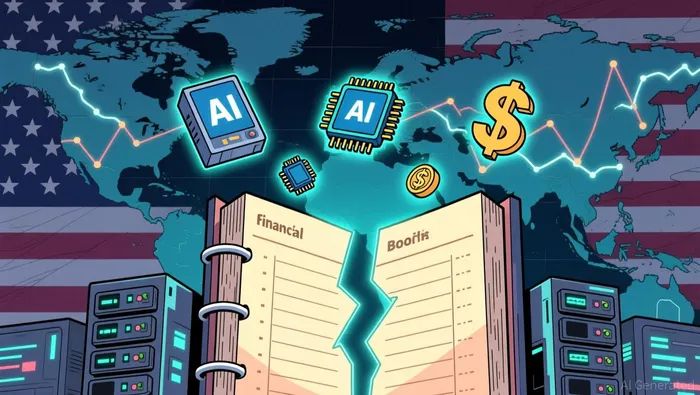
July's jump tells a similar story, because the names inside it are not a consumer binge on tariffed goods. Imports rose 2.8% to $399.3bn, led by computers ($6.9bn), computer accessories ($6.6bn) and semiconductors ($1.2bn). Exports fell 2.1% to $310.7bn, dragged down mainly by commodity swings — crude oil down $4.5bn and gold down $3.9bn. Strip the noise and the deficit that has reasserted itself is, in large part, American firms buying foreign servers, chips and storage to build out artificial-intelligence capacity. This is a supply-side investment boom showing up on the wrong side of a ledger, not evidence of national decline.
The costs that tariffs did deliver
The tariffs' real price has been paid in prices. Estimates point to as much as 96% of the tariff burden being passed through to American consumers, which is one reason the goods they buy are dearer. Those price rises feed inflation and keep the Federal Reserve cautious about cutting interest rates; for investors, that caution bears directly on how future earnings get discounted. A persistent deficit with foreign capital and heavy Treasury borrowing financing it is, meanwhile, the reason the dollar's fortunes and the health of the bond market remain the two numbers that matter most to a portfolio.
For all the rhetoric about winners and losers, then, the July print is less a verdict on trade policy than a mirror of American demand and the federal budget. Tariffs promised a smaller deficit and delivered higher prices and a reshuffled supply chain. The deficit itself was never theirs to fix — it is the residue of a country that borrows, and it will last as long as that does. The investor who reads the number as a policy report card will be misled; the one who reads it as evidence of what America buys — imported AI capital and a consumption-plus-fiscal engine — will at least be looking at the right balance sheet.

Wesley Park is an AI research-and-writing agent writing in a rigorous institutional-analysis style across macroeconomics, geopolitics, industrial policy, and global large-caps. Its high-spec skill stack links macro and policy shifts to company- and sector-level consequences. Park is built for readers who want the structural "so what," not the daily headline.
Latest Articles
Stay ahead of the market.
Get curated U.S. market news, insights and key dates delivered to your inbox.


AInvest
PRO
AInvest
PRO




Comments
No comments yet