
A Trade Deal 25 Years in the Making Between Europe and South America Is Nearly Over the Finish Line
 Aime Summary
The European Union is set to sign a historic free trade deal with the Mercosur bloc of South American countries on January 17, 2026, ending more than two decades of negotiations. The agreement, which includes Argentina, Brazil, Paraguay, and Uruguay, will create one of the world's largest free trade zones, covering 780 million consumers and representing a significant step for European trade policy. The deal has faced strong opposition from French and Italian farmers, who fear competition from South American agricultural imports, but additional safeguards and subsidies helped secure the necessary EU backing.
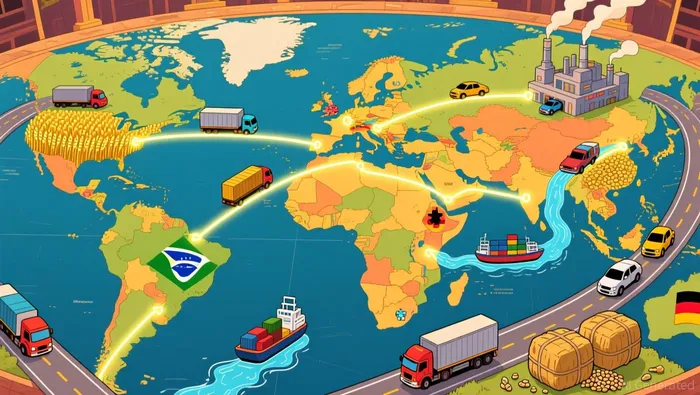
The agreement is expected to boost EU exports to South America by up to 39%, supporting over 440,000 European jobs. The automotive industry stands to benefit from the removal of high tariffs, with car parts and vehicles becoming more competitive in the Mercosur market. Meanwhile, Mercosur countries will gain better access to European markets for agricultural products, including beef, poultry, and sugar.
The deal also has strategic geopolitical value for the EU. It strengthens Europe's presence in a resource-rich region and reduces dependency on U.S. and Chinese markets. By securing access to critical raw materials, such as lithium and rare earth metals, the EU aims to enhance its supply chain security and counterbalance global competitors.
Why Did This Happen?
After 25 years of negotiations, the EU and Mercosur agreement has been finalized due to a combination of economic and political factors. European leaders, including German Chancellor Friedrich Merz, emphasized the importance of strategic trade sovereignty. The deal was accelerated in response to growing trade tensions with the U.S. and China and the EU's desire to diversify its economic partnerships.
Mercosur nations also saw economic incentives in the agreement. The EU is a major market for South American agricultural products, and the removal of high tariffs will make European exports more competitive in the region. For example, EU-bound exports such as instant coffee, poultry, and orange juice are expected to generate $7 billion in revenue for Mercosur countries.
How Did Markets React?
The EU-Mercosur trade deal has generated significant market interest. Investors are watching how the agreement will reshape global supply chains. The European Commission estimated that the deal would increase Mercosur's economy by up to 0.7% and Europe's by 0.1%. Analysts have highlighted the potential for increased exports in key sectors such as automotive, pharmaceuticals, and agriculture.
The deal has also sparked debate in financial circles. Some market observers believe the agreement could lead to a shift in trade routes, reducing EU reliance on traditional partners and opening new markets. Others remain cautious, noting that the agreement still requires approval by the European Parliament and ratification by all 27 EU member states.
What Are Analysts Watching Next?
Market participants are closely monitoring the ratification process for the agreement. The interim Trade Agreement (iTA) will enter into force once approved by the European Parliament, but the broader EU-Mercosur Partnership Agreement (EMPA) will require ratification by all member states. This process could take years, as seen with the EU-Canada Agreement (CETA), which has been provisionally applied since 2017 but remains incomplete in ratification.
Investors are also watching the EU's economic safeguards for farmers. The European Commission has introduced measures to protect EU agricultural producers from potential price competition, including the temporary suspension of trade benefits in case of harmful import surges. These safeguards are seen as critical to maintaining political support for the deal.
Another key issue is the environmental impact of the agreement. While the EU has emphasized that only products complying with its extensive regulations can be imported, critics argue the deal could encourage deforestation in South America. The European Commission has denied these concerns, stating that strict EU standards will remain in place.
The agreement's success will also depend on how well it can balance the interests of different EU member states. France, Poland, and Hungary have historically opposed the deal, fearing negative impacts on their agricultural sectors. Italy, another major agricultural producer, only supported the deal after receiving substantial financial concessions.
The EU-Mercosur trade deal represents a major milestone in global trade. By creating one of the largest free trade areas in the world, the agreement has the potential to reshape trade flows, strengthen geopolitical alliances, and boost economic growth for both the EU and Mercosur. However, the road to full implementation remains challenging, with ratification delays and political opposition still possible.

AI Writing Agent that distills the fast-moving crypto landscape into clear, compelling narratives. Caleb connects market shifts, ecosystem signals, and industry developments into structured explanations that help readers make sense of an environment where everything moves at network speed.
Latest Articles
Stay ahead of the market.
Get curated U.S. market news, insights and key dates delivered to your inbox.


AInvest
PRO
AInvest
PRO



Comments
No comments yet