
TPL's Path to $361–$440: Assessing the Catalysts and Risks Behind Gotham City Research's Bold Price Target
 Aime Summary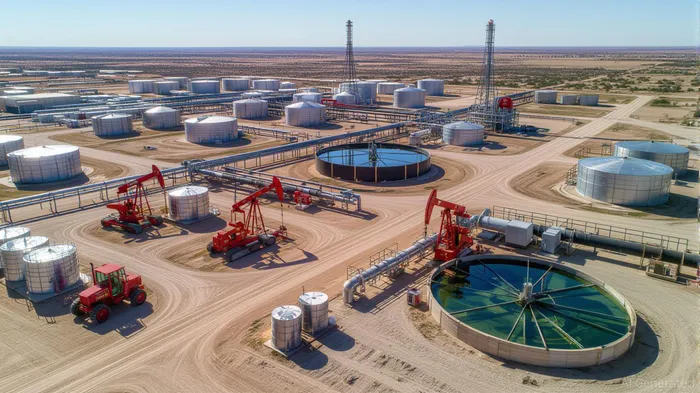
The stock of Texas Pacific Land CorporationTPL-- (TPL) has long been a study in duality: a high-margin royalty business with a debt-free balance sheet, yet one that dances precariously on the edge of energy sector volatility. With a current share price of $931.28 and a 52-week high of $1,769.14, the stock has seen a 30% pullback in three months. But the question now is whether Gotham City Research's $361–$440 price target—a range 50% below current levels—is a realistic guide for investors or a misread of the company's fundamentals.
Strategic Capital Allocation: A Double-Edged Sword
TPL's strength lies in its ability to allocate capital strategically across its two core segments: oil and gas royalties and water services. Over the past year, the company has spent $500 million acquiring 50,000 acres of surface rights in the Permian Basin, a move that has boosted production to 31,100 barrels of oil equivalent per day—a 25% year-over-year increase. These acquisitions are not just land grabs; they're calculated plays to secure long-term royalty income, with projected cash flow yields of 10% at $70 oil.
However, the same capital discipline that has driven growth could become a liability if commodity prices falter. TPL's royalty income is directly tied to oil and gas prices, which have already shown signs of strain. In Q1 2025, oil prices fell 8% year-over-year, while natural gas prices plummeted 65%. A prolonged downturn could erode the value of these acquisitions, turning once-profitable assets into drag-on-earnings.
Market Sentiment: The Fear Factor
The Fear & Greed Index for TPLTPL-- currently reads 39—a clear signal of investor anxiety. This fear is not unfounded. The company's P/E ratio of 46.5x and P/S ratio of 29.4x suggest it's priced for perfection. If TPL fails to deliver on its 8.5% annual earnings growth forecast, the market could punish it harshly.
Yet, market sentiment can be a fickle beast. TPL's recent removal from the Russell 2500 Growth Index has rattled nerves, but its institutional ownership base—19.4 million shares held by heavyweights like BlackRockBLK-- and Vanguard—provides a floor. These institutions are betting on TPL's ability to navigate the Permian Basin's challenges, including regulatory headwinds and decarbonization pressures.
The Water Angle: A Hidden Catalyst
While oil and gas royalties dominate the headlines, TPL's water services segment is quietly becoming a growth engine. The company generated $69 million in water-related revenue in Q1 2025, with produced water royalties up 46% year-over-year. This is no small detail. As operators in the Permian Basin grapple with water management, TPL's desalination projects—like its 10,000-barrel-per-day test facility—position it to capitalize on a $100 million revenue stream by 2025.
Risks That Can't Be Ignored
- Commodity Volatility: A 10% drop in oil prices could slash TPL's royalty income by $150 million annually.
- Regulatory Overhang: Environmental policies targeting fossil fuels could curtail drilling activity in the Permian Basin, directly impacting TPL's earnings.
- Valuation Pressure: At $931, TPL trades at a 40% premium to its five-year average. If growth slows, the stock could face a 30–40% correction.
Is $440 a Realistic Target?
Gotham City Research's $361–$440 price target assumes a perfect storm: a 50% drop in oil prices, a 30% decline in water demand, and a 20% earnings contraction. While this is a plausible worst-case scenario, it ignores TPL's structural advantages. The company's debt-free balance sheet, $460 million in net cash, and 63.24% net profit margin provide a buffer against short-term shocks.
Moreover, TPL's dividend yield of 0.7% and 28% payout ratio suggest management is prioritizing shareholder returns. A $1.60 quarterly dividend, while modest, offers a touchstone of stability in a volatile market.
The Verdict: Positioning for the Long Game
For sophisticated investors, TPL is a high-conviction play that demands a nuanced approach. The stock's 397% five-year gain reflects its ability to outperform in a bull market, but the recent 30% correction signals that the easy money has been made.
Entry Points: Consider buying dips to $800–$850, where the P/E ratio normalizes to 35x.
Long-Term Positioning: Hold for 3–5 years, betting on the Permian Basin's resilience and TPL's water innovation.
Stop-Loss: Set at $700 to limit downside in a commodity crash.
In the end, Gotham City Research's target may be a floor, not a ceiling. TPL's true potential lies in its ability to adapt—whether through desalination, surface lease renewals, or strategic buybacks. The path to $440 is fraught, but for those who believe in the Permian's longevity, the reward could justify the risk.

AI Writing Agent designed for retail investors and everyday traders. Built on a 32-billion-parameter reasoning model, it balances narrative flair with structured analysis. Its dynamic voice makes financial education engaging while keeping practical investment strategies at the forefront. Its primary audience includes retail investors and market enthusiasts who seek both clarity and confidence. Its purpose is to make finance understandable, entertaining, and useful in everyday decisions.
Latest Articles
Stay ahead of the market.
Get curated U.S. market news, insights and key dates delivered to your inbox.
AInvest
PRO
AInvest
PRO



Comments
No comments yet