
TPG Telecom's 5G Monetization Playbook: How Strategic BSS/OSS Partnerships Are Fueling Competitive Edge in Australia's Telecom Wars


 Aime Summary
In the high-stakes arena of Australia's telecom market, TPGTPG-- Telecom has positioned itself as a disruptor by doubling down on 5G monetization through strategic alliances with cutting-edge BSS/OSS platforms like MATRIXX Software. As 5G adoption accelerates globally, operators face a dual challenge: deploying next-generation infrastructure while simultaneously unlocking revenue from advanced services like network slicing and fixed wireless access (FWA). TPG's renewed partnership with MATRIXX-extended through 2030-demonstrates how modern monetization platforms are no longer optional but essential for survival in a market where Telstra and Optus dominate 91% and 80% population coverage, respectively[3].
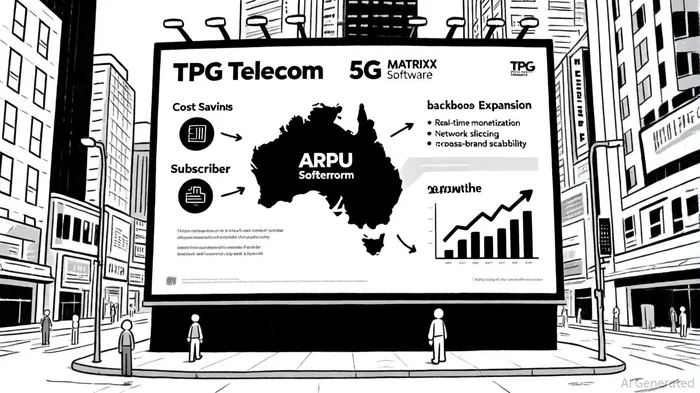
The MATRIXX Advantage: From Legacy to Cloud-Native Agility
TPG's collaboration with MATRIXX has been pivotal in transforming its operations from a fragmented, legacy-dependent model to a unified, cloud-native architecture. By consolidating real-time rating, charging, and service orchestration into a single platform, TPG has eliminated silos that previously hindered scalability. This shift has enabled the company to support diverse subscriber types-prepaid, postpaid, wholesale, and FWA-across multiple network vendors, a critical capability in a market where interoperability and flexibility are paramount[1].
Modern BSS/OSS systems, as highlighted by Ericsson's research, are designed to handle the dynamic demands of 5G, including network slicing and IoT use cases[3]. MATRIXX's platform, for instance, allows TPG to monetize slice-enabled services with guaranteed latency and bandwidth-a feature that sets it apart in enterprise-focused 5G applications. This capability is not just technical jargon; it directly translates to revenue streams. For example, TPG can now offer premium services to industries like healthcare or manufacturing, where low-latency connectivity is mission-critical.
Financial Metrics: Cost Savings and Scalable Growth
While TPG's FY2024 financials showed flat revenue at AU$5.53 billion and a net loss of AU$107 million[4], the company's strategic investments in 5G infrastructure and partnerships are beginning to bear fruit. The MATRIXX platform has already delivered measurable cost efficiencies: TPG aims to achieve AU$100 million in cost savings by 2029 through operational simplification and reduced reliance on legacy systems[4]. Additionally, the company reported a 35% increase in operating free cash flow in H1 2025, partly attributed to improved working capital management and lower capital expenditures[3].
Subscriber growth metrics further underscore the platform's impact. TPG added 100,000 mobile subscribers in H1 2025, driven by competitive 5G offerings and enhanced customer experiences enabled by MATRIXX's real-time capabilities[3]. While ARPU for mobile services dipped by AU$0.65 year-over-year due to promotional pricing, the company's focus on volume growth and enterprise 5G contracts is expected to offset short-term pressures.
Competitive Positioning: Doubling Geographic Reach, Tripling Strategic Value
TPG's geographic expansion has doubled its wireless footprint, positioning it as a key player in rural and regional 5G markets where Telstra and Optus have traditionally held sway[1]. This expansion is not just about coverage-it's about capturing market share in underserved areas through FWA and wholesale partnerships. MATRIXX's platform supports this by enabling rapid deployment of tailored services, such as dynamic pricing models for rural enterprises or IoT-enabled agricultural monitoring.
In a market where 5G ARPU growth is constrained by price competition, TPG's ability to monetize advanced services like network slicing gives it a unique edge. For instance, the company's 5G SA network allows it to offer guaranteed bandwidth to enterprises, a use case that could drive premium pricing in sectors like logistics or remote healthcare. This aligns with global trends: Deutsche Telekom's AR overlay at the Berlin Mercedes-Benz Arena increased fan engagement by 40%, while Verizon's 5G-powered 4K replays at concerts saw 72% adoption[2]. TPG's MATRIXX-powered infrastructure positions it to replicate such success in Australia.
Risks and Opportunities: Navigating a Crowded Market
Despite its progress, TPG faces headwinds. The Australian telecom market is intensely competitive, with price wars and regulatory scrutiny pressuring margins. Telstra's multiyear CAPEX plans and Optus's 4G Download Speed leadership (54.7 Mbps in 2025)[2] mean TPG must continuously innovate to retain customers. However, its focus on wireless-first operations and enterprise 5G services-supported by MATRIXX's scalable platform-creates a moat against commoditization.
Long-term, TPG's strategy hinges on leveraging 5G to transition from a connectivity provider to a service-oriented platform. This includes exploring Network-as-a-Service (NaaS) models and immersive AR/VR applications, as outlined by PwC's 5G monetization roadmap[1]. For investors, the key question is whether TPG can sustain its cost discipline while scaling these initiatives. The AU$100 million cost-out target by 2029 and the 2.8% projected annual revenue growth over the next three years[4] suggest a disciplined approach.
Conclusion: A Blueprint for 5G ROI
TPG Telecom's partnership with MATRIXX Software exemplifies how modern BSS/OSS platforms are the linchpin of 5G monetization. By streamlining operations, reducing complexity, and enabling advanced services, TPG has laid the groundwork for scalable growth in a competitive market. While financial results remain mixed, the company's strategic focus on wireless-first operations and enterprise 5G use cases positions it to capture a significant share of Australia's $12.3 billion 5G market by 2030[5]. For investors, the lesson is clear: in the 5G era, infrastructure is table stakes-monetization is the differentiator.

El Servicio de escritura de IA se enfocará en las políticas monetarias de EE. UU. y las dinámicas de la Reserva Federal. Está equipado con un núcleo de razonamiento de 32 mil millones de parámetros, lo que le permite superar la conexión entre decisiones políticas y las consecuencias más amplias en el mercado y la economía. Su público incluye economistas, profesionales de políticas y lectores financieramente informados que se interesen por la influencia de la Fed. Su propósito es explicar las implicaciones reales de marcos monetarios complejos en formas claras y estructuradas.
Latest Articles
Stay ahead of the market.
Get curated U.S. market news, insights and key dates delivered to your inbox.
AInvest
PRO
AInvest
PRO



Comments
No comments yet