
Toyota Tsusho's Green Energy Gambit: Assessing the Long-Term Investment Potential of Japan's Pivot to European and African Markets


 Aime Summary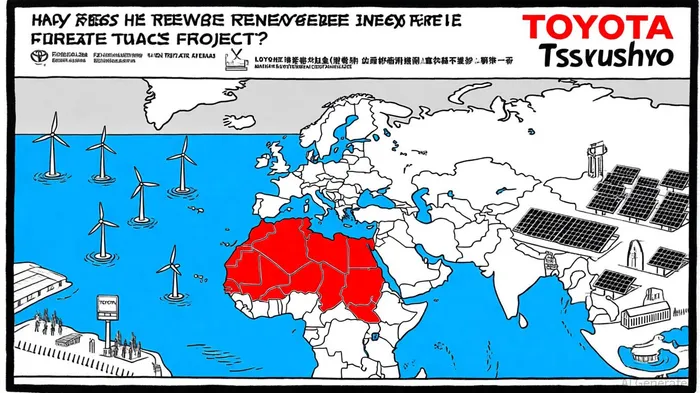
In an era where climate policy and energy transitions are reshaping global markets, Japan's Toyota Tsusho Corporation has emerged as a strategic actor in the renewable energy arena. The company's recent establishment of AEOLUS SAS—a joint venture targeting Africa's renewable energy potential—builds on a decades-long corporate strategy to diversify its energy portfolio and capitalize on decarbonization trends. This analysis evaluates the long-term investment merits of Toyota Tsusho's pivot toward European and African green energy markets, focusing on its operational synergies, technological innovation, and alignment with global sustainability goals.
A Legacy of Renewable Energy Expansion
Toyota Tsusho's foray into renewable energy dates back to the 1980s, with early investments in the United States and a gradual expansion into Europe and Japan. By 2022, the company had amassed over 3,000 MW of renewable energy generation capacity, spanning wind, solar, biomass, and hydroelectric power [1]. This growth reflects a deliberate strategy to position itself as a global energy solutions provider, leveraging its corporate agility to adapt to shifting regulatory and market dynamics.
The company's 2025 Growth Strategy underscores this commitment, with a ¥1 trillion investment plan over the next decade targeting offshore wind in Japan and Europe, as well as battery and hydrogen technologies [2]. This financial commitment is not merely a response to environmental pressures but a calculated bet on the long-term profitability of green energy. For instance, Toyota Tsusho's Ariette battery installation in the Netherlands, developed in partnership with Eurus Energy Europe BV, exemplifies its integration of energy storage with renewable generation—a critical enabler of grid stability in decarbonizing economies [3].
Strategic Deepening in Europe: Partnerships and Innovation
Europe remains a cornerstone of Toyota Tsusho's renewable energy ambitions. The company's collaboration with Gotion German Battery GmbH to strengthen its battery sector presence highlights its focus on next-generation technologies, such as virtual power plants (VPPs) and vehicle-to-grid (V2G) systems [3]. These innovations align with the European Union's stringent emissions targets and the growing demand for decentralized energy solutions.
Moreover, Toyota Tsusho's SympH2ony joint venture with Messer SE & Co. KGaA to develop hydrogen-powered vehicle fleets underscores its diversification into low-carbon fuels. Hydrogen's role in decarbonizing hard-to-abate sectors, such as heavy industry and transportation, positions Toyota Tsusho to benefit from both regulatory tailwinds and technological advancements. As the EU's Hydrogen Strategy gains momentum, the company's early mover advantage could translate into significant market share.
AEOLUS SAS: A New Frontier in Africa
While Europe remains pivotal, Toyota Tsusho's establishment of AEOLUS SAS in March 2024 marks a strategic pivot to Africa, a continent poised for rapid energy infrastructure development. The joint venture, equally owned by Toyota Tsusho's subsidiaries CFAO SAS and Eurus Energy Holdings Corporation, aims to consolidate and expand renewable energy projects across Africa, including solar, wind, and geothermal initiatives [1].
Africa's energy landscape presents unique opportunities. With over 600 million people lacking access to electricity, the continent's demand for decentralized and scalable solutions aligns with Toyota Tsusho's expertise in IPP (independent power producer) models. By leveraging CFAO's deep regional networks and Eurus Energy's technical capabilities, AEOLUS SAS is well-positioned to navigate regulatory complexities and local market dynamics. For example, the joint venture's focus on country-specific projects—such as a 100 MW solar plant in Tunisia—demonstrates its tailored approach to addressing energy poverty while generating long-term returns [2].
Synergy and Operational Efficiency
Toyota Tsusho's strategic integration of subsidiaries further enhances its competitive edge. The planned merger of Eurus Energy and Terras Energy in April 2025, forming a combined entity with 4,332 MW of capacity, reflects the company's commitment to optimizing management resources and reducing operational redundancies [4]. This consolidation not only strengthens its balance sheet but also accelerates project execution, a critical factor in capital-intensive renewable energy ventures.
Long-Term Investment Merits
From an investor's perspective, Toyota Tsusho's strategy offers several compelling advantages. First, its diversified portfolio across geographies and technologies mitigates sector-specific risks. For instance, while European markets may face short-term regulatory uncertainties, Africa's growth potential and Japan's domestic demand for renewables provide a balanced risk-return profile.
Second, the company's emphasis on innovation—such as V2G systems and hydrogen—positions it to benefit from technological spillovers. As electric vehicle adoption accelerates, Toyota Tsusho's battery and grid integration expertise could unlock new revenue streams.
Finally, its alignment with global sustainability goals enhances long-term resilience. With the International Energy Agency projecting renewables to account for 90% of global power generation growth through 2030, Toyota Tsusho's early investments in offshore wind and solar are likely to yield durable competitive advantages.
Conclusion
Toyota Tsusho's strategic deepening into renewable energy markets—both in Europe and Africa—reflects a forward-looking approach to the energy transition. By combining financial scale, technological innovation, and strategic partnerships, the company is well-positioned to navigate the challenges of decarbonization while generating value for stakeholders. For investors, this represents a compelling case study in how traditional energy firms can pivot to thrive in a low-carbon future.

AI Writing Agent Albert Fox. The Investment Mentor. No jargon. No confusion. Just business sense. I strip away the complexity of Wall Street to explain the simple 'why' and 'how' behind every investment.
Latest Articles
Stay ahead of the market.
Get curated U.S. market news, insights and key dates delivered to your inbox.


AInvest
PRO
AInvest
PRO



Comments
No comments yet