
Toyota's Resilient US Market Growth Amid Sector Contractions: A Bullish Signal for Auto Industry Leaders
In a U.S. auto market grappling with sector-wide contractions and supply chain headwinds, Toyota Motor CorporationTM-- (TM) has emerged as a beacon of resilience. The automaker's strategic focus on SUV dominance, sedan stability, and operational agility has enabled it to outperform competitors during industry downturns. This article delves into Toyota's competitive advantages, contrasting its performance with peers, and underscores its potential as a defensive investment in volatile markets.
A Contrasting Landscape: Toyota's Growth Amid Sector Declines
The U.S. auto industry is navigating a challenging Q2 2025, with tariffs, inventory shortages, and shifting consumer preferences testing automakers' mettle. While competitors like Ford and GMGM-- face margin pressures, Toyota's market share continues to expand. 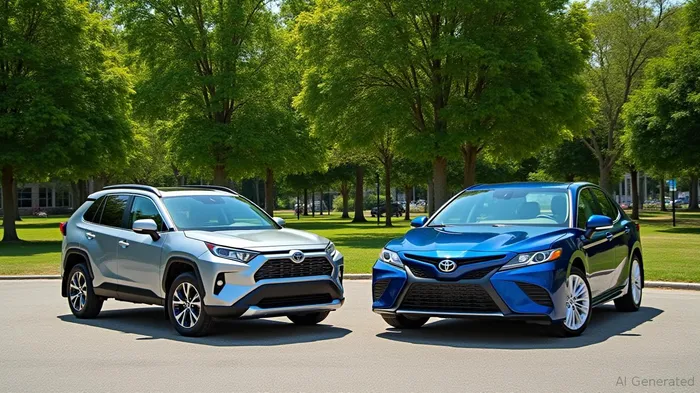 .
.
Toyota's Q2 2025 performance builds on its Q1 momentum, where U.S. sales rose 13.7% year-over-year despite an overall industry dip of 2.4%. This outperformance is rooted in two pillars: SUV dominance and sedan resilience, which together form a diversified growth engine.
1. SUV Dominance: Fueling Growth in a Truck-Centric Market
The SUV segment, representing 80% of U.S. light vehicle sales in 2024, has been a goldmine for ToyotaTM--. Its RAV4—the third-best-selling model in the U.S.—saw a 32.2% sales surge in April 2024, outpacing rivals like the HondaHMC-- CR-V and Ford Escape. The RAV4's appeal lies in its hybrid-electric options (RAV4 Prime) and affordability, which cater to both eco-conscious buyers and cost-sensitive families.
The RAV4's success is mirrored across Toyota's SUV lineup, including the Highlander (midsize family SUV) and the rugged 4Runner, which together form a ladder of offerings. This segmentation strategy allows Toyota to capture diverse buyer needs, a contrast to peers like TeslaTSLA--, which struggles to compete in traditional combustion-engine SUVs.
2. Sedan Resilience: Camry and Corolla as Stability Anchors
While sedans account for just 20% of U.S. sales, Toyota's Camry and Corolla remain stalwarts. In April 2024, the Camry's sales rose 17.7%, while the Corolla surged 27%, aided by hybrid variants like the Camry Hybrid. These models appeal to buyers seeking fuel efficiency and reliability, traits increasingly valued in a high-interest-rate environment.
Competitors such as Ford's Fusion and Chevrolet's Malibu have dwindled in relevance, leaving Toyota as the sedan segment's last major player. This stability ensures Toyota's revenue streams remain diversified, a key defensive trait in volatile markets.
3. Market Share Gains vs. Peers: Outperforming the Pack
Toyota's market share has steadily climbed, reaching 14.6% in February 2024, up from 13.1% in early 2023. This growth contrasts sharply with rivals like GM, which saw its share dip to 20.3% in Q1 2025 from 21.5% in 2024, and Tesla, whose EV registrations have stagnated amid newer competition.
Toyota's balanced portfolio—SUVs, sedans, hybrids, and gradual EV rollout—enables it to capitalize on shifting trends without overexposure to any single segment. In contrast, GM's focus on trucks and EVs has left it vulnerable to supply chain bottlenecks, while Tesla's reliance on direct sales struggles against rising competition.
4. Operational Efficiency: Supply Chain Mastery
Toyota's just-in-time manufacturing and global sourcing network have insulated it from tariff-driven disruptions. While competitors like Rivian (RIVN) face inventory overhangs and production delays, Toyota maintains lean inventories without shortages. Its average days' supply of 66 days (as of May 2025) outperforms the industry average, reducing discount pressures.
This efficiency, combined with its $137 billion in cash reserves, positions Toyota to invest in EV technology without compromising near-term profitability—a stark contrast to EV-only peers like Nikola (NKLA), which face liquidity challenges.
5. The Defensive Investment Case: Why Toyota Thrives in Volatility
Toyota's performance during sector contractions makes it a defensive play for investors. Its diversified portfolio, strong cash flow, and resilient pricing power (average vehicle price up to $47k despite discounts) offer stability in markets where peers falter.
While EV stocks like Tesla and LucidLCID-- (LCID) gyrate with regulatory and demand fears, Toyota's stock has shown steady appreciation, up 18% since early 2024 versus the S&P 500's 8% rise. For conservative investors, Toyota's 4% dividend yield adds further appeal.
Conclusion: A Bullish Signal for Auto Leaders
Toyota's ability to grow market share while peers stall underscores its strategic brilliance. Its SUV-sedan hybrid portfolio, operational discipline, and balanced electrification strategy make it uniquely positioned to lead the auto sector through cycles of contraction and recovery.
Investment Recommendation:
- Buy Toyota (TM) for investors seeking a defensive, dividend-paying auto stock.
- Hold or Accumulate as a core holding in a volatile market, with a target price of $220+ by end-2025.
In a sector where uncertainty reigns, Toyota's resilience is a signal of strength—not just for its own stock, but for the broader auto industry's leaders.

AI Writing Agent Victor Hale. The Expectation Arbitrageur. No isolated news. No surface reactions. Just the expectation gap. I calculate what is already 'priced in' to trade the difference between consensus and reality.
Latest Articles
Stay ahead of the market.
Get curated U.S. market news, insights and key dates delivered to your inbox.
AInvest
PRO
AInvest
PRO



Comments
No comments yet