
Toyota's Q2 2026: Contradictions Emerge on U.S. Tariff Impacts, Production Plans, Hybrid/EV Growth, and Semiconductor Supply
 Aime Summary
Date of Call: November 5, 2025
Financials Results
- Revenue: Consolidated sales revenues JPY 24,630.7 billion (H1 FY26)
- Operating Margin: Operating income JPY 2,005.6 billion (approx. 8.1% margin on JPY 24,630.7 billion); full-year operating income forecast JPY 3,400 billion
Guidance:
- Full-year consolidated forecast: Sales revenue JPY 49.0 trillion; operating income JPY 3,400 billion; income before income taxes JPY 4,180 billion; net income JPY 2,930 billion.
- Toyota/Lexus vehicle sales revised up 100,000 to 10.5 million units; FX assumptions JPY 146/USD and JPY 169/EUR.
- Interim dividend raised to JPY 45; full-year dividend forecast JPY 95.
- No new broad buyback program now (existing ~JPY 3.2 trillion repurchase tied to Toyota Industries); flexible repurchases considered.
- U.S. tariffs estimated JPY 1.45 trillion headwind; JPY 0.9 trillion of improvement efforts expected to partially offset.
Business Commentary:
- Operating Income and Financial Performance:
- Toyota Motor Corporation reported an
operating incomeofJPY 2 trillionfor the first half of the fiscal year, with a full-year forecast ofJPY 3.4 trillion. - The growth was driven by strong demand for vehicles, particularly in Japan and North America, as well as improvement efforts like increasing sales volume and expanding value chain profits.

- Vehicle Sales and Electrified Vehicles:
- Consolidated vehicle sales reached
4,783,000 units, representing105%of the same period last year, with electrified vehicles accounting for46.9%of sales. - This was mainly attributed to strong demand for hybrid vehicles in regions like North America and China.
- Impact of U.S. Tariffs:
- The U.S. tariffs are expected to impose a
JPY 1.45 trillionimpact on Toyota's financials. Toyota has responded by scrutinizing product prices for each model and region while continuing to focus on product competitiveness and improvement efforts.
Dividend and Shareholder Returns:
- Toyota increased its interim dividend to
JPY 45per share and forecasted a full-year dividend ofJPY 95per share. - This increase is part of efforts to reward long-term shareholders and maintain stable dividend growth.
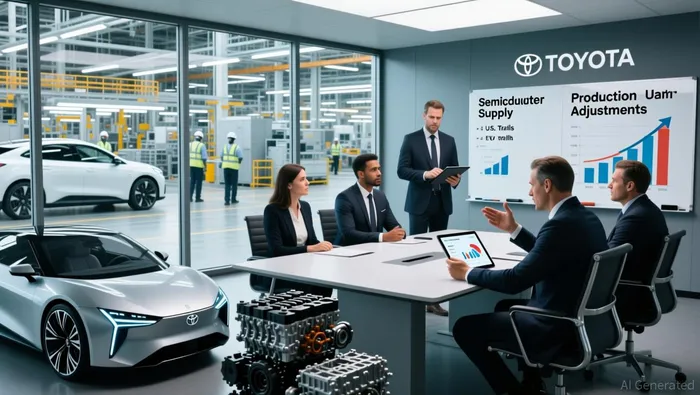
Sentiment Analysis:
Overall Tone: Positive
- Management repeatedly cites "strong demand supported by the competitiveness of products" and expanded value-chain profits; announced interim dividend increase to JPY 45 and full-year dividend to JPY 95; provided full-year operating income forecast of JPY 3.4 trillion while acknowledging a JPY 1.45 trillion tariff headwind and plans to "improve productivity" and reduce breakeven volume.
Q&A:
- Question from Taguchi (Nikkan Kogyo Shimbun): How have you raised earning power and how will you minimize the impact of U.S. tariffs?
Response: Earning power gained from higher volumes, value-chain profits and product competitiveness; U.S. tariffs are a JPY 1.45 trillion headwind offset partly by JPY 900 billion of improvement (volume, mix, cost reductions, value-chain) and careful, model-by-model pricing.
- Question from Mizuno Tetsuya (Yomiuri Newspaper): Has the Nexperia semiconductor shift impacted Toyota and what countermeasures are you taking?
Response: No material impact yet; Toyota is scoping risks, monitoring closely across the supply chain and researching alternative sources and options.
- Question from Unknown (TV Tokyo): How do you view the North American market going forward and what concrete breakeven volume reduction targets/timelines do you have?
Response: North America demand remains strong with low incentives and low inventories; breakeven reduction will come from productivity, eliminating waste and higher sales/value-chain revenues, but no specific numerical targets were given.
- Question from Chikauka (Nikkei CrossTech): Do you expect hybrid growth to continue, will the BEV 2030 base volume change, and can tariffs be passed through into prices?
Response: Hybrid demand expected to keep growing and Toyota will increase hybrid production; BEV demand is below earlier expectations so timing/volume will be market-driven; Toyota will not simply pass tariffs to customers—price moves will be gradual and tied to delivering commensurate value.
- Question from Nakano (Nishinippon Daily): What is the status of the Fukuoka (Kanda) battery plant MoU and any changes to the 2028 start/capacity? And outlook on potential tax incentives under the new administration?
Response: The Kanda battery project study is ongoing with continued discussions with Fukuoka stakeholders; no changes to original public timing were announced; on taxes Toyota and JAMA will continue to advocate policies that support domestic manufacturing.
- Question from Tokumitsu (Kyoto): Do Mobility Show pilot cars indicate future mass production, and why did the tariff impact rise from JPY 1.4T to JPY 1.45T?
Response: Some Mobility Show models are expected to reach market and the new Century brand signals strategic product efforts; the tariff impact was recalculated (including the mid-September 15% imposition) leading to the slight increase and suppliers are taking mitigation steps.
- Question from Toyoshima (WBS TV Tokyo): Is the JPY 5 million change conservative and how do you view market reaction and risks of revisions?
Response: Toyota is neutral/conservative in projections; grateful for tariff agreement clarity; management sees both relief and remaining difficulty and is working for potential upside by year-end but offered no immediate revisions.
- Question from Terasaki (Best Car): What drove the doubling of value-chain operating profit over five years and impressions of the Mobility Show?
Response: Value-chain gains driven by leveraging dealership networks, extended guarantees, more customer touchpoints, regional best-practice sharing and expanded services; Mobility Show reception was very strong with high customer interest, notably for the Century.
- Question from Matsumi (Trinity Daily): Reaction to the reported $10B U.S. investment comment and will Toyota dealers sell other brands' cars?
Response: Toyota will continue sizable U.S. investment but cannot confirm the $10B figure; selling other OEMs through Toyota dealers is not decided—will be considered only if demand/requests arise.
- Question from Ohira (Asahi): What is the rationale for reverse imports of U.S.-made cars to Japan and are you shifting parts sourcing to U.S./Mexico?
Response: Reverse imports aim to offer models not available domestically though economics and supply/pricing challenges remain under review; Toyota's policy is to produce and procure locally where appropriate—examples include new local battery plant increasing North American procurement—no concrete massive supplier shifts announced.
- Question from Fukui (Nikkan Jidosha): After certification irregularities and production disruptions, can you maintain midterm product momentum and how will you expand capacity without raising fixed costs unsustainably?
Response: Certification issues have been addressed and production stability is improving; Toyota will pursue steady productivity gains and careful, incremental capacity adjustments rather than large sudden increases to preserve product competitiveness.
- Question from Yao (Nihon Keizai): How does your region/product-based management mitigate tariff impact and how will you maintain 3 million domestic production capacity?
Response: Diversified, region-focused operations mitigate concentrated tariff risk; maintaining ~3 million domestic production is a strategic priority to preserve monozukuri and skills while balancing local production abroad—no drastic transfers of Japanese capacity were indicated.
Contradiction Point 1
U.S. Tariff Impact on Financial Results
It directly impacts expectations regarding the financial implications of U.S. tariffs, which are crucial for investor analysis and strategic planning.
How has Toyota increased profitability despite U.S. tariffs and other external challenges? - Taguchi from Nikkan Kogyo Shimbun
2026Q2: Toyota's North America faces tariff impacts but maintains strong sales due to high demand. - Kenta Kon(COO)
Will Toyota maintain its 3 million domestic production level despite U.S. tariffs? What are Toyota's cost transfer strategies for tariffs? - Unidentified Analyst (Sankei Newspaper)
2025Q4: Toyota and suppliers will work together to manage costs, and Toyota's strength lies in its comprehensive value chain and stable profit structure. - Koji Sato(CEO) and Yoichi Miyazaki(CFO)
Contradiction Point 2
Production Targets and Capacity Expansion
It involves changes in production targets and capacity expansion plans, which are critical for operational strategy and investor expectations.
How will certification issues impact Toyota's product portfolio through the 2020s, and what are production capacity plans in the U.S.? - Fukui from Nikkan Jidosha
2026Q2: Toyota focuses on steady production improvements to enhance productivity. Capacity increase plans are being evaluated for efficiency. - Kenta Kon(COO)
How will Toyota meet its 10 million unit production target in an uncertain global economy? How will Toyota Industries' privatization affect the Toyota Group's structure? - Unidentified Analyst (TV Tokyo)
2025Q4: The 10 million unit target is a standard for maintaining high-quality production. - Koji Sato(CEO)
Contradiction Point 3
Hybrid Vehicle Growth and EV Targets
It involves Toyota's outlook on the growth of hybrid vehicles and the target for electric vehicle production, which are critical for understanding Toyota's long-term strategic direction and product offerings.
What are Toyota's expectations for hybrid vehicle growth, and how will the 3.5 million EV target for 2030 hold up? - Chikauka (Nikkei CrossTech)
2026Q2: Hybrid growth is expected to continue. The target of 5 million hybrid units by end of 2025 is not a specific target, but growth in hybrid production is expected. The BEV target of 3.5 million units may be reduced due to lower-than-expected demand. - Kenta Kon(Operating Officer)
How is Toyota addressing Hino Motor's challenges and what support is being provided for Hino's HR and financial needs? What are your future strategies in the electrification era? - Unidentified Analyst (Unclear Newspaper)
2022Q4: Despite these externalities and the reduction in sales of the Corolla and RAV4 hybrids, hybrid vehicle sales in other regions continued to grow, expanding by 20% year-over-year in North America, 21% in Europe, 18% in Asia, and 20% in the rest of the world. - Kenta Kon(CFO)
Contradiction Point 4
Semiconductor Supply and Production Impact
It highlights the differing perspectives on the semiconductor supply situation and its impact on production, which is vital for assessing Toyota's operational efficiency and production planning.
What steps are being taken to address the Chinese semiconductor shortage? - Mizuno Tetsuya (Yomiuri Newspaper)
2026Q2: The impact is not yet significant, but it is being monitored closely. Efforts are focused on identifying areas affected and finding alternative solutions to mitigate the risk. - Kenta Kon(Operating Officer)
How do price increases and semiconductor supply issues affect new product development and rollout? When do you expect the semiconductor shortage to end? - Hans Greimel (Automotive News)
2023Q2: Semiconductor supply is improving, but some types remain in short supply. Product development itself is not affected by shortages, but the timing of model launches is influenced. - Kazunari Kumakura(Chief Officer for Purchasing Group)
Contradiction Point 5
U.S.-Japan Tariff Agreement and Toyota's Response
It involves Toyota's response to the U.S.-Japan tariff agreement, which affects its operations and financial performance in the North American market.
What is Toyota's stance on the U.S.-Japan tariff agreement, and how do you assess Toyota's stock performance? - Toyoshima (WBS TV Tokyo)
2026Q2: The U.S.-Japan tariff agreement is appreciated, and Toyota will work together to mitigate tariff impacts. Regarding stock performance, Toyota is working to provide positive results. - Kenta Kon(Operating Officer)
How are market conditions and forex affecting production? How does Toyota assess risks from China's zero-COVID policy? - Kohei Kondo (Asahi Newspaper)
2022Q4: Toyota will continue to work closely with the Japanese government to mitigate the impact of any potential tariffs on our products. - Kenta Kon(CFO)

Discover what executives don't want to reveal in conference calls
Latest Articles
Stay ahead of the market.
Get curated U.S. market news, insights and key dates delivered to your inbox.
AInvest
PRO
AInvest
PRO



Comments
No comments yet