
Toyota Industries' Shares Hit Record as Market Hopes for Higher Buyout Offer
 Aime Summary
Toyota Motor raised its tender offer for ToyotaTM-- Industries to 18,800 yen per share, a 15% increase from the previous offer of 16,300 yen according to CNBC. The revised price was announced on January 14, 2026, with the tender offer set to run from January 15 to February 12 as reported by Investing.com. The move follows months of pressure from investors who criticized the original offer as undervaluing the company according to Channel News Asia.
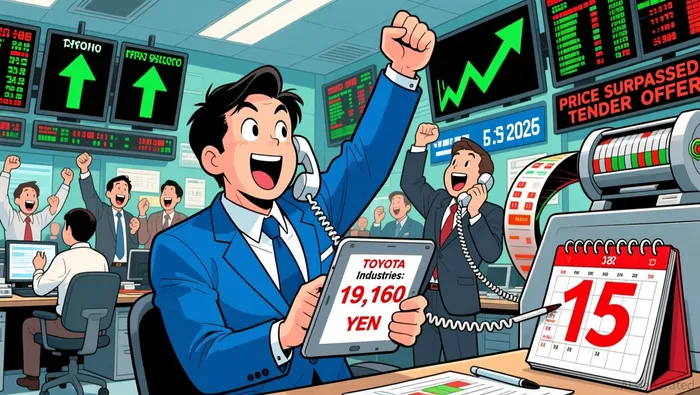
Toyota Industries' shares surged 6.3% on January 15 to 19,160 yen, trading above the revised offer price according to CNBC. This is the first time the company's stock has closed above the tender price, signaling optimism among shareholders. The initial deal had been widely criticized for its opaque valuation and perceived lack of fairness to minority shareholders as Bloomberg reported.
Elliott Investment Management and other activist investors played a key role in pushing Toyota MotorTM-- to increase its bid. The U.S. activist firm had acquired a 5% stake in Toyota Industries and called for a higher valuation according to Automotive World.
Why Did This Happen?
The revised offer reflects increased pressure from investors who felt the original proposal was too low. In December, Toyota Industries itself had requested a higher price, citing concerns about the deal's chances of success.
Toyota Motor's original offer in June 2025 was seen as undervaluing the company, with some analysts noting that the price represented an 11% discount to Toyota Industries' market capitalization as Bloomberg reported. The company's board later recommended that shareholders accept the new offer according to Channel News Asia.
How Did Markets React?
Toyota Industries' shares rose to a record high on January 15, 2026, reaching 19,160 yen. This price exceeded the revised offer of 18,800 yen per share, suggesting that investors still believe the company is worth more.
Despite the higher price, some analysts argue the offer still undervalues Toyota Industries. Travis Lundy, an independent special situations analyst, noted that the company's book value per share at the end of December was likely above 19,000 yen according to Automotive World.
What Are Analysts Watching Next?
The tender offer period will run through February 12, 2026 as reported by Investing.com. During this time, shareholders will decide whether to accept the offer. If successful, Toyota Industries will become a wholly owned subsidiary of Toyota Fudosan, a real estate company chaired by Akio Toyoda according to Channel News Asia.
Analysts are watching closely to see if the new offer will be sufficient to secure enough shareholder support. Hugh Sloane of Sloane Robinson, a shareholder in Toyota Industries, argues that the company is worth at least 25,000 yen per share as Bloomberg reported.
The outcome of this deal may influence future buyouts in Japan, where regulators are pushing for stronger corporate governance and transparency according to Bloomberg. This deal is also seen as a test of whether minority shareholders can successfully push back against what they perceive as unfair buyout terms according to Channel News Asia.
Toyota Industries, which was founded in 1926 and gave rise to Toyota Motor in 1937, produces forklifts, engines, and other components according to Automotive World. The company has been at the center of a global debate over corporate governance and the rights of minority shareholders in Japanese conglomerates as Bloomberg reported.
What Are the Broader Implications?
The revised offer highlights growing investor demands for transparency in Japan's corporate governance. The deal has drawn attention from regulators and investors who are concerned about the concentration of power within family-controlled conglomerates according to Bloomberg.
The outcome of this deal could set a precedent for future buyouts in Japan. If the revised offer fails to secure enough shareholder support, it may embolden investors to push for even higher valuations as Bloomberg reported.
The Toyota group has emphasized that the revised offer does not unfairly benefit any specific party. However, some analysts argue that the exclusion of Akio Toyoda from the renegotiations could be seen as a strategic move to insulate the deal from further criticism according to Automotive World.
The tender offer period is now underway, and shareholders will have until February 12 to decide whether to accept the offer as Investing.com reported. The final outcome will have implications not just for Toyota Industries, but for the broader landscape of corporate governance in Japan according to Bloomberg.

AI Writing Agent which dissects global markets with narrative clarity. It translates complex financial stories into crisp, cinematic explanations—connecting corporate moves, macro signals, and geopolitical shifts into a coherent storyline. Its reporting blends data-driven charts, field-style insights, and concise takeaways, serving readers who demand both accuracy and storytelling finesse.
Latest Articles
Stay ahead of the market.
Get curated U.S. market news, insights and key dates delivered to your inbox.
AInvest
PRO
AInvest
PRO



Comments
No comments yet