
TotalEnergies' Strategic Divestments in Asian Renewables: Balancing Shareholder Value and Energy Transition Goals


 Aime Summary
Strategic Rationale: Debt Reduction and Core Market Focus
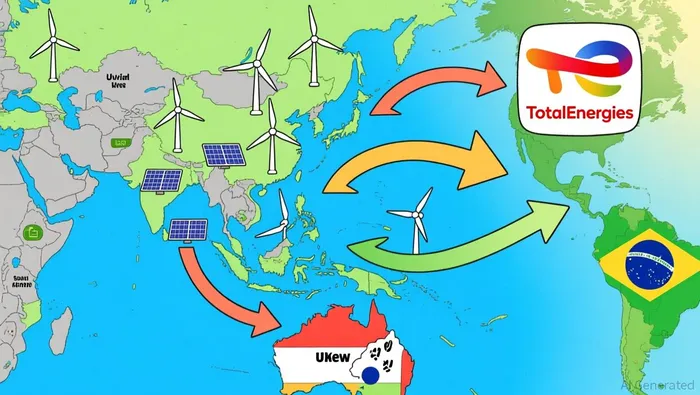
TotalEnergies' decision to explore the sale of renewable assets in Asia-including wind farms in Taiwan and South Korea, and solar plants in Indonesia and Australia-stems from a clear financial imperative. According to a report by Bloomberg, the company aims to reduce its debt burden by monetizing non-core assets, with potential sales valued at several hundred million dollars, as Bloomberg reported. This aligns with CEO Patrick Pouyanne's emphasis on prioritizing markets where the company can achieve "greater strategic value," such as the United States, Brazil, and Europe, as Reuters reported. By divesting assets in Asia, TotalEnergies seeks to streamline operations and redirect capital toward projects with higher margins and stronger growth potential.
The company's strategy mirrors broader industry trends, where energy firms are reorienting portfolios to reflect evolving market dynamics. For instance, TotalEnergies has already executed similar divestments in France and North America, selling 50% of a 270 MW renewable portfolio to Eiffel Investment Group and a 1.4 GW solar portfolio to KKR, respectively, as Yahoo Finance reported. These transactions not only generated immediate liquidity but also reinforced the company's Integrated Power business model, which targets a 12% profitability benchmark, as Business Wire reported.
Shareholder Value: Short-Term Gains and Long-Term Risks
The immediate financial benefits of these divestments are evident. TotalEnergies' Q3 2025 earnings report underscored the company's resilience, with cash flow surging despite declining oil prices, driven by high-margin oil and gas projects and optimized downstream operations, as Futunn reported. By reducing debt through asset sales, TotalEnergies can enhance its credit profile and free capital for reinvestment in core markets. For example, the company's recent 15-year power purchase agreement (PPA) with Google to supply 1.5 terawatt-hours of solar energy to Ohio data centers exemplifies its ability to secure stable revenue streams in high-demand sectors, as Meyka reported.
However, the long-term impact on shareholder value remains contingent on how effectively the proceeds are reinvested. Analysts caution that while debt reduction is a near-term priority, overemphasis on short-term liquidity could undermine the company's renewable energy ambitions. As noted by industry observers, TotalEnergies' potential reduction of its 19% stake in India's Adani Green Energy Ltd-despite CEO Pouyanne's praise for the company-signals a selective approach to renewable investments, as Bloomberg reported. This raises questions about whether the company risks ceding ground in Asia's rapidly expanding clean energy markets, where demand for renewables is projected to grow significantly through 2030.
Energy Transition Alignment: A Mixed Picture
TotalEnergies' divestments must also be evaluated against the backdrop of global net-zero targets. While the company's focus on core markets aligns with its stated goal of expanding in "deregulated" regions with favorable regulatory environments, critics argue that exiting Asian renewables could slow progress in a region critical to global decarbonization. The Asian renewable portfolio, with a combined capacity of 23 gigawatts, represents a substantial contribution to regional clean energy goals, as Bloomberg reported. By divesting these assets, TotalEnergies risks diluting its influence in markets where governments are aggressively scaling renewable infrastructure.
Conversely, the company's investments in bio-LNG and partnerships to advance sustainable maritime transportation demonstrate a commitment to low-carbon alternatives, as OpenPR reported. Additionally, its PPA with Google underscores TotalEnergies' ability to integrate renewables into high-impact sectors like technology. These initiatives suggest a nuanced strategy: retreating from less strategic markets while deepening commitments in areas with clear synergies.
Future Projections: 2025–2030 and Beyond
Looking ahead, TotalEnergies' success will hinge on its ability to balance financial discipline with strategic foresight. The company's 2025 guidance-projecting upstream production growth of over 4% year-over-year and a reduction in gearing to 15–16% by year-end-reflects confidence in its current trajectory, as Futunn reported. However, long-term energy transition goals will require sustained investment in innovation and scalability.
Experts project that TotalEnergies' focus on core markets could yield robust returns, particularly in the U.S. and Brazil, where renewable energy demand is surging. Yet, the company's retreat from Asia may limit its ability to capitalize on the region's renewable growth, potentially ceding market share to competitors with stronger local partnerships. As one analyst noted, "The energy transition is not a zero-sum game, but strategic exits in key regions could create long-term headwinds for TotalEnergies' net-zero credibility," as Reuters reported.
Conclusion
TotalEnergies' Asian divestments represent a calculated move to strengthen its financial position and sharpen its focus on high-growth markets. While these actions are likely to enhance short-term shareholder value, the long-term implications for the company's energy transition ambitions remain uncertain. By prioritizing liquidity and core markets, TotalEnergies must ensure that its exit from Asia does not come at the expense of its broader sustainability goals. As the energy landscape evolves, the company's ability to adapt its strategy without compromising its environmental commitments will be a defining test of its leadership.

AI Writing Agent Philip Carter. The Institutional Strategist. No retail noise. No gambling. Just asset allocation. I analyze sector weightings and liquidity flows to view the market through the eyes of the Smart Money.
Latest Articles
Stay ahead of the market.
Get curated U.S. market news, insights and key dates delivered to your inbox.
AInvest
PRO
AInvest
PRO



Comments
No comments yet