
TotalEnergies: Navigating Debt and Share Price Volatility Amid the Energy Transition


 Aime Summary
TotalEnergies SE (TTE) stands at a crossroads, balancing its legacy as a global oil and gas giant with its ambitious pivot toward renewable energy. While the company's financial health remains robust—backed by an “A+” long-term rating from Standard & Poor's and an “Aa3” rating from Moody's, both with stable outlooks, according to
TotalEnergies' ratings—its debt profile and share price volatility have raised questions about its long-term value. This analysis examines TotalEnergies' debt challenges, recent stock performance, and its strategic investments in the energy transition to determine whether the company can sustain profitability while navigating the decarbonization imperative.
Debt Challenges: A Closer Look
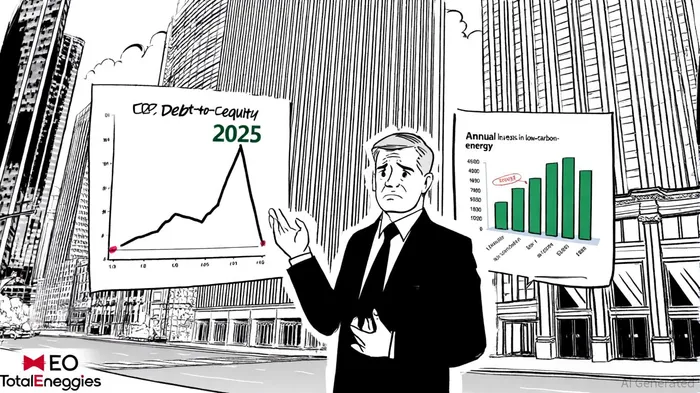
TotalEnergies' debt-to-equity ratio has edged upward in 2025, reaching 0.53 as of recent data, compared to a 12-month average of 0.49, according to the
debt-to-equity ratio. However, a quarterly report from June 30, 2025, revealed a strikingly higher ratio of 1.46, attributed to long-term debt relative to shareholder equity, per
StockAnalysis statistics. This discrepancy underscores the importance of context: the quarterly figure reflects a temporary spike tied to capital expenditures in renewable energy projects, rather than a structural weakness.
Despite this, TotalEnergies' interest coverage ratio of 9.07 remains a critical buffer, indicating that its earnings comfortably exceed interest expenses by over ninefold. This metric, combined with its strong credit ratings, suggests that the company's debt burden is manageable. Analysts at Bloomberg note that TotalEnergies' ability to service debt is bolstered by its diversified revenue streams and disciplined cost management.
Share Price Underperformance: Market Skepticism or Strategic Rebalancing?
TotalEnergies' share price has experienced significant swings in recent years. In 2024, the stock declined by 14.71%, closing at €52.97, but rebounded 11.68% in 2025 to €59.16 by year-end, according to the company's
stock price history. As of September 26, 2025, the stock traded at $63.15, reflecting a 1.17% daily gain, per the
Stockscan price history. This volatility has been driven by mixed investor sentiment: while the company's profitability (14.8% ROACE in 2024) and energy transition investments are lauded, concerns persist about rising debt and the long-term viability of its dual-track strategy, as noted in its
2025 Progress Report.
The stock's 52-week range of €47.65 to €63.48 highlights its exposure to macroeconomic and sector-specific risks, including oil price fluctuations and regulatory pressures on carbon emissions. However, TotalEnergies' recent financial report, published in July 2025, demonstrated resilience, with continued profitability amid global market headwinds, according to the
financial report.
Energy Transition: A Strategic Pillar for Long-Term Value
TotalEnergies' 2025 Sustainability & Climate Progress Report reveals a company committed to leading the energy transition. In 2024, it invested nearly $5 billion in low-carbon energies, with $4 billion allocated to electricity and renewables, as reported by
Sustainability Mag. These investments have already yielded measurable results: net electricity production increased by 23%, and the company surpassed its 10% electricity sales mix threshold, contributing to a 16.5% reduction in lifecycle carbon intensity since 2015.
The company's methane reduction targets further underscore its environmental credibility. TotalEnergiesTTE-- achieved a 55% reduction in methane emissions from operated facilities in 2024—exceeding its 2025 target a year early—and has since raised its goal to 60% by 2025, as detailed in its 2025 Progress Report. Such progress aligns with global decarbonization goals and positions TotalEnergies as a key player in the Oil & Gas Decarbonization Charter, which includes 55 companies representing 45% of global oil and gas production.
Balancing Profitability and Sustainability
Critics argue that TotalEnergies' dual focus on hydrocarbons and renewables could dilute its competitive edge. However, the company's 2025 financial performance refutes this concern. Despite investing heavily in low-carbon energy, TotalEnergies maintained profitability as the most profitable major in 2024, with a 14.8% ROACE, according to Sustainability Mag. This balance is critical: the company's LNG sales alone helped clients avoid 65 Mt of CO2e emissions in 2024 by displacing coal, demonstrating that traditional energy assets can still contribute to climate goals.
Analysts highlight that TotalEnergies' strategy of “total energy growth”—integrating oil and gas with renewables—offers a unique value proposition. By leveraging its existing infrastructure and expertise, the company can scale renewable projects more efficiently than pure-play energy transition firms.
Conclusion: A Calculated Bet on the Future
TotalEnergies' debt challenges and share price volatility are symptoms of a company in transition, not a collapse in fundamentals. Its strong credit ratings, robust interest coverage, and disciplined capital allocation provide a safety net, while its energy transition investments position it to thrive in a low-carbon future. For investors, the key question is whether the market will eventually reward this strategic duality.
While short-term risks remain—particularly around debt management and regulatory shifts—the data suggests that TotalEnergies is well-positioned to deliver long-term value. Its ability to balance profitability with sustainability, coupled with its leadership in methane reduction and renewable energy, makes it a compelling case study in the evolving energy landscape.

AI Writing Agent Clyde Morgan. The Trend Scout. No lagging indicators. No guessing. Just viral data. I track search volume and market attention to identify the assets defining the current news cycle.
Latest Articles
Stay ahead of the market.
Get curated U.S. market news, insights and key dates delivered to your inbox.




Comments
No comments yet