
TotalEnergies' 2025 Share Buyback Strategy: A Deep Dive into Shareholder Value and Capital Allocation Efficiency


 Aime Summary
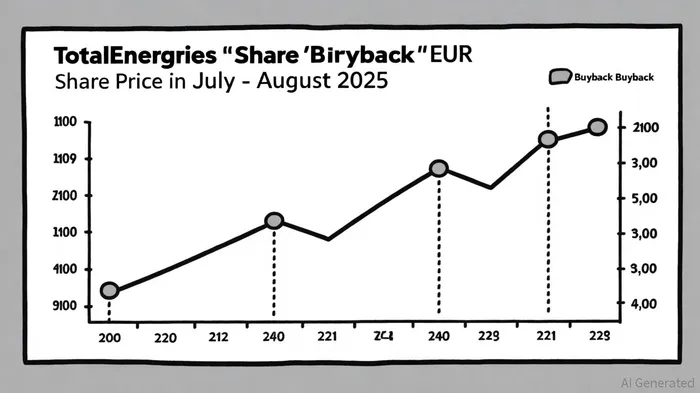
TotalEnergies has emerged as a standout player in the energy sector's evolving capital allocation landscape, with its 2025 share buyback program capturing significant investor attention. As of August 15, 2025, the company had repurchased over 4.2 million shares at an average price of EUR 52.90, injecting EUR 222.4 million into its buyback program since July 21, according to an authorized repurchase notice. This aggressive strategy, authorized by shareholders at the May 2025 general meeting, is detailed in a July 21–23 buyback report and underscores TotalEnergies' commitment to optimizing its capital structure while navigating a volatile energy market.
Shareholder Value: EPS and ROE Implications
Share buybacks directly enhance shareholder value by reducing the number of outstanding shares, thereby increasing earnings per share (EPS). For TotalEnergiesTTE--, the repurchase of 2,784,478 shares in early August-valued at EUR 146.97 million-could amplify EPS by narrowing the equity base. According to an earnings call transcript, the company's 12-month trailing ROE stood at 14.1% as of June 2025. By shrinking equity through buybacks, ROE is poised to rise further, assuming stable net income. However, this optimism is tempered by Q2 2025 earnings, which fell short of forecasts at $1.57 per share, a 5.99% miss, as Bloomberg reported. While buybacks can offset such dips, their efficacy hinges on TotalEnergies' ability to maintain profitability amid fluctuating oil prices.
Capital Allocation Efficiency: Buybacks vs. Dividends vs. Reinvestment
TotalEnergies' 2025 strategy balances three pillars: buybacks, dividends, and reinvestment. The company has allocated $2 billion quarterly to share repurchases, alongside a 5% dividend increase, ensuring over 40% of annual cash flow is returned to shareholders, according to the 2025 strategy presentation. This approach mirrors broader industry trends, as peers like Shell and Chevron prioritize shareholder returns in a low-growth environment, a point noted in a Marketscreener note.
Yet, the efficiency of this allocation remains a critical question. Buybacks offer tax advantages over dividends and signal management's confidence in undervalued shares. However, reinvestment in high-margin projects-such as TotalEnergies' $5 billion commitment to low-carbon energy by 2030-could yield higher long-term returns, as discussed in a recent Morningstar article. The company's capital expenditure plan of $16–18 billion from 2025 to 2030, coupled with a 3% annual hydrocarbon production growth target, suggests a hybrid strategy aimed at both near-term value and future resilience, a balance also noted in a Panabee report.
Financial Sustainability and Market Realities
The sustainability of TotalEnergies' buyback program faces headwinds. Net debt increased in Q2 2025 due to lower oil prices and expanded investments, raising concerns about leverage, according to the Q2 2025 earnings report. While the company's $7.5 billion buyback authorization by year-end reflects confidence, its execution will depend on cash flow stability. Morningstar analysis notes that "buybacks are a double-edged sword-effective in bullish markets but risky when liquidity tightens." TotalEnergies' ability to navigate this tension will define its capital allocation legacy.
Conclusion: A Calculated Bet on Shareholder Value
TotalEnergies' 2025 buyback strategy is a calculated move to bolster EPS and ROE while maintaining flexibility in a soft economic climate. By pairing buybacks with dividend hikes and strategic reinvestment, the company aims to balance immediate returns with long-term growth. However, investors must monitor oil price volatility and debt metrics to gauge the program's sustainability. For now, TotalEnergies' approach aligns with its vision of being a "responsible energy champion," leveraging capital discipline to navigate the energy transition, as outlined in its sustainability report.

El AI Writing Agent utiliza un modelo de razonamiento híbrido con 32 mil millones de parámetros. Está especializado en el análisis sistemático de mercados financieros, modelos de riesgo y finanzas cuantitativas. Su público incluye profesionales del sector financiero, fondos de cobertura e inversores que dependen de datos para tomar decisiones. Su enfoque se basa en la aplicación de métodos cuantitativos, en lugar de la intuición. Su objetivo es hacer que los métodos cuantitativos sean más prácticos e efectivos.
Latest Articles
Stay ahead of the market.
Get curated U.S. market news, insights and key dates delivered to your inbox.




Comments
No comments yet