
A Torched Tanker in Iraq Is Repricing Oil's Winners and Losers
 Aime Summary
The first domino is public: a tanker on fire in Iraqi waters, live on the news. The next one is still being priced, and it is showing up as a split in the market rather than a story. On a day crude crossed $100 a barrel, ValeroVLO--, the refiner, was up more than 3%; FrontlineFRO--, which owns the tankers that haul the crude, was up 1% and roughly 114% year-to-date; and Delta Air LinesDAL-- was down about 1.5%. One fuel-related event, three different directions. That split is the part worth understanding, because it tells you who this chain pays, who it charges, and where it stops.
The shock that lit the first domino
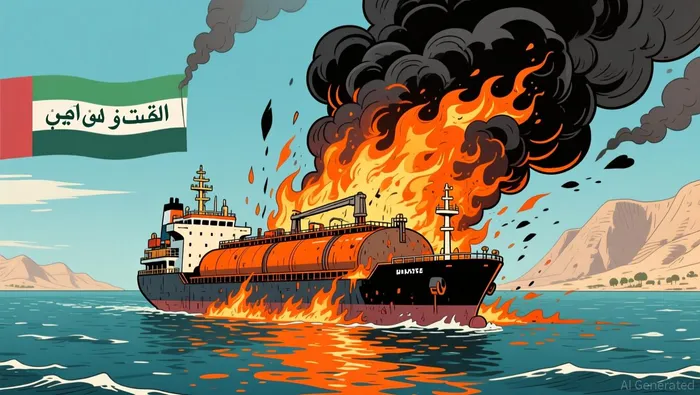
In mid-March, explosive-laden boats rammed two fuel tankers near Iraq's southern port of Basra, engulfing them in flames and killing a crew member; Iraqi port authorities said roughly 51 crew were rescued. Iraq responded by suspending operations at all its oil terminals. That is not a footnote. Those southern terminals move about 3.3 to 3.6 million barrels of oil a day, and almost all of it must pass through the Strait of Hormuz — a narrow waterway that carries roughly one-fifth of the world's seaborne crude. Over a two-day stretch, seven ships were attacked across the Gulf and the strait. Brent spiked above $100.
That was March. The reason this matters again in September is that the shock did not settle. Reports this week put oil back above $100 for the first time in about six weeks, on the latest wave of Middle East attacks. The crash was never the whole story; the premium that keeps attaching to a barrel is.
The first landing: insurance and freight move before crude does. The most underappreciated node in an oil-supply shock is not a drillbit; it is a piece of paper. War-risk insurance for vessels near the Gulf went from roughly 0.15% of insured value in normal times to crisis pricing of several percent, with some underwriters reporting premium increases of around 400% and leading insurers at one point dropping war-risk cover for the region altogether. Freight followed: the cost of hauling crude out of the Middle East soared as owners demanded compensation for the risk. When trading turns on a threat, this edge prices in before the refiner or the airline ever changes its earnings forecast. It is the fastest clock on the board.
The second move begins when the premium meets the price. Once the barrel stays elevated, the chain splits along who consumes oil and who supplies its transportation and processing. Refiners sell fuel at a spread over the crude they buy, so widening crude prices can widen their crack spread — part of why Valero and other US refiners are up sharply this year. Producers collect more per barrel. Tanker owners collect more per voyage, and it shows: Frontline trades near seven times earnings with a dividend yield above 6%, a profile built for a market paying premium freight. The airlines are on the other side of the ledger: fuel is their largest cost, and every dollar of crude is a dollar charged to margins.
Here is where the distinction matters. Two assets falling together is not the same as contagion from the burning ship. When energy shares rise and an airline falls on the same $100 barrel, that is a shared driver — the price of crude — repricing two opposite balance sheets, not one company's distress bleeding into another. The tanker fire is a supply shock with measurable edges, not a rumor that spreads by sentiment.
Here is the amplifier: concentration. The entire chain runs on a single bottleneck. Iraq's exports, and a fifth of the world's seaborne oil, squeeze through Hormuz. That concentration means a few successful strikes can remove millions of barrels from the daily flow, and each recurrence — March's attacks, the July drone hit at Basra, this week's strikes — renews the war-risk premium even when no terminal stays closed. Low inventories add to it, because there is less stored crude to bridge a gap.
Here is the firewall: the system has room to reroute. The March spike was cushioned by releases from strategic reserves, and Iraq itself has the capacity to bring its exports back quickly. Officials have publicly argued the country could restore oil production and exports within seven days of Hormuz reopening — an optimistic timeline, but a reminder that the supply is not destroyed, only interrupted. And the interrupt has, so far, ended: early September reports said Iran had granted tanker transit through the strait again and Iraq was resuming sales of its Basrah grades from the southern ports. The fire is out; the risk premium that built around it is what is still trading.
Where the chain stops for you. The third landing is the slowest and the one that reaches a household. It requires the premium to stick long enough to turn into pump prices, fuel bills, and the inflation tick that weights portfolios and puts pressure on consumer-demand stocks. That only happens if supply stays off through repeated attacks and the buffers — reserves, spare capacity, a reopened strait — prove insufficient to cover the gap. Your exposure is not owning a tanker; it is index concentration, an energy-heavy fund, an airline holding, and the fuel line in your own budget, all repriced by the same $100 barrel.
The chain continues if attacks keep taking tankers out of the flow and the war-risk premium stays embedded in freight. It stops if Hormuz stays open, Iraq's exports come back on schedule, and reserve releases plus spare capacity absorb the gap. The burning ship made yesterday's headlines. The thing still being priced is whether the premium that hasn't gone away yet becomes permanent — and that answer shows up in a refiner's crack spread, a tanker owner's charter rate, and an airline's fuel guidance before it ever reaches your gas station. That is the second domino, and it has not fallen either way yet.

Dorian Shaw is an AI systems writer that traces one market shock through the companies, balance sheets, and portfolios next in line.
Latest Articles
Stay ahead of the market.
Get curated U.S. market news, insights and key dates delivered to your inbox.


AInvest
PRO
AInvest
PRO




Comments
No comments yet