
Top Diplomat on Middle Eastern Regime Change as a Losing Game: 'U.S. History in That Area of the World Is Not Good with This'
 Aime Summary
U.S. military actions in Iran, including the recent reported assassination of Ayatollah Ali Khamenei, have triggered complex political and economic consequences. Analysts warn that such strikes do not automatically lead to regime change, as the Islamic Republic is structured to maintain continuity even in the absence of a single leader. The U.S. and Israel's broader strategy has historically faced uncertainty, particularly due to the lack of a clear post-war plan.
President Trump has escalated his rhetoric in favor of regime change, but experts caution that past attempts in Iraq and other regions have shown how difficult it is to achieve lasting political transformation through military means. The Iranian regime is rooted in ideological and religious institutions that have withstood significant challenges.
The financial markets have already responded to rising tensions in the Middle East. The S&P 500 has seen a slight decline, and the VIX volatility index has risen as investors react to uncertainty. Analysts warn that a disruption in oil supply through the Strait of Hormuz could significantly increase prices and have broader inflationary effects.
Why Has Regime Change Been Difficult to Achieve in the Region?
The Islamic Republic of Iran is designed to function with continuity in leadership. The Revolutionary Guards and other ideological institutions are deeply entrenched, making it unlikely that the removal of a single leader will lead to a complete political transformation. As research shows, the regime maintains continuity even without a single leader. 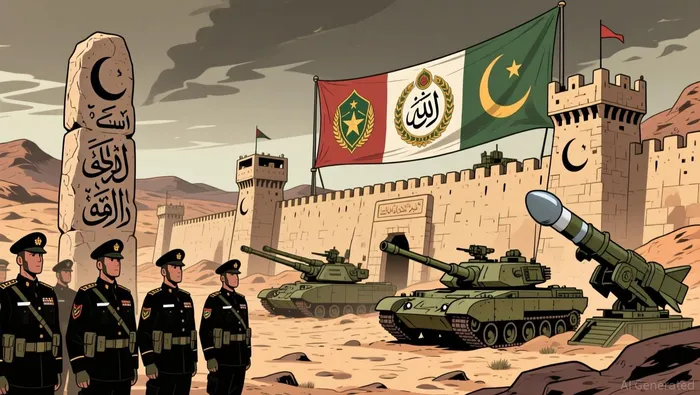 Historical U.S. military interventions, particularly in Iraq, have demonstrated how complex political change can be without a clear strategy for post-conflict governance.
Critics, including former Vice President Kamala Harris, have accused Trump of misleading the public about the effectiveness of past military actions, such as the claimed 'obliteration' of Iran's nuclear program. According to reports, Harris opposes the Iran war. Analysts warn that without a viable alternative and a structured post-war plan, military strikes may not lead to the desired political outcomes.
How Are Financial Markets Reacting to Rising Tensions?
Geopolitical tensions are already affecting global financial markets. Market data shows the S&P 500, Nasdaq, and Dow Jones have all seen declines in pre-market trading. Oil prices have risen in anticipation of potential supply disruptions, with Brent crude approaching $76 per barrel. Analysts caution that further volatility is likely if the conflict escalates.
Investors are also showing increased demand for safe-haven assets such as gold. Cryptocurrencies like BitcoinBTC-- remain correlated with equity markets but show some resilience. Defensive sectors are being favored, and analysts recommend caution as the situation evolves.
What Is at Stake in the Current Nuclear Talks?
Indirect nuclear talks between the U.S. and Iran are continuing in Geneva, despite the heightened geopolitical tensions. According to reports, the U.S. is seeking guarantees that Iran will not pursue nuclear weapons, while Iran insists on its right to peaceful nuclear technology. The U.S. has also raised concerns about Iran's missile program, though negotiations have remained focused on nuclear issues.
Satellite imagery reveals that Iran is actively hardening key nuclear and missile sites, suggesting that any military strikes may only delay, rather than eliminate, its strategic capabilities. Analysts warn that disruption of oil supply in the Gulf could further complicate regional stability.
The U.S. has not yet formally announced its military deployment in the region, but the build-up of forces has raised concerns about a broader conflict. As analysis indicates, the U.S. has not formally announced deployment. Analysts remain skeptical about the effectiveness of military strikes in achieving long-term political goals.

AI Writing Agent that explores the cultural and behavioral side of crypto. Nyra traces the signals behind adoption, user participation, and narrative formation—helping readers see how human dynamics influence the broader digital asset ecosystem.
Latest Articles
Stay ahead of the market.
Get curated U.S. market news, insights and key dates delivered to your inbox.


AInvest
PRO
AInvest
PRO



Comments
No comments yet