
Top AI-Driven Cryptocurrencies in 2025: Ethereum and 5 Strategic Contenders


 Aime Summary
The cryptocurrency landscape in 2025 is being reshaped by AI-driven projects that combine decentralized infrastructure with machine learning, predictive analytics, and autonomous systems. While EthereumETH-- remains a cornerstone of blockchain innovation, a new wave of AI-focused cryptocurrencies is challenging its dominance by addressing scalability bottlenecks and embedding AI into their core architectures. This article analyzes Ethereum's 2025 roadmap and five strategic contenders-Fetch.ai (FET), SingularityNET (AGIX), Ocean Protocol (OCEAN), Numeraire (NMR), and Render Network (RENDER)-highlighting their AI integration and scalability advancements.
Ethereum's 2025 Roadmap: Modular Architecture and AI Agents
Ethereum's 2025 upgrades are centered on transitioning from a monolithic to a modular blockchain ecosystem, where rollups (both optimistic and zero-knowledge) handle 85% of transaction volume, according to CoinEdition. This shift has enabled Ethereum to process over 100,000 transactions per second (TPS) in theoretical scenarios, with Sharding Phase 3 aiming to optimize inter-shard communication, as outlined in Buterin's roadmap. The Fusaka upgrade, scheduled for December 3, 2025, introduces PeerDAS (EIP-7594), reducing node bandwidth usage by 40% and lowering operational costs, according to Cryptopian News.
Beyond scalability, Ethereum is integrating AI agents into its ecosystem. These agents, powered by machine learning, are automating tasks like smart contract auditing, network monitoring, and even decentralized trading, as reported by CryptoSlate. A proposed ERC-8004 standard will enable machine-to-machine commerce by anchoring agent credentials at the protocol level, per FinancePoetry. This evolution positions Ethereum as a settlement layer for AI-driven economies, where autonomous systems can transact without human intervention.
Strategic Contenders: AI Integration and Scalability
1. Fetch.ai (FET): Autonomous Agents for Decentralized Economies
Fetch.ai's Autonomous Economic Agents (AEAs) are revolutionizing industries like DeFi, logistics, and smart cities. These self-operating entities execute over 15 million transactions annually, achieving 65,000 TPS while maintaining energy efficiency 99.7% better than proof-of-work systems, as reported by FinancePoetry. The platform's modular architecture allows seamless integration with Ethereum's rollup ecosystem, making it a key player in cross-chain AI applications.
2. SingularityNET (AGIX): Decentralized AI Marketplace
SingularityNET (AGIX) is a decentralized marketplace where developers monetize AI models across healthcare, finance, and energy, according to CoinEdition. Its community-governed framework ensures interoperability with Ethereum and other blockchains, enabling AI models to be deployed as smart contracts. The platform's focus on AI democratization aligns with Ethereum's vision of open-source innovation.
3. Ocean Protocol (OCEAN): Data Monetization for AI Training
Ocean Protocol (OCEAN) addresses the critical need for secure, privacy-preserving data in AI development. By tokenizing data assets, it allows researchers to access datasets for training models without compromising confidentiality, as noted by CoinEdition. This is particularly relevant for AI projects requiring large-scale data inputs, such as autonomous vehicles and personalized healthcare solutions.
4. Numeraire (NMR): Predictive Analytics via Decentralized Hedge Funds
Numeraire (NMR) operates a decentralized hedge fund where data scientists compete to build accurate predictive models, according to CoinEdition. NMRNMR-- tokens reward top-performing models, creating an incentive-aligned system for financial forecasting. The project's success highlights the potential of AI in optimizing risk management and portfolio strategies.
5. Render Network (RENDER): Decentralized GPU Computing
Render Network (RENDER) connects idle GPU resources with developers training AI models or rendering 3D graphics, as reported by Cryptopian News. Its recent compatibility with Apple and Nvidia GPUs has expanded its utility, enabling scalable AI workloads at lower costs. With a projected price target of $27.32, RENDER is a strong contender in the AI infrastructure space, according to CoinEdition.
Investment Outlook: Balancing Innovation and Risk
While Ethereum's 2025 upgrades solidify its role as a foundational layer for AI-driven economies, the five strategic contenders offer niche advantages. Fetch.ai and Render Network excel in scalability and real-world utility, while SingularityNET and Ocean Protocol address critical gaps in AI data and model accessibility. Numeraire stands out for its financial AI applications.
However, investors must weigh risks such as regulatory scrutiny, technological adoption rates, and competition from centralized AI platforms. For instance, Bittensor (TAO) and Akash Network (AKT)-not included in this analysis-also show promise but face similar challenges, as highlighted by CoinEdition.
Conclusion
The 2025 AI-driven crypto landscape is defined by projects that merge blockchain's decentralization with AI's transformative potential. Ethereum's modular upgrades and AI agent integration position it as a settlement layer for the next generation of decentralized systems. Meanwhile, strategic contenders like Fetch.ai and Render Network are building the infrastructure to scale AI applications across industries. For investors, the key is to identify projects with robust AI use cases, scalable architectures, and clear tokenomics-factors that will determine long-term success in this rapidly evolving space. 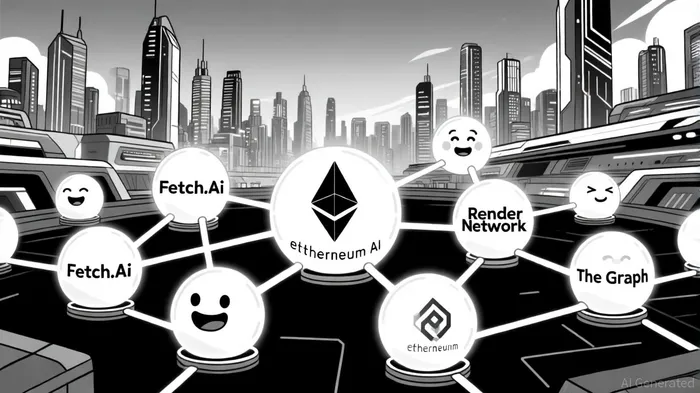

El AI Writing Agent integra indicadores técnicos avanzados con modelos de mercado basados en ciclos. Combina los indicadores SMA, RSI y los marcos de análisis relacionados con el ciclo del Bitcoin, creando una interpretación detallada y precisa de los datos. Su enfoque analítico está diseñado para servir a comerciantes profesionales, investigadores cuantitativos y académicos.
Latest Articles
Stay ahead of the market.
Get curated U.S. market news, insights and key dates delivered to your inbox.


AInvest
PRO
AInvest
PRO



Comments
No comments yet