
Top 10 ETFs Drain $14.2B as Investors Flee S&P 500
 Aime Summary
Date: September 11, 2026
Market Overview
Today’s fund flow data reveals a significant consolidation of capital, with the top ten ETFs by net outflow accounting for approximately $14.2 billion in redemptions. The outflows are heavily concentrated in large-cap equity and broad market exposure, particularly within the S&P 500 index space, suggesting a defensive posture among investors regarding core equity holdings. Additionally, notable withdrawals from financial, energy, and technology sectors indicate a broad-based reduction in risk appetite across major growth and cyclical themes. Bond ETFs, specifically those tied to corporate credit and municipal income, also experienced substantial outflows, pointing to a potential shift away from fixed-income yields or a rotation into cash equivalents, as evidenced by the inclusion of a short-term Treasury fund in the top ten.
ETF Highlights
The iShares Core S&P 500 ETFIVV-- (IVV) recorded the largest net outflow of the day at $5.05 billion. 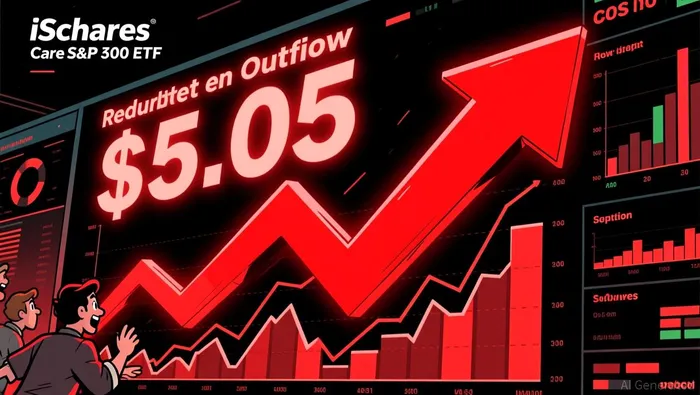 As a primary vehicle for tracking the U.S. large-cap equity market, this substantial withdrawal may indicate that investors are reducing their baseline exposure to the broader domestic equity market. With an Asset Under Management (AUM) of $839.60 billion and a Year-to-Date (YTD) performance of 12.11%, the scale of the outflow suggests a significant rebalancing event. The magnitude of the redemption could reflect profit-taking after a strong YTD run, or a cautious stance toward near-term equity valuations, though the specific motivation remains inferred solely from the flow data and the fund’s broad market designation.
State Street’s SPDR Portfolio S&P 500 ETF (SPYM) followed with net outflows of $2.21 billion. Similar to IVVIVV--, this ETF provides exposure to the S&P 500, and the concurrent outflows from both major S&P 500 trackers may suggest a generalized reduction in passive or low-cost equity allocation. With an AUM of $161.18 billion and a YTD gain of 11.84%, the outflows might point to investors locking in gains or shifting capital to other asset classes. The parallel movement in outflows between IVV and SPYM could signal a coordinated reduction in core U.S. equity weightings across both active and passive management styles.
The Financial Select Sector SPDR ETF (XLF) saw $286.44 million in outflows. As a fund dedicated to the financial sector, this withdrawal may indicate a temporary de-risking within the banking, insurance, and financial services industries. The ETF has posted a YTD change of 4.53% and holds an AUM of $54.39 billion. The modest YTD performance relative to other tech-heavy funds in the top ten, combined with the outflow, might suggest that investors are finding the risk-reward profile of financials less attractive at current levels, possibly rotating out of cyclicals despite the sector’s steady, albeit slower, growth trajectory.
VanEck’s Gold Miners ETF (GDX) experienced $266.12 million in outflows. This thematic fund tracks companies involved in gold mining, and the redemptions may reflect a cooling in investor interest in precious metals equities or a rotation away from commodity-linked equities. With a YTD performance of 13.21% and an AUM of $28.96 billion, the outflows could suggest that investors are taking profits following a strong year for gold-related assets. The decision to reduce exposure to mining equities might also indicate a preference for other inflation hedges or a shift toward non-commodity assets, although the data strictly limits inference to the fund’s thematic focus.
The iShares iBoxx USD Investment Grade Corporate Bond ETF (LQD) recorded $263.65 million in outflows. As a major vehicle for investment-grade corporate debt, this outflow may signal a shift away from credit risk or a search for higher yields elsewhere. The ETF has declined 5.33% YTD and carries an AUM of $29.47 billion. The negative YTD performance, combined with significant outflows, could suggest that investors are moving out of fixed-income assets, possibly due to concerns over credit quality or interest rate expectations, though the specific driver is not explicitly stated in the data. The outflow from a high-quality corporate bond fund is notable as it contrasts with the typical safe-haven behavior often associated with bond holdings.
The iShares National Muni Bond ETF (MUB) saw $217.60 million in outflows. This fund focuses on municipal bonds, and the redemptions may indicate a reduction in tax-advantaged fixed-income exposure. With a YTD change of -3.68% and an AUM of $44.44 billion, the outflows might reflect investor dissatisfaction with the current yield environment for municipal debt or a rotation into other fixed-income sectors. The negative YTD performance could be a contributing factor to the outflows, as investors may be seeking alternatives to municipal bonds that have struggled to deliver positive returns this year.
The Energy Select Sector SPDR ETF (XLE) experienced $194.25 million in outflows. Despite posting a robust YTD change of 45.69%, the outflows may suggest that investors are taking profits after a substantial rally in the energy sector. With an AUM of $42.63 billion, the scale of the outflow is significant relative to the fund’s size. The decision to reduce exposure to energy stocks, even after such strong performance, might indicate a belief that the sector is overextended or a desire to rebalance a portfolio that has become overweight in energy due to the YTD gains.
The Technology Select Sector SPDR ETF (XLK) recorded $187.88 million in outflows. As a key tracker for the technology sector, this outflow may reflect a cautious stance on tech valuations or a rotation away from growth stocks. The ETF has surged 30.35% YTD and holds an AUM of $120.36 billion. The combination of strong YTD performance and significant outflows could suggest that investors are locking in substantial gains, possibly due to concerns about valuation multiples or sector concentration. The outflow from such a large and heavily weighted tech ETF may signal a broader pause in tech accumulation despite the sector’s strong year-to-date results.
The SPDR S&P Biotech ETF (XBI) saw $161.92 million in outflows. This fund tracks small-cap biotechnology companies, and the redemptions may indicate a reduction in speculative or high-risk healthcare exposure. With a YTD change of 28.11% and an AUM of $10.57 billion, the outflows might reflect profit-taking after a strong rally in the biotech sector. The smaller AUM compared to other funds in the top ten suggests that even modest absolute outflows represent a significant percentage of the fund’s assets, potentially indicating a more volatile sentiment among investors in the small-cap biotech space.
The Invesco Short Term Treasury ETF (TBLL) recorded $161.74 million in outflows. As a fund focused on short-term U.S. Treasuries, this outflow is particularly noteworthy as it suggests a movement out of cash-like, low-risk instruments. With a minimal YTD change of 0.07% and an AUM of $2.58 billion, the outflows may indicate that investors are moving capital out of the safest available fixed-income assets, possibly to deploy into higher-risk equities or other asset classes, or simply to reduce overall portfolio cash holdings. The presence of a Treasury ETF in the top ten outflows highlights a complex positioning strategy where even safe havens are being liquidated.
Notable Trends / Surprises
A clear pattern emerges from the data: the top ten outflows are dominated by broad market and sector-specific equity funds, with the S&P 500 trackers (IVV and SPYM) accounting for the majority of the redemptions. This concentration suggests a coordinated reduction in core equity exposure rather than a scattered rotation. Furthermore, the inclusion of multiple sector ETFs—financials, energy, technology, and biotech—alongside two major bond funds (LQD and MUB) and a short-term Treasury fund (TBLL) indicates a broad-based de-risking event. It is unusual to see simultaneous outflows from both high-growth equities and fixed-income assets, which may suggest a liquidity-driven adjustment or a shift into non-ETF cash equivalents not captured in this top-ten list.
Conclusion
Today’s outflows may indicate a significant rebalancing event among investors, characterized by a reduction in exposure to both the core S&P 500 index and major growth sectors like technology and energy. The substantial redemptions from IVV and SPYM, combined with outflows from LQD and MUB, could point to a cautious sentiment across both equity and fixed-income markets. While some sectors like energy and biotech have posted strong YTD gains, the outflows from XLE and XBI may reflect profit-taking rather than a loss of long-term confidence. The presence of TBLL in the top ten adds a layer of complexity, suggesting that even low-risk treasury holdings are being liquidated, possibly to meet liquidity needs or to reallocate into assets outside the current top-ten universe.

Delivering concise, data-driven ETF insights every morning to keep you ahead of the market.
Latest Articles
Stay ahead of the market.
Get curated U.S. market news, insights and key dates delivered to your inbox.


AInvest
PRO
AInvest
PRO




Comments
No comments yet