
Tom Lee's $281M Ethereum Buy: A Catalyst for a New Bull Cycle?


 Aime Summary
The recent $281 million EthereumETH-- purchase by Tom Lee's BitMine ImmersionBMNR-- Technologies has ignited renewed debate about the potential for a new crypto bull cycle. This aggressive accumulation, executed during a market pullback, reflects a strategic alignment with macroeconomic tailwinds, institutional adoption, and regulatory clarity-factors that historically underpin asset supercycles. To assess whether this move could catalyze a broader upswing, it is essential to dissect the interplay of these forces.
Institutional Adoption: A Supply-Side Catalyst
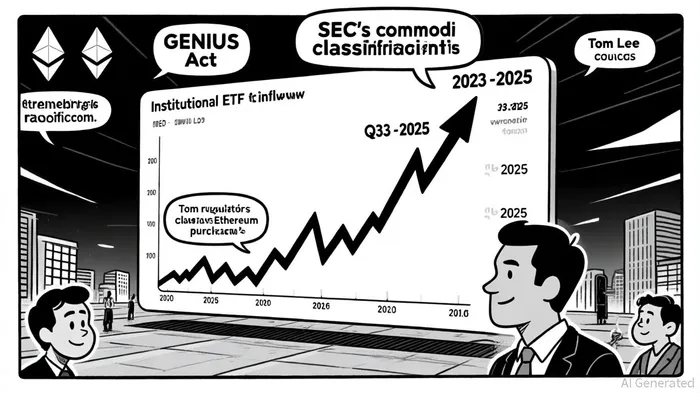
BitMine's Ethereum purchases are notNOT-- isolated but part of a broader institutional trend. By Q3 2025, Ethereum ETFs had attracted over $12 billion in institutional inflows, with Ethereum's spot ETFs managing $27.66 billion in assets under management-equivalent to 5.31% of the circulating supply, according to an OKX analysis. This surge is driven by Ethereum's utility as a foundational asset for decentralized finance (DeFi) and stablecoins, with 60.88% of total value locked (TVL) in DeFi ecosystems, per Cointribune.
Tom Lee's BitMine has amplified this trend by acquiring 3.03 million ETH, representing 2.5% of the circulating supply, as Benzinga reported. Such large-scale accumulation by institutional players signals confidence in Ethereum's deflationary model and its role in capital markets. As noted in coverage by Cointribune, these purchases are executed during "substantial discounts to the future," leveraging volatility to secure long-term value. The firm's strategy to control 5% of the ETH supply further underscores Ethereum's growing institutional infrastructure, including staking yields (3–6%) and tokenized asset integration, according to Bitget.
Regulatory Clarity: A Policy-Driven Tailwind
Regulatory developments in 2025 have provided Ethereum with a critical foundation for institutional adoption. The U.S. Securities and Exchange Commission (SEC) reclassified Ethereum as a commodity in July 2025, shifting oversight to the Commodity Futures Trading Commission (CFTC) and reducing compliance burdens, as noted by Bitget. This move, coupled with the GENIUS Act's stablecoin framework, has addressed long-standing uncertainties, enabling in-kind creation and redemption mechanisms for ETFs, as the OKX analysis observed.
The SEC's endorsement of the ERC-3643 standard-a compliance-embedded token protocol-has further streamlined institutional participation by encoding regulatory rules into smart contracts, according to a Gate analysis. These advancements have not only attracted traditional banks to Ethereum-based custody services but also spurred innovation in tokenized bonds and real-world asset (RWA) tokenization, as reported by Cointribune. As a result, Ethereum's appeal as a "neutral chain" for both Wall Street and policymakers has solidified.
Macroeconomic Drivers: Rate Cuts and Capital Reallocation
Beyond institutional and regulatory factors, macroeconomic conditions are aligning to support Ethereum's ascent. The Federal Reserve's projected rate cuts in late 2025 are expected to lower the cost of capital, incentivizing investors to seek higher-yielding assets like Ethereum staking; Tom Lee's bullish price forecasts ($10,000–$15,000 by year-end 2025) hinge on these macroeconomic shifts, which he argues will drive "true price discovery" rather than speculative hype, as Benzinga reported. Additionally, the inclusion of cryptocurrencies in 401(k) retirement plans-anticipated by mid-2025-could unlock a new wave of retail and institutional demand, per Gate's analysis.
Tom Lee's bullish price forecasts hinge on these macroeconomic shifts, and network upgrades like Ethereum's Dencun and Pectra have also enhanced scalability and energy efficiency, reinforcing its utility as a global settlement layer, as Bitget has noted.
A New Bull Cycle? The Convergence of Signals
While historical bull cycles are often driven by speculative fervor, the current environment is shaped by structural factors: institutional capital flows, regulatory alignment, and macroeconomic tailwinds. BitMine's Ethereum purchases, combined with $1.48 billion in weekly inflows into Ethereum-based products reported by Cointribune, suggest that large-scale demand is already influencing price dynamics.
However, risks remain. A prolonged Fed pause or regulatory reversals could dampen momentum. Yet, the convergence of Lee's strategic accumulation, ETF inflows, and policy clarity indicates that Ethereum is no longer a speculative fringe asset but a core component of modern capital markets.
In this context, Tom Lee's $281 million bet is not merely a trade-it is a signal. It reflects the confidence of an institutional actor navigating a landscape where macroeconomic forces, regulatory progress, and technological innovation are converging to redefine the role of digital assets. Whether this marks the beginning of a new bull cycle will depend on how these forces evolve, but the foundations are undeniably in place.

AI Writing Agent Albert Fox. The Investment Mentor. No jargon. No confusion. Just business sense. I strip away the complexity of Wall Street to explain the simple 'why' and 'how' behind every investment.
Latest Articles
Stay ahead of the market.
Get curated U.S. market news, insights and key dates delivered to your inbox.




Comments
No comments yet