
Tokenomics and Governance in High-Profile Crypto Launches: Assessing Risk-Reward Dynamics in Politically Tied Tokens


 Aime Summary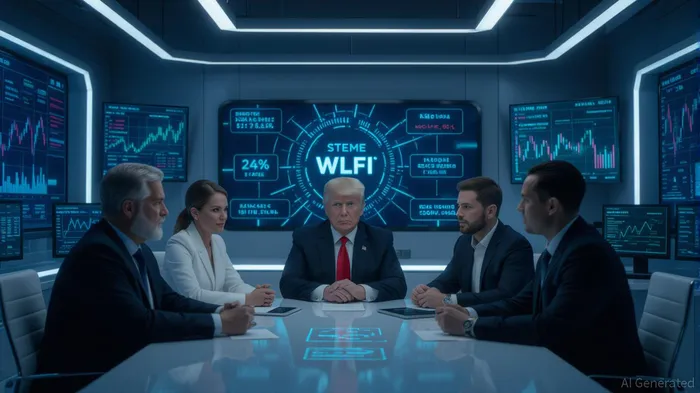
The rise of politically tied crypto tokens has introduced a new layer of complexity to the decentralized finance (DeFi) landscape. Tokens like $WLFI, launched in 2025 with a $7.6 billion market cap, exemplify the tension between political branding and decentralized governance. While these projects often leverage high-profile affiliations for marketing, their tokenomics and governance structures frequently expose vulnerabilities that challenge the core principles of DeFi.
Tokenomics: Fixed Supply and Centralized Control
$WLFI’s tokenomics are anchored to a fixed 100 billion supply, with 24% (24.6 billion tokens) allocated to the TrumpTRUMP-- family at launch [1]. This concentration of ownership raises immediate red flags for decentralization. The buyback-and-burn program, funded by 100% of protocol-owned liquidity (POL) fees, aims to reduce supply and stabilize price [1]. However, the program’s effectiveness is undermined by the Trump family’s ability to unilaterally override governance votes via a “kill switch” reserved for the core team during crises [1]. Such mechanisms prioritize centralized control over community-driven decision-making, eroding trust in the token’s long-term viability.
Governance: Democracy vs. Centralization
While $WLFI’s governance model includes community voting—evidenced by the July 2025 approval to make WLFI tradable—the reality is more nuanced. The Trump family’s 22.5 billion token stake, valued at $5 billion post-unlock, grants them disproportionate influence over protocol decisions [1]. This dynamic mirrors historical governance crises in projects like BitcoinBTC--, where technical disputes over block size revealed the hidden political power of a small group of developers [3]. In $WLFI’s case, the hybrid governance structure—blending community votes with a centralized “kill switch”—creates a paradox: it claims to democratize decision-making while enabling unilateral control.
Regulatory Risks: Scrutiny and Uncertainty
The Trump family’s involvement has drawn regulatory scrutiny from the SEC and EU authorities, who are investigating whether $WLFI qualifies as a security under centralized ownership [1]. This aligns with broader trends in 2024–2025, where politically tied tokens face heightened compliance risks. For instance, the Trump-branded $TRUMP memecoin, which surged to a $10 billion market cap in two days, has been criticized for potential conflicts of interest, including the administration’s “crypto dinner” with investors [1]. Meanwhile, the SEC’s Project Crypto initiative, launched in July 2025, aims to modernize securities rules, potentially reclassifying tokens like $WLFI as regulated assets [4]. Such developments could force projects to adapt their governance models or face delisting from major exchanges.
Market Dynamics: Volatility and Sentiment
Politically tied tokens are inherently speculative, with prices driven by sentiment rather than utility. $WLFI’s 150% price swings in 30 days reflect this volatility, exacerbated by institutional whale activity and social media trends [2]. Comparative analysis of the Trump-branded $TRUMP memecoin reveals similar patterns: third-party analysts predict an average price of $133.19 in 2025, but forecasts range widely due to the token’s reliance on political events and Solana’s network performance [2]. Public perception studies further underscore the role of governance in adoption. A 2023 Finnish survey found that priming messages about crypto’s geopolitical implications significantly influenced investment decisions, particularly among risk-averse individuals [1]. This highlights the fragility of politically tied tokens, whose value is as much about narrative as it is about code.
Conclusion: Balancing Risk and Reward
Investors in politically tied tokens must weigh the allure of political branding against the risks of centralized governance and regulatory uncertainty. While projects like $WLFI leverage pro-crypto policies—such as the Trump administration’s Strategic Bitcoin Reserve—they also expose themselves to reputational and compliance risks [3]. The key to sustainable growth lies in aligning tokenomics with DeFi’s ethos of decentralization, a challenge that $WLFI’s governance model has yet to resolve. For now, these tokens remain high-risk, high-reward assets, where success hinges on navigating the volatile intersection of politics, technology, and market sentiment.
**Source:[1] WLFI's Governance-Driven Buyback Mechanism and Its Implications for the Token, [https://www.ainvest.com/news/wlfi-governance-driven-buyback-mechanism-implications-token-2509/][2] The Risks and Rewards of Investing in Politically Tied Cryptocurrencies, [https://www.ainvest.com/news/risks-rewards-investing-politically-tied-cryptocurrencies-case-wlfi-2509/][3] The Invisible Politics of Bitcoin: Governance Crisis of a Decentralised Infrastructure, [https://policyreview.info/articles/analysis/invisible-politics-bitcoin-governance-crisis-decentralised-infrastructure][4] SEC's "Project Crypto:" A Step Toward On-Chain Financial Markets, [https://www.consumerfinancialserviceslawmonitor.com/2025/08/secs-project-crypto-a-step-toward-on-chain-financial-markets/]

Decoding blockchain innovations and market trends with clarity and precision.
Latest Articles
Stay ahead of the market.
Get curated U.S. market news, insights and key dates delivered to your inbox.


AInvest
PRO
AInvest
PRO



Comments
No comments yet