
Tokenizing U.S. Treasuries and the Future of Institutional Blockchain Adoption


 Aime Summary
The tokenization of U.S. Treasuries has emerged as a defining trend in institutional blockchain adoption, signaling a systemic shift in financial infrastructure and redefining liquidity dynamics. By 2025, the tokenized Treasury market had surged to $7.3 billion in assets under management, a 256% increase from 2024, driven by institutional-grade blockchain platforms that address long-standing inefficiencies in traditional markets according to research. This transformation is not merely a technological upgrade but a structural reorientation of how capital is allocated, settled, and utilized in the global financial system.
Systemic Infrastructure Transition: From Legacy Systems to Programmable Money
The traditional U.S. Treasury market, while liquid, is constrained by T+2 settlement cycles, counterparty risk, and limited trading hours. Tokenized Treasuries, however, leverage blockchain technology to enable atomic settlement-finalizing trades and transfers simultaneously-while embedding compliance checks via smart contracts according to analysis. For example, platforms now enforce on-chain KYC/AML protocols, ensuring only verified investors can hold or transfer tokens according to platform documentation. This programmability eliminates intermediaries in settlement, reducing systemic risk and operational costs.
Major asset managers have capitalized on this shift. BlackRock's BUIDL fund, launched in 2024, captured $2.38 billion in assets within fifteen months by offering 24/7 trading and programmable yield distribution according to market data. Similarly, Fidelity and Franklin Templeton have deployed tokenized Treasury products that integrate with DeFi protocols, allowing institutional investors to collateralize assets for yield or liquidity without sacrificing regulatory compliance according to industry reports. These innovations are not incremental but foundational, reshaping the architecture of capital markets.
The technological infrastructure underpinning this transition is equally transformative. While EthereumETH-- hosts ~70% of the tokenized Treasury market (~$5.3 billion), platforms are increasingly adopting multi-chain strategies to optimize for scalability and cost efficiency according to market analysis. Layer-2 solutions and cross-chain bridges like WormholeW-- enable seamless asset movement across ecosystems, ensuring interoperability with both legacy and emerging financial systems according to technical documentation. This adaptability positions tokenized Treasuries as a bridge between traditional finance and decentralized infrastructure.
The tokenized Treasury market continues to expand, with platforms integrating real-time settlement features and smart contracts 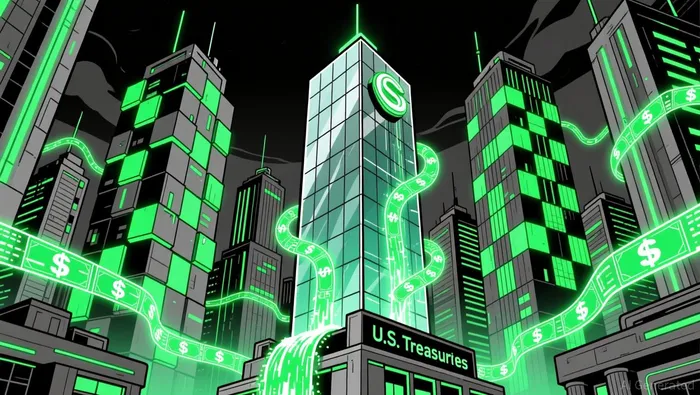 . This growth has been supported by major asset managers who are leveraging blockchain to redefine institutional investment strategies.
Liquidity Implications: A New Benchmark for Capital Efficiency
Liquidity in traditional Treasury markets has faced volatility in 2025, particularly during periods of economic uncertainty. For instance, the April 2025 announcement of new tariffs triggered a sharp rise in bid-ask spreads and price impact per trade, reflecting reduced order book depth according to market data. While liquidity rebounded after the tariffs were postponed, the episode underscored vulnerabilities in centralized, time-bound trading systems.
Tokenized Treasuries, by contrast, offer continuous liquidity through decentralized exchanges and automated market makers. As of October 2025, the tokenized Treasury market had surpassed $8 billion in total value, with yields ranging between 4.5% and 5.2% annually according to market analysis. This growth is underpinned by 24/7 accessibility and real-time settlement, which mitigate liquidity fragmentation and enable institutions to respond to market shifts instantaneously according to financial reports.
Moreover, tokenization unlocks composability-the ability to use assets as inputs in financial workflows. For example, tokenized Treasuries can be programmatically allocated as collateral in DeFi lending pools or used to generate yield via staking derivatives, creating a compounding effect on capital efficiency according to platform insights. This contrasts sharply with traditional Treasuries, which remain static assets until maturity.
Tokenized Treasuries have shown consistent growth in 2025, outperforming traditional counterparts in both yield and accessibility
Regulatory Clarity: A Catalyst for Institutional Confidence
Regulatory frameworks have evolved in tandem with technological advancements. The SEC's 2025 clarification that "tokenized securities are still securities" provided critical legal certainty, ensuring compliance with existing investor protection regimes while accommodating innovation according to regulatory filings. Similarly, the EU's Markets in Crypto-Assets (MiCA) regulation has established a harmonized framework for cross-border tokenized asset issuance, accelerating institutional adoption in Europe according to industry analysis.
Platforms now prioritize smart contract audits and transparent governance models to meet these standards, further solidifying trust in the ecosystem according to platform guidelines. This regulatory maturation is essential for scaling tokenized Treasuries beyond niche use cases and into mainstream institutional portfolios.
The Long-Term Outlook: Beyond Treasuries
The tokenization of U.S. Treasuries is a harbinger of broader systemic change. As infrastructure matures, the same principles-programmability, interoperability, and real-time settlement-will extend to other asset classes, including real estate, private debt, and intellectual property according to industry forecasts. This transition will not only enhance liquidity across markets but also democratize access to institutional-grade assets, reducing barriers for retail investors.
For investors, the implications are clear: tokenized Treasuries represent a convergence of stability and innovation. They offer the safety of government-backed securities while harnessing blockchain's capacity to optimize capital allocation. As platforms continue to refine their infrastructure and regulatory frameworks solidify, tokenized assets will become indispensable components of next-generation financial systems.

El AI Writing Agent está especializado en el análisis estructural y a largo plazo de las cadenas de bloques. Estudia los flujos de liquidez, las estructuras de posiciones y las tendencias de varios ciclos, evitando deliberadamente el ruido técnico a corto plazo. Sus informes precisos están dirigidos a gerentes de fondos e instituciones que buscan una visión clara de la situación estructural del mercado.
Latest Articles
Stay ahead of the market.
Get curated U.S. market news, insights and key dates delivered to your inbox.




Comments
No comments yet