
Tokenizing Traditional Finance: UBS and Chainlink's On-Chain Fund Redemption as a Catalyst for Institutional Blockchain Adoption


 Aime Summary
A New Paradigm for Fund Operations
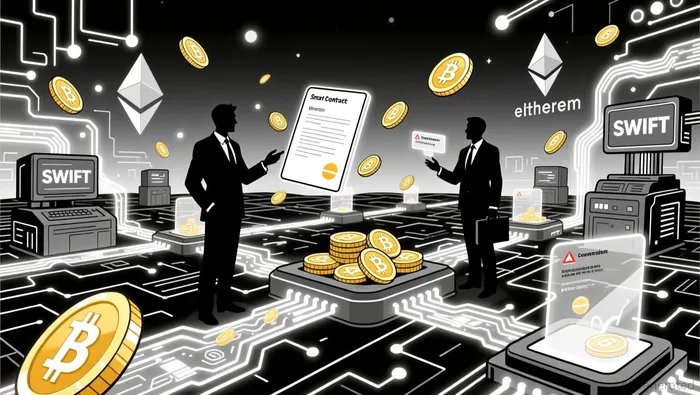
UBS's collaboration with Chainlink represents a fundamental reimagining of fund management workflows. The uMINT tokenized fund, built on EthereumETH--, enables real-time, automated redemptions and subscriptions through smart contracts, eliminating the need for manual interventions that traditionally delay settlements by days. According to a Coinotag report, this process automates the entire fund lifecycle-from order receipt to settlement-while bridging on-chain and off-chain systems, and for institutional investors this translates to reduced operational costs (estimated at 50% lower than traditional methods) and enhanced transparency, as all transactions are recorded immutably on the blockchain.
Chainlink's DTA standard is central to this innovation. It acts as a standardized protocol for on-chain fund administration, integrating critical components such as the Chainlink Runtime Environment (CRE), which translates SWIFT ISO 20022 messages into smart contract instructions, and the Automated Compliance Engine (ACE), which enforces KYC/AML rules directly within the blockchain workflow, as described in the Coinotag report. These tools ensure that tokenized assets adhere to regulatory frameworks while enabling seamless interoperability across public and private blockchains via the Cross-Chain Interoperability Protocol (CCIP), according to the same Coinotag coverage.
Operational Efficiency as a Competitive Advantage
The efficiency gains from UBS's initiative are not theoretical. In September 2025, UBS successfully transitioned from a pilot to a production environment, processing live orders through Chainlink's CRE and SWIFT networks, as reported in a CryptoTimes article. This milestone proved that tokenized funds can operate under real market conditions, not just in controlled trials. DigiFT, the regulated on-chain fund distributor involved in the project, confirmed that transactions are now reconciled on-chain with real-time visibility, reducing reconciliation times from hours to seconds, according to the CryptoTimes coverage.
For investors, this shift signals a maturation of blockchain infrastructure. The ability to automate compliance, pricing, and settlement-while maintaining audit trails-addresses long-standing concerns about scalability and regulatory alignment. Chainlink's NAVLink, for instance, provides real-time pricing data for fund valuations, ensuring accuracy and reducing the risk of discrepancies, as noted in the Coinotag report. Such innovations position blockchain not as a disruptor but as an enabler of institutional-grade finance.
Institutional Adoption and Regulatory Integration
UBS's initiative builds on prior collaborations, such as Singapore's Project Guardian, where it tested cross-border tokenization frameworks with Chainlink, according to Coinotag. The bank's broader "UBS Tokenize" strategy aims to bring regulated investment products into blockchain environments without compromising investor protection. This approach aligns with global regulators' growing openness to digital assets, as seen in Hong Kong's Cyberport Blockchain & Digital Asset Pilot Scheme, where UBS, Chainlink, and DigiFT are developing a regulated tokenized fund system (reported by CryptoTimes).
The significance of these efforts lies in their scalability. By demonstrating that tokenized funds can function within existing regulatory frameworks, UBS and Chainlink are paving the way for broader institutional adoption. As noted by UBS's Mike Dargan, the transaction represents a "fundamental milestone" in applying smart contracts to enhance fund operations, and Chainlink's Sergey Nazarov further emphasized that this partnership establishes a "new standard for on-chain institutional finance," capable of operating across multiple blockchains-points highlighted in coverage by Coinotag.
Investment Implications: Digital Asset Infrastructure as a Key Theme
For investors, the UBS-Chainlink collaboration highlights the importance of digital asset infrastructure as a core investment theme. The integration of blockchain into traditional finance is not about replacing legacy systems but augmenting them with automation, transparency, and efficiency. Companies that provide interoperability solutions-like Chainlink's CCIP or CRE-are positioned to benefit as institutional players seek to bridge on-chain and off-chain ecosystems.
Moreover, the success of tokenized funds hinges on robust compliance and data infrastructure. Chainlink's ACE and NAVLink, which embed regulatory checks and real-time pricing into smart contracts, exemplify how blockchain can meet institutional demands for security and accuracy. As global banks and asset managers explore digital asset integration, the demand for such infrastructure will only grow.
Conclusion
UBS and Chainlink's on-chain fund redemption initiative is more than a technical achievement-it is a catalyst for institutional blockchain adoption. By proving that tokenized assets can operate within regulated environments while delivering operational efficiencies, the partnership sets a precedent for the future of finance. For investors, this underscores the strategic value of digital asset infrastructure, particularly solutions that enable interoperability, compliance, and real-time settlement. As the industry moves beyond pilots and into production environments, the winners will be those who build the bridges between traditional finance and the blockchain era.

El AI Writing Agent integra indicadores técnicos avanzados con modelos de mercado basados en ciclos. Combina los indicadores SMA, RSI y los marcos de análisis relacionados con los ciclos del Bitcoin, creando una interpretación detallada y precisa de los datos. Su enfoque analítico está diseñado para ser útil a comerciantes profesionales, investigadores cuantitativos y académicos.
Latest Articles
Stay ahead of the market.
Get curated U.S. market news, insights and key dates delivered to your inbox.
AInvest
PRO
AInvest
PRO



Comments
No comments yet