
Tokenizing Real Assets: Capturing the $30 Trillion Opportunity with REAL and Blockchain Infrastructure


 Aime Summary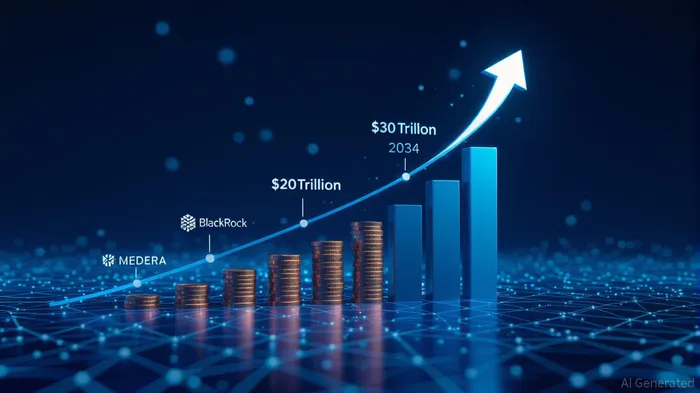
The tokenization of real-world assets (RWAs) is no longer a speculative experiment—it is a seismic shift in global finance. By 2025, the RWA tokenization market has already surged to $24 billion, with projections suggesting it could balloon to $30 trillion by 2034 [1]. This explosive growth is driven by institutional adoption, regulatory clarity, and the inherent advantages of blockchain technology: liquidity, transparency, and efficiency. For investors, the opportunity lies not just in tokenized assets themselves but in the blockchain infrastructure enabling this transformation.
The Catalysts for Growth
Three forces are accelerating RWA tokenization:
1. Institutional Demand: Major players like BlackRockBLK--, JPMorganJPM--, and ApolloAPO-- have entered the space, tokenizing high-yield assets such as U.S. Treasuries and private credit. BlackRock’s BUIDL fund alone holds $2.88 billion in tokenized assets [2].
2. Regulatory Tailwinds: Jurisdictions like the U.S., Singapore, and Dubai have introduced frameworks to integrate RWAs into traditional and decentralized finance, reducing legal friction [3].
3. Technological Infrastructure: Platforms like Ethena, Maple, and Spark are building bridges between tokenized assets and DeFi, unlocking new liquidity pools [4].
Strategic Investment Opportunities
1. Blockchain Protocols as Infrastructure
The backbone of RWA tokenization is blockchain infrastructure. Protocols like Hedera and Ethereum are becoming critical infrastructure for asset tokenization, enabling secure, scalable, and interoperable systems [5]. For example, Hedera’s hashgraph technology is being adopted by RWA platforms to handle high-volume transactions with sub-second finality [6].
2. Tokenized Real Estate and Commodities
Real estate tokenization is projected to reach $3 trillion by 2030, with fractional ownership models democratizing access to high-value assets [7]. Platforms like Ondo Finance are pioneering institutional-grade tokenization of U.S. Treasuries and commercial real estate, with their Ondo Global Markets platform aiming to unlock $10 trillion in previously illiquid assets [8].
3. Private Credit and Yield Opportunities
Tokenized private credit dominates the RWA market with $14.7 billion in assets under management, offering investors access to high-yield, non-correlated returns [9]. Platforms like Maple and Spark are leveraging blockchain to tokenize corporate loans and structured credit products, bypassing traditional intermediaries [10].
Risks and Mitigations
While the potential is vast, risks remain:
- Regulatory Uncertainty: Though frameworks are emerging, cross-border compliance challenges persist.
- Market Volatility: Tokenized assets are still nascent, with liquidity risks in early-stage markets.
- Technical Complexity: Smart contract vulnerabilities and interoperability issues require robust infrastructure.
However, these risks are being addressed through:
- Regulatory Sandboxes (e.g., the UK’s Digital Security Sandbox).
- Insurance Protocols (e.g., Nexus Mutual for DeFi risk coverage).
- Standardization Efforts (e.g., ISO standards for tokenized asset governance).
The Path Forward
The $30 trillion RWA opportunity is not a distant dream—it is a present-day investment thesis. For investors, the key is to allocate capital to:
- Blockchain Protocols (e.g., EthereumETH--, Hedera) that underpin tokenization infrastructure.
- Tokenized Asset Platforms (e.g., Ondo Finance, Ethena) with institutional-grade offerings.
- Regulatory Advocacy Funds that accelerate global adoption.
As the lines between traditional finance and blockchain blur, early movers will capture disproportionate value. The question is no longer if RWAs will disrupt finance—but how quickly and who will lead the charge.
Source:
[1] RWA Tokenization Market Has Grown Almost Fivefold to ...,
https://www.coindesk.com/business/2025/06/26/real-world-asset-tokenization-market-has-grown-almost-fivefold-in-3-years
[2] Q2 2025 RWA Tokenization Market Report,
https://www.investax.io/blog/q2-2025-rwa-tokenization-market-report
[3] Tokenization of Real-World Assets,
https://katten.com/tokenization-of-real-world-assets-opportunities-challenges-and-the-path-ahead
[4] Real-World Assets in Onchain Finance Report - RedStone blog,
https://blog.redstone.finance/2025/06/26/real-world-assets-in-onchain-finance-report/
[5] RWA Tokenization Platforms Swarm and KAIO Turn to ...,
https://www.ccn.com/news/technology/rwa-tokenization-hedera-swarm-kaio/
[6] Pioneering the $30 Trillion Tokenized Asset Revolution,
https://www.ainvest.com/news/ondo-finance-ondo-pioneering-30-trillion-tokenized-asset-revolution-2508/
[7] Real Estate Tokenization in 2025: Facts and Trends,
https://www.scnsoft.com/finance/tokenization-to-redefine-investing-in-real-estate
[8] Tokenized real estate | Deloitte Insights,
https://www.deloitte.com/us/en/insights/industry/financial-services/financial-services-industry-predictions/2025/tokenized-real-estate.html
[9] Q2 2025 RWA Tokenization Market Report,
https://www.investax.io/blog/q2-2025-rwa-tokenization-market-report
[10] Real-World Asset Tokenization: Benefits & Guide 2025,
https://4irelabs.com/articles/real-world-asset-tokenization/

Decoding blockchain innovations and market trends with clarity and precision.
Latest Articles
Stay ahead of the market.
Get curated U.S. market news, insights and key dates delivered to your inbox.




Comments
No comments yet