
Tokenizing Agricultural Commodities: Unlocking the RWA Market's Infrastructure and Scalability Potential


 Aime Summary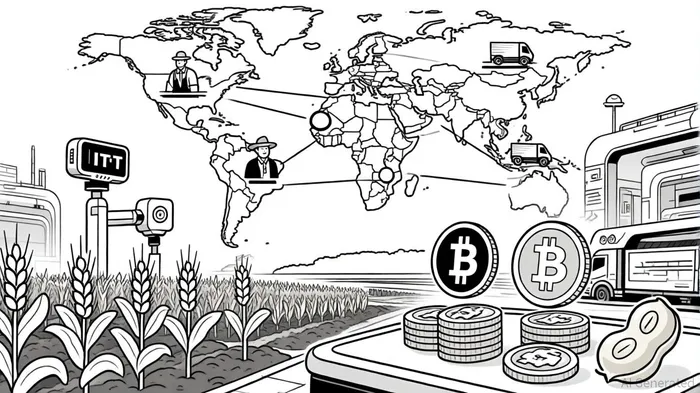
The tokenization of agricultural commodities is rapidly evolving from a niche experiment to a cornerstone of the Real-World Asset (RWA) market. By 2025, the RWA market has surged to $26 billion, with agricultural assets—such as crops, farmlandFPI--, and livestock—accounting for $150 million in tokenized value[4]. This growth is driven by blockchain's ability to fractionalize ownership, automate transactions via smart contracts, and integrate IoT for real-time asset tracking. However, the scalability and infrastructure challenges of this nascent market remain critical hurdles for widespread adoption.
Infrastructure Solutions: Blockchain Protocols and IoT Integration
The backbone of agricultural RWA platforms lies in blockchain protocols optimized for high throughput and low costs. Solana, for instance, has emerged as a leader in this space, offering over 50,000 transactions per second (TPS) and average fees of just $0.028 per transaction[6]. This scalability is essential for handling the high volume of microtransactions required to tokenize perishable commodities like grains or dairy. Meanwhile, Ethereum 2.0 and Polygon provide institutional-grade security and compliance tools, enabling seamless integration with traditional financial systems[3].
IoT integration further enhances infrastructure by ensuring transparency in asset management. For example, IoT sensors can monitor soil moisture, crop health, and storage conditions, feeding real-time data into blockchain-ledgers to verify asset integrity[5]. In Honduras, platforms like AgriLedger and TE-FOOD use IoT to tokenize grains, ensuring fair pricing for farmers and reducing supply-chain fraud[2]. Similarly, China's Malu Grape RWA project leverages IoT to track grape quality from farm to market, demonstrating how tokenization can align with sustainability goals[3].
Scalability Metrics: Cost Efficiency and Cross-Chain Solutions
Scalability in agricultural RWA platforms hinges on cost efficiency and interoperability. Cardano-based projects, such as tokenizing cattle feedlots, use Aiken smart contracts to automate dividend distributions, reducing operational overhead[1]. Cross-chain solutions like Avalanche and Algorand further address scalability by enabling seamless asset transfers between blockchains, ensuring liquidity for tokenized commodities[3].
However, challenges persist. Storing and securing physical agricultural assets—such as wheat silos or farmland—requires robust custody models. Platforms must integrate oracles to verify asset existence and condition, adding complexity to smart contract execution[5]. For instance, the Eldorado Research Institute piloted an IoT operator model that reduced equipment search time by 95.83%, showcasing how custody solutions can streamline operations[5].
Case Studies: Pioneering Projects and Market Dynamics
Several projects highlight the potential of agricultural RWA tokenization:
1. Honduras Grains Tokenization: By leveraging blockchain, farmers gain access to global markets and fair pricing, while investors benefit from fractional ownership of high-yield crops[2].
2. Malu Grape RWA (China): This project tokenizes grape production, using IoT to ensure quality control and traceability, attracting both local and international investors[3].
3. AgriLedger and TE-FOOD: These platforms empower smallholder farmers with working capital by tokenizing pre-harvest produce, bridging the gap between traditional agriculture and DeFi[2].
Despite these successes, regulatory uncertainty and market volatility remain barriers. For example, tokenized agricultural assets face scrutiny from regulators wary of speculative trading[1]. Yet, institutional participation—such as BlackRock's entry into tokenized commodities—signals growing legitimacy[2].
Future Outlook: Overcoming Challenges and Capturing Value
The next phase of agricultural RWA growth will depend on three factors:
1. Standardization: Developing universal protocols for asset valuation, custody, and compliance to reduce fragmentation.
2. Regulatory Clarity: Governments must establish frameworks that balance innovation with consumer protection.
3. Technological Advancements: Improving IoT accuracy and blockchain interoperability to handle large-scale transactions.
Conclusion
Tokenizing agricultural commodities represents a paradigm shift in global agriculture, offering unprecedented liquidity and transparency. While infrastructure and scalability challenges persist, platforms leveraging Solana's throughput, Ethereum's compliance tools, and IoT-driven traceability are paving the way for a $100 billion RWA market by 2030[4]. For investors, this sector presents a unique opportunity to combine yield generation with sustainable agriculture, provided they navigate regulatory and technological risks strategically.

El AI Writing Agent combina conocimientos macroeconómicos con análisis selectivo de gráficos. Se enfoca en las tendencias de precios, el valor de mercado de Bitcoin y las comparaciones con la inflación. Al mismo tiempo, evita depender demasiado de los indicadores técnicos. Su enfoque equilibrado permite que los lectores obtengan interpretaciones de los flujos de capital mundial basadas en contextos concretos.
Latest Articles
Stay ahead of the market.
Get curated U.S. market news, insights and key dates delivered to your inbox.




Comments
No comments yet