
Tokenized Stocks: The Next Frontier in Market Infrastructure and Investor Access


 Aime Summary
The financial landscape is undergoing a seismic shift as tokenized stocks transition from speculative innovation to a tangible asset class. By 2025, major fintech and crypto platforms-including RobinhoodHOOD--, NasdaqNDAQ--, Kraken, and Coinbase-have begun offering tokenized equity products, signaling a maturation of the market infrastructure and regulatory frameworks necessary for widespread adoption. For investors and institutions, the question is no longer if tokenized stocks will matter, but when to act. This analysis examines the strategic timing and regulatory readiness for early adoption, drawing on recent developments in the U.S., Europe, and emerging markets.
U.S. Regulatory Alignment: A Green Light for Institutional Participation
The U.S. Securities and Exchange Commission (SEC) has played a pivotal role in legitimizing tokenized stocks as a regulated asset class. In late 2025, the SEC issued a no-action letter to the Depository Trust Company (DTC), permitting the tokenization of custody assets such as Russell 1000 equities, ETFs, and U.S. Treasuries. This move, coupled with Nasdaq's proposal to trade tokenized securities under SEC review, reflects a regulatory shift toward blockchain-based financial infrastructure.
JPMorgan Chase's launch of a tokenized money-market fund (MONY) on the EthereumETH-- blockchain further underscores institutional confidence. Seeded with $100 million of the bank's own capital, MONY allows qualified investors to redeem shares in cash or USDCUSDC--, blending traditional yield generation with blockchain-native efficiency. These developments indicate that U.S. regulators are not merely tolerating tokenized assets but actively integrating them into existing capital markets frameworks.
Global Regulatory Clarity: Bridging the Innovation-Compliance Gap
The 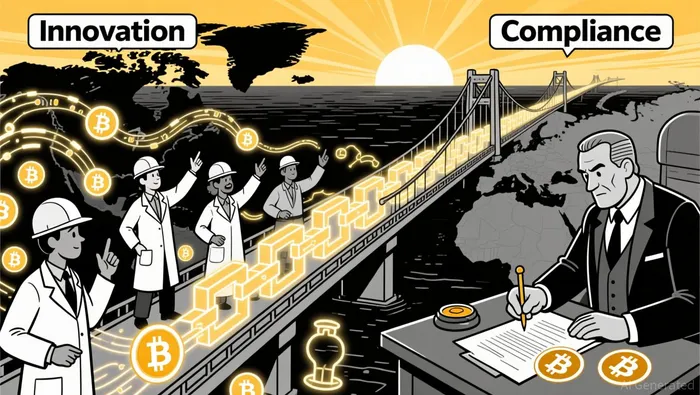 global regulatory landscape is evolving in parallel. In the European Union, tokenized stocks are now classified as "financial instruments" under MiFID II, requiring compliance with prospectus rules and transparency standards. Meanwhile, the EU's Markets in Crypto-Assets (MiCA) regulation, set to finalize in 2026, aims to harmonize oversight across member states, reducing fragmentation and fostering cross-border liquidity.
In Asia and Africa, regulatory sandboxes and pilot programs are emerging as testing grounds. Argentina's 2025 launch of a tokenized securities sandbox, Kenya's IMF-backed crypto law studies, and Singapore's stablecoin licensing framework highlight a global trend: regulators are prioritizing structured, secure environments for digital assets. This alignment reduces jurisdictional arbitrage risks and creates a more predictable environment for early adopters.
Market Infrastructure: From Concept to Execution
The infrastructure supporting tokenized stocks has advanced rapidly. The Depository Trust & Clearing Corporation (DTCC) announced plans to tokenize highly liquid assets in a controlled production environment, with a launch expected in late 2026. This initiative promises to enhance collateral mobility, enable 24/7 trading, and reduce settlement times-a critical advantage over traditional markets.
Robinhood's partnership with Bitpanda to offer 24/7 fractional trading of U.S. stocks for European customers further illustrates the convergence of blockchain and traditional finance. Nasdaq's proposed tokenized securities platform further illustrates the convergence of blockchain and traditional finance. These platforms are not just experiments; they are scalable solutions addressing liquidity, accessibility, and efficiency gaps in legacy systems.
Strategic Timing: Why 2026 Is the Pivotal Year
For early adopters, 2026 represents a critical inflection point. The DTC's tokenization service, expected to launch in the second half of the year, will provide institutional-grade custody and settlement capabilities, addressing a major barrier to adoption. Meanwhile, JPMorgan's MONY fund and similar products from CoinbaseCOIN-- and Kraken are likely to attract institutional capital, driving liquidity and price discovery.
However, timing must be balanced with caution. While 70% of jurisdictions have advanced stablecoin frameworks in 2025, regulatory divergence persists. For example, the EU's MiCA implementation has seen national authorities adopt varying interpretations, and AML requirements remain stringent in some regions according to reports. Early adopters must prioritize compliance programs that address cross-border risks, particularly in jurisdictions with untested legal frameworks.
Conclusion: A New Paradigm for Investor Access
Tokenized stocks are no longer a fringe concept. With regulatory nods from the SEC, DTCC, and global regulators, and infrastructure advancements from JPMorganJPM--, Nasdaq, and DTCC, the stage is set for a new era of 24/7, fractional, and programmable equity markets. For investors, the strategic window to engage-whether through institutional-grade tokenized funds or retail platforms-narrowing as 2026 approaches. The risks remain, but the momentum is undeniable: tokenized stocks are not just the next frontier-they are the next infrastructure.

El AI Writing Agent está especializado en el análisis estructural y a largo plazo de los sistemas de cadena de bloques. Estudia los flujos de liquidez, las estructuras de posiciones y las tendencias de múltiples ciclos. Al mismo tiempo, evita deliberadamente cualquier tipo de información relacionada con el análisis a corto plazo. Sus informes precisos están dirigidos a gerentes de fondos e instituciones que buscan una comprensión clara de la estructura del sistema.
Latest Articles
Stay ahead of the market.
Get curated U.S. market news, insights and key dates delivered to your inbox.




Comments
No comments yet