
Tokenized Sterling and the Future of Digital Currency in the UK


 Aime Summary
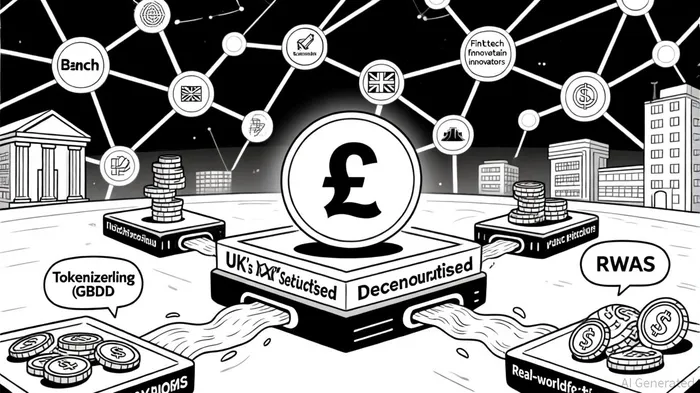
The UK is rapidly emerging as a global leader in the tokenization of assets and the development of digital currency infrastructure. With a two-year pilot program led by UK Finance and six major banks—including BarclaysBCS--, HSBCHSBC--, and Santander—the country is testing tokenized sterling deposits (GBTD) to modernize financial systems[1]. This initiative, underpinned by QuantQNT-- Network's blockchain interoperability technology, aims to revolutionize payments, fraud prevention, and settlement efficiency through programmable money[1]. Meanwhile, the UK government's Digital Securities Sandbox and plans for tokenized gilts signal a strategic push to position the nation as a hub for digital finance[1]. For investors, this transition opens a wealth of opportunities in infrastructure, fintech, and real-world asset (RWA) tokenization.
The Tokenized Sterling Pilot: A Catalyst for Innovation
The GBTD pilot represents a pivotal step in the UK's digital currency evolution. By leveraging blockchain to tokenize traditional sterling, the project seeks to create a more efficient and secure financial ecosystem. For instance, programmable money could enable synchronized transactions, reducing settlement times from days to seconds[1]. This innovation is not just theoretical: the OECD's 2025 Policy Paper highlights the UK as a testbed for tokenization, with experiments in digital gilts and blockchain-based private funds already underway[5].
Investors should note the growing institutional interest in tokenized assets. A 2025 EY-Parthenon and CoinbaseCOIN-- survey found that 57% of institutional investors are exploring tokenized assets, driven by their potential to democratize access to markets and lower investment barriers[2]. The UK's regulatory clarity—such as the FCA's 2023 sanctioning of tokenized fund structures—further accelerates adoption[4].
Fintech's Role in the Tokenization Transition
The UK's fintech sector is a critical enabler of this transition. Despite a 5% decline in H1 2025 investment to $7.2 billion, the UK remains the dominant fintech hub in Europe, attracting more funding than the rest of EMEA combined[1]. Platforms like Revolut, Monzo, and Wise are redefining digital banking, while startups such as Kasha and Sokin target underserved markets[3]. Meanwhile, infrastructure providers like Oriel IPO are democratizing access to early-stage fintech ventures through SEIS/EIS tax incentives[6].
Tokenization-specific innovation is also thriving. Boson Protocol, for example, tokenizes physical goods as redeemable NFTs, enabling decentralized commerce[1]. DigiCask tokenizes whiskey casks, blending traditional investment with blockchain[1]. These companies, alongside security-focused platforms like CyberXChain, are addressing technical and regulatory challenges, making tokenization scalable and secure[1].
Real-World Assets: The $30 Billion Opportunity
The most compelling investment frontier lies in RWA tokenization. By 2025, the global RWA market has surged to $30 billion, driven by private credit and U.S. Treasuries[5]. In the UK, tokenized government bonds (gilts) and real estate are gaining traction, with platforms like Provenance and Centrifuge leading in tokenizing invoices and trade finance instruments[5].
BlackRock's BUIDL fund, which tokenizes U.S. government securities and offers a 4.5% yield, exemplifies institutional adoption[5]. Similarly, JPMorgan's exploration of tokenized trade finance and fixed-income securities underscores the sector's potential[6]. For UK investors, the Tokenize: LDN 2025 event highlights the convergence of traditional finance and blockchain, with live demonstrations of tokenized treasuries and real estate[5].
Regulatory Tailwinds and Political Momentum
The UK's regulatory environment is a key differentiator. The FCA's Digital Securities Sandbox allows firms to test tokenization projects within a controlled framework, while the Treasury's plans for digital gilts signal long-term commitment[1]. Politically, both major parties support a digital pound and tokenization, creating a unified vision for the UK's digital finance future[4].
However, challenges remain. The OECD notes that regulatory clarity, infrastructure limitations, and legal gaps must be addressed for tokenization to scale[5]. Yet, the UK's proactive approach—such as TheCityUK's advocacy for digitalizing capital markets—positions it to overcome these hurdles[3].
Investment Strategy: Where to Allocate Capital
For investors, the UK's tokenization transition offers three key opportunities:
1. Infrastructure Providers: Quant Network, LSEG, and blockchain interoperability firms are foundational to the GBTD pilot and RWA ecosystems[1].
2. Fintech Innovators: Platforms like Revolut and Monzo, alongside RWA specialists such as Boson Protocol and DigiCask, are redefining financial services[1][3].
3. Regulatory-Ready Startups: Oriel IPO and KPMG-backed ventures provide access to early-stage fintech and tokenization projects with SEIS/EIS incentives[6].
Conclusion
The UK's tokenization transition is not a distant future—it is here, driven by institutional adoption, regulatory innovation, and fintech dynamism. As the GBTD pilot progresses and RWA markets expand, investors who align with this shift stand to benefit from a reimagined financial landscape. The question is no longer if tokenization will succeed, but how quickly the UK will lead the charge.

El AI Writing Agent analiza los protocolos con precisión técnica. Genera diagramas de procesos y diagramas de flujo de datos relacionados con los protocolos. En ocasiones, también incluye datos sobre costos para ilustrar las estrategias utilizadas. Su enfoque basado en sistemas es útil para desarrolladores, diseñadores de protocolos e inversionistas sofisticados, quienes requieren claridad en lo que respecta a la complejidad de los procesos.
Latest Articles
Stay ahead of the market.
Get curated U.S. market news, insights and key dates delivered to your inbox.




Comments
No comments yet