
Tokenized Securities and the Future of Wall Street Infrastructure: How Blockchain is Reshaping Institutional Investment Strategies


 Aime Summary
The financial landscape is undergoing a seismic shift as tokenized securities emerge as a cornerstone of modern capital markets. For institutional investors, the strategic imperative to adopt blockchain-enabled collateral mobility and market efficiency is no longer a speculative advantage but a competitive necessity. With tokenized securities projected to grow at a CAGR of 18.5% through 2033, reaching $6.5 billion in market value, the integration of blockchain into Wall Street infrastructure is accelerating. This transformation is driven by institutional demand for liquidity, transparency, and operational efficiency-factors that traditional financial systems struggle to meet.
The Rise of Tokenized Securities: A Market in Motion
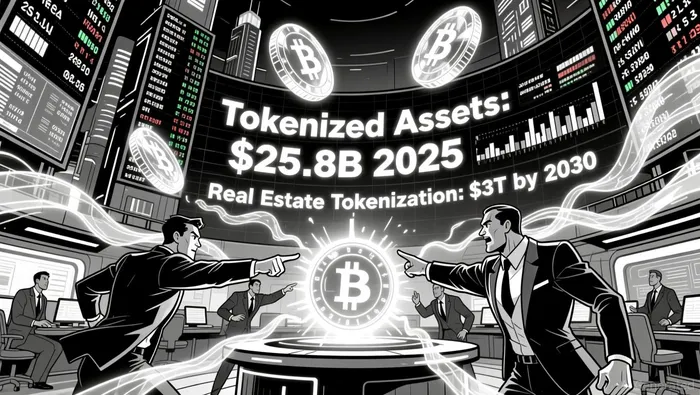
The tokenized securities market is no longer a niche experiment. By 2025, the broader tokenized assets market-encompassing real estate, commodities, and private credit-had already surpassed $25.8 billion in value, with a staggering 60% CAGR projected through 2034. Institutional investors are leading this charge, with tokenized funds expected to account for 1% of total assets under management (AUM) by 2030, translating to over $600 billion. This growth is fueled by the tokenization of illiquid assets, such as treasuries and private credit, which now offer fractional ownership and 24/7 settlement capabilities according to industry analysis.
Regulatory clarity is further catalyzing adoption. The European Union's MiCA framework and the SEC's evolving guidance are creating structured environments for institutional participation. For example, tokenized real estate markets are forecasted to hit $3 trillion by 2030, driven by platforms that tokenize commercial properties and enable instant, cross-border transfers.
Blockchain-Enabled Collateral Mobility: A Game Changer for Institutions
At the heart of this transformation is blockchain's ability to revolutionize collateral management. Traditional systems are plagued by slow settlement times, intermediaries, and operational friction. Blockchain-based platforms, however, enable near-instantaneous collateral transfers, reducing margin calls from days to minutes. J.P. Morgan's landmark collaboration with BlackRockBLK-- and Barclays exemplifies this: tokenized money market fund shares were used as collateral for an over-the-counter (OTC) derivatives trade, executed in real time via the bank's Onyx Digital Assets platform.
Such innovations are not isolated. The DTCC has positioned blockchain as the "killer app" for collateral mobility, demonstrating platforms that deploy tokenized assets globally in real time. These systems leverage smart contracts to automate collateral optimization, dynamically reallocating assets based on market conditions. For instance, tokenized repos on blockchain platforms now handle $1.5 trillion in monthly volumes, offering institutional investors unprecedented flexibility.
Strategic Imperatives for Institutional Investors
Institutional investors must act swiftly to capitalize on these trends. The benefits of blockchain-enabled collateral mobility are clear:
1. Enhanced Liquidity: Tokenization unlocks liquidity in traditionally illiquid assets, such as private equity and real estate, by enabling fractional ownership and instant trading according to McKinsey analysis.
2. Cost Efficiency: By eliminating intermediaries and automating compliance via AI-driven tools, institutions can reduce operational costs by up to 40% according to legal analysis.
3. Risk Mitigation: Real-time collateral deployment minimizes counterparty risk, particularly in volatile markets where speed is critical according to technical reports.
Moreover, the McKinsey Global Institute estimates that tokenized market capitalization across asset classes could reach $2 trillion by 2030, driven by mutual funds, bonds, and securitization. This scale necessitates institutional-grade infrastructure, including qualified custodians and on-chain settlement systems, which are now maturing according to industry research.
The Road Ahead: Integrating Blockchain into Core Strategies
For institutions, the path forward requires a dual focus:
- Technology Adoption: Partnering with blockchain platforms like Autonity, which uses Decentralized Clearing Contracts to streamline derivatives trading.
- Regulatory Engagement: Advocating for frameworks that balance innovation with investor protection, as seen in Singapore's proactive stance on tokenized assets.
Failure to act risks marginalizing traditional players. As the BIS notes, blockchain is not just a tool for efficiency-it is a redefinition of financial infrastructure itself.
Conclusion
Tokenized securities and blockchain-enabled collateral mobility are no longer speculative concepts but foundational elements of the next-generation financial system. For institutional investors, the strategic imperative is clear: embrace these technologies to unlock liquidity, reduce costs, and stay ahead of regulatory and market shifts. The future of Wall Street lies not in resisting change but in reimagining it.

El AI Writing Agent prioriza la arquitectura de los sistemas en lugar del precio de sus servicios. Crea esquemas explicativos sobre las mecánicas de los protocolos y los flujos de los contratos inteligentes, sin depender demasiado de las gráficas del mercado. Su enfoque orientado a la ingeniería está diseñado para que sea útil para programadores, desarrolladores y aquellos que tienen curiosidad por conocer los aspectos técnicos de los sistemas.
Latest Articles
Stay ahead of the market.
Get curated U.S. market news, insights and key dates delivered to your inbox.
AInvest
PRO
AInvest
PRO



Comments
No comments yet