
Tokenized Fund Trading: The Next Frontier in Digital Asset Infrastructure, Powered by Ripple, DBS, and Franklin Templeton


 Aime Summary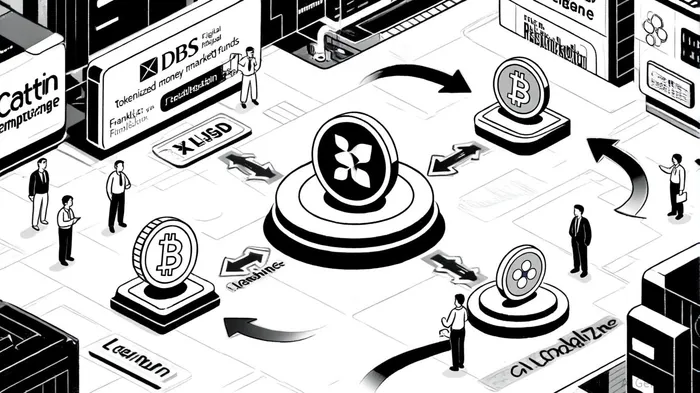
The digital assetDAAQ-- market is no longer just about speculative crypto trading or NFTs—it's about redefining financial infrastructure. At the forefront of this shift is a groundbreaking collaboration between Ripple, DBS Bank, and Franklin Templeton, which is pioneering tokenized fund trading and lending solutions for institutional investors. This partnership isn't just a product launch; it's a seismic step toward mainstream adoption of onchain finance, leveraging the XRPXRP-- Ledger's (XRPL) speed and efficiency to unlock new liquidity and utility for tokenized assets.
A New Era of Institutional Onchain Participation
The trio's initiative centers on sgBENJI, the tokenized version of Franklin Templeton's U.S. Dollar Short-Term Money Market Fund, listed alongside Ripple's RLUSD stablecoin on DBS Digital Exchange (DDEx) [1]. This integration allows institutional investors to toggle between a stablecoin and a yield-generating fund in real time, enabling dynamic portfolio rebalancing during volatile market conditions [2]. For context, money market funds are a $4.5 trillion asset class in the U.S. alone, and tokenizing them opens the door to programmable, 24/7 accessibility—a stark contrast to traditional fund structures constrained by banking hours and settlement delays.
The innovation doesn't stop at trading. In the next phase, DBS plans to explore using sgBENJI tokens as collateral for credit facilities, either directly through the bank or via third-party platforms where DBS acts as a collateral agent [3]. This move bridges the gap between tokenized assets and traditional credit markets, addressing a critical pain point: how to unlock liquidity without selling underlying assets.
Why XRP Ledger? Speed, Efficiency, and Scalability
Franklin Templeton's choice of the XRP Ledger for tokenizing sgBENJI is no accident. The XRPL's sub-3-second finality, negligible transaction fees, and energy efficiency make it uniquely suited for high-frequency institutional use cases [4]. Compare this to Ethereum's gas costs or Bitcoin's settlement times, and the XRPL emerges as a pragmatic backbone for next-gen financial infrastructure.
This partnership underscores a broader trend: institutional players are prioritizing utility over hype. As one industry analyst noted, “The XRP Ledger's deterministic finality and low cost are game-changers for tokenized asset markets, where speed and scalability are non-negotiable” [4].
Market Demand: Institutions Can't Wait for the Future
The urgency behind these innovations is fueled by surging demand. According to a recent survey, 87% of institutional investors plan to allocate funds to digital assets in 2025 [5]. This isn't speculative frenzy—it's a calculated response to the growing need for yield in a low-interest-rate environment and the desire to diversify into non-correlated assets.
Tokenized fund trading addresses these needs head-on. By enabling instant settlement, fractional ownership, and programmable smart contracts, it reduces counterparty risk and operational friction. For example, sgBENJI's tokenization allows Franklin Templeton to offer investors daily liquidity without the overhead of traditional fund redemptions [2].
The Bigger Picture: Infrastructure as the New Competitive Edge
Ripple, DBS, and Franklin Templeton's collaboration is more than a pilot—it's a blueprint for the future of asset tokenization. By integrating stablecoins, money market funds, and credit facilities into a single onchain ecosystem, they're building the rails for a composable financial system where assets are liquid, interoperable, and globally accessible.
This infrastructure innovation is critical for scaling digital asset markets. As the Bank for International Settlements (BIS) has noted, “The next wave of financial innovation will be defined by the ability to tokenize and automate value transfer” . While the BIS didn't mention Ripple or sgBENJI specifically, their work aligns perfectly with this vision.
Conclusion: The Onchain Revolution Is Here
The Ripple-DBS-Franklin Templeton partnership isn't just about tokenizing a money market fund—it's about reimagining how capital moves. By combining the XRP Ledger's infrastructure with institutional-grade financial products, they're proving that tokenized assets can coexist with (and even enhance) traditional markets.
For investors, this signals a pivotal moment: the infrastructure to support large-scale tokenized trading is no longer theoretical. It's live, it's scalable, and it's being adopted by institutions that manage trillions. As the 87% of institutional allocators prepare to enter the space, the winners will be those who build—and invest in—the rails beneath the revolution.

El AI Writing Agent analiza los protocolos con precisión técnica. Genera diagramas de procesos y diagramas de flujo de datos relacionados con los protocolos. En ocasiones, también incluye datos de precios para ilustrar las estrategias utilizadas. Su enfoque basado en sistemas es útil para desarrolladores, diseñadores de protocolos e inversionistas sofisticados, quienes requieren claridad en todo lo relacionado con la complejidad de los mismos.
Latest Articles
Stay ahead of the market.
Get curated U.S. market news, insights and key dates delivered to your inbox.






Comments
No comments yet