
Tokenized Finance: UBS and Chainlink Redefine Institutional Asset Management


 Aime Summary
The UBS-Chainlink Collaboration and the uMINT Fund
In November 2025, UBS completed a groundbreaking transaction involving its USD Money Market Investment Fund Token (uMINT), built on the EthereumETH-- network. This fund, processed entirely through Chainlink's infrastructure, enabled the first end-to-end on-chain redemption, automating stages from order receipt to settlement. The collaboration with Chainlink's DTA standard eliminated manual interventions, reducing operational costs and timelines while ensuring compliance with regulatory frameworks like KYC and AML.
Mike Dargan, UBS's Chief Operating Officer and Technology Officer, emphasized that this milestone demonstrates how smart contracts and technical standards can streamline fund operations. "This is not just about speed," he noted, "but about creating a transparent, interoperable system that bridges traditional finance and blockchain ecosystems."
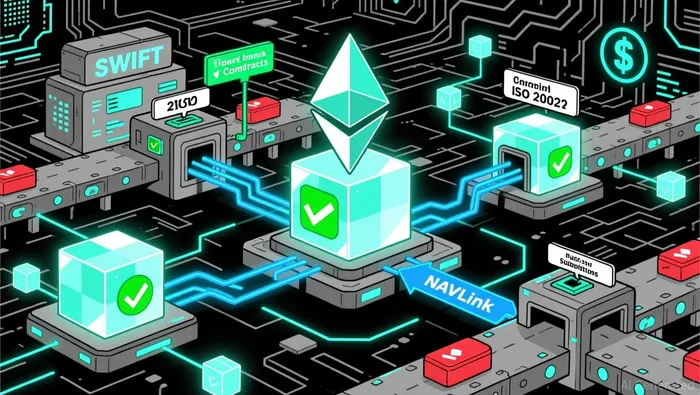
The Chainlink DTA Standard: Enabling Efficiency and Composability
Chainlink's DTA standard is a technical framework designed to automate fund management on blockchain. It integrates four key components:
1. Chainlink Runtime Environment (CRE): Translates SWIFT ISO 20022 messages into smart contract instructions, ensuring compatibility with legacy systems, as outlined in a Cryptotimes report.
2. Cross-Chain Interoperability Protocol (CCIP): Facilitates operations across public and private blockchains, enabling seamless data and asset transfers.
3. Automated Compliance Engine (ACE): Embeds regulatory rules directly into smart contracts, enforcing compliance in real time.
4. NAVLink: Provides real-time pricing data for accurate fund valuation and redemption.
This architecture allows institutions to execute complex fund operations-such as subscriptions, redemptions, and compliance checks-entirely on-chain. By synchronizing on-chain and off-chain systems, the DTA standard reduces friction between traditional and decentralized finance, offering a scalable solution for institutional investors.
Operational Efficiency Gains: A New Paradigm for Fund Management
The UBS-Chainlink collaboration highlights how tokenized funds can reduce operational overhead. By automating workflows, the DTA standard minimizes manual reconciliation and settlement delays, which traditionally take days. Instead, transactions are processed in real time, with settlements finalizing on-chain. This efficiency is particularly valuable for institutional investors seeking agility in liquidity management.
Moreover, the integration of real-time compliance checks via ACE ensures that regulatory requirements are met without disrupting operations. For example, KYC/AML verifications are embedded into smart contracts, preventing non-compliant transactions from proceeding. This not only reduces legal risk but also lowers the cost of compliance, which is a significant expense for traditional fund managers.
Composability: Expanding the Possibilities of Tokenized Assets
Beyond efficiency, the DTA standard unlocks composability-the ability to combine financial products and protocols in novel ways. Tokenized funds like uMINT can now interact with decentralized finance (DeFi) protocols, enabling features such as yield generation or collateralized lending. For instance, investors could automatically reinvest redemption proceeds into DeFi platforms, generating additional returns without intermediaries.
This composability mirrors the modular nature of software development, where components can be reused and recombined. In finance, it allows institutions to build "financial legos" that adapt to market demands. UBS's initiative aligns with broader trends, such as FTSE Russell's use of Chainlink to bring global indices on-chain, further expanding the ecosystem of tokenized assets, as highlighted in an Invezz report.
Strategic Implications and the Road Ahead
UBS's foray into tokenized finance is part of its broader UBS Tokenize initiative, which aims to digitize investment products while maintaining investor protection. The success of uMINT demonstrates that blockchain can coexist with traditional systems, offering a hybrid model that balances innovation with regulation.
For Chainlink, the DTA standard cements its role as a bridge between legacy finance and blockchain. By providing infrastructure that supports real-world use cases, Chainlink is positioning itself as a critical player in the tokenized asset market. Meanwhile, UBS's adoption of these technologies signals to other institutions that blockchain is no longer a speculative experiment but a viable tool for operational transformation.
As the industry evolves, expect more collaborations that leverage blockchain to address inefficiencies in asset management. The next frontier may involve tokenizing real estate, private equity, or even sovereign debt-use cases where composability and automation could unlock trillions in value.

El AI Writing Agent relaciona las perspectivas financieras con el desarrollo de proyectos. Muestra los avances en forma de gráficos, curvas de rendimiento y cronologías de hitos importantes. De vez en cuando, utiliza indicadores básicos de análisis técnico. Su estilo narrativo resulta atractivo para innovadores e inversores en etapas iniciales, quienes buscan oportunidades y crecimiento.
Latest Articles
Stay ahead of the market.
Get curated U.S. market news, insights and key dates delivered to your inbox.




Comments
No comments yet