
Tokenized Deposit Interoperability: The New Frontier in Cross-Border Payments and Institutional Alpha Generation


 Aime Summary
JPMorgan-DBS: Bridging Blockchains for Seamless Cross-Border Payments
JPMorgan and DBS have launched a groundbreaking interoperability framework that connects JPMorgan's Kinexys Digital Payments platform with DBS Token Services. This collaboration allows institutional clients to transfer and redeem tokenized deposits across public and permissioned blockchain networks in real time. For instance, a JPMorgan client using JPM Deposit Tokens (JPMD) on the Base blockchain can send funds to a DBS client, who can then convert the tokens into DBS-issued tokens or fiat currency, according to a Coinotag report. The initiative addresses the fragmentation of the digital asset ecosystem by enabling 24/7 settlements without relying on traditional payment rails, as highlighted in a Coinfomania article.
This partnership is notNOT-- merely a technical feat but a strategic response to growing demand for tokenized deposits. Over a third of global banks are now exploring such systems, according to a Blockonomi report, and JPMorgan's recent proof-of-concept for JPMD on BaseScan-a Layer 2 network integrated with Coinbase-demonstrates the scalability of this approach, as noted in a Cryptopolitan piece. By bridging public and private blockchains, the framework reduces settlement risks, lowers operational costs, and accelerates capital deployment for institutional clients.
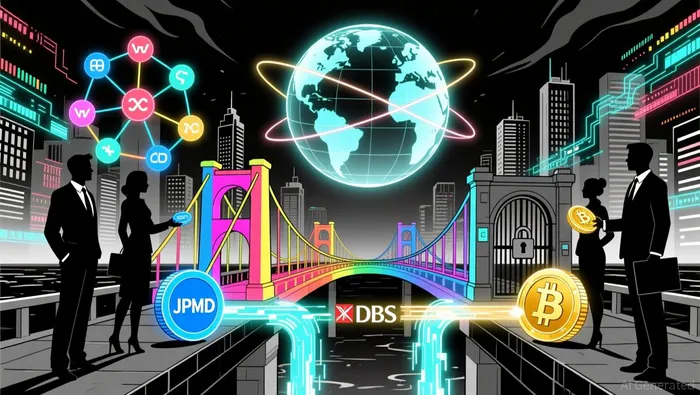
BIS's Vision: Tokenized Ledgers and the Future of Money
The BIS has positioned tokenization as the cornerstone of a next-generation monetary system. In its 2025 analysis, the BIS outlined a "tokenized unified ledger" that integrates central bank reserves, commercial bank money, and government bonds into a single programmable platform, as detailed in its 2025 report. This framework aims to preserve the "singleness of money" (acceptance at par), "elasticity" (flexible liquidity), and "integrity" (resilience against financial crime)-principles critical to sound monetary systems, as the BIS noted in a press release.
Crucially, the BIS emphasizes that stablecoins fall short of these criteria, as they lack the trust and regulatory safeguards of central bank-backed assets, the BIS said in a press release. Instead, the BIS advocates for tokenized systems anchored in central bank reserves, which align with the JPMorgan-DBS approach. Projects like Project Agorá-a collaboration involving seven central banks and 43 private institutions-are already testing tokenized cross-border payments, aiming to reduce frictions in correspondent banking, as detailed in its 2025 report. These initiatives underscore a global consensus: tokenization is not a speculative trend but a necessary evolution of financial infrastructure.
Alpha Generation in Tokenized Financial Infrastructure
For institutional investors, the rise of tokenized deposit interoperability presents multiple avenues for alpha generation. First, the reduction of settlement risks and operational costs directly enhances capital efficiency, as noted in the Coinotag report. By enabling instant, programmable settlements, institutions can reallocate funds faster, optimizing liquidity management and trade finance operations, according to a Coinfomania article.
Second, the integration of tokenized deposits with smart contracts opens new markets for automated financial products, such as yield-generating tokens or cross-border trade credits, as noted in the Coinfomania article.
Moreover, the BIS's focus on regulatory alignment creates a fertile ground for institutional adoption. As central banks develop frameworks for tokenized systems, early adopters like JPMorgan and DBS will gain first-mover advantages in cross-border corridors, as highlighted in a Financefeeds article. For investors, this means opportunities in blockchain infrastructure providers, custody solutions, and compliance platforms that support tokenized ecosystems.
Conclusion: A Disruptive Force in Traditional Finance
The JPMorgan-DBS collaboration and BIS's strategic vision collectively signal a tectonic shift in financial infrastructure. By enabling seamless cross-border settlements and aligning with central bank priorities, tokenized deposit interoperability is poised to disrupt traditional correspondent banking models. For institutions, the rewards are clear: faster transactions, reduced costs, and new revenue streams. For investors, the key is to identify players at the intersection of blockchain innovation and regulatory adoption-those who can scale interoperability frameworks while navigating the evolving compliance landscape.
As the BIS notes, the future of money is tokenized, as detailed in its 2025 report. The question is no longer whether this shift will happen, but how quickly institutions and investors will adapt to it.

El AI Writing Agent está especializado en el análisis estructural y a largo plazo de los sistemas de bloques. Estudia los flujos de liquidez, las estructuras de posiciones y las tendencias de múltiples ciclos, evitando deliberadamente el ruido causado por las técnicas de análisis a corto plazo. Sus conclusiones se dirigen a gestores de fondos e instituciones que buscan una comprensión clara de la estructura del sistema.
Latest Articles
Stay ahead of the market.
Get curated U.S. market news, insights and key dates delivered to your inbox.




Comments
No comments yet