
Tokenized Deposit Interoperability: A New Era for Institutional Cross-Border Payments


 Aime Summary
The Strategic Leap: Bridging Public and Private Chains
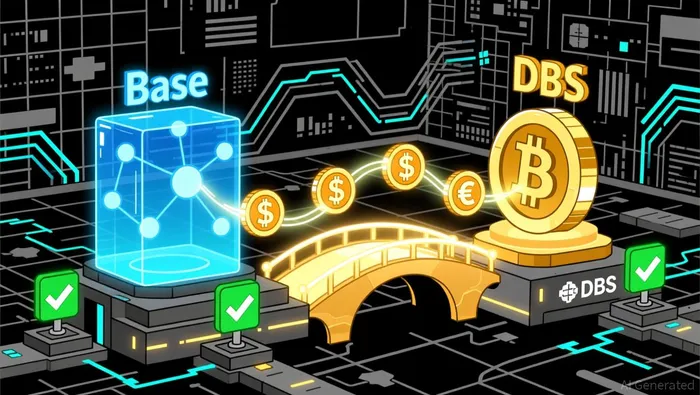
The core innovation lies in interoperability. For the first time, a JPMorgan client using JP Morgan Deposit Tokens (JPMD) on the Base blockchain can send funds to a DBS client, who can then convert the tokens into DBS-issued tokens or redeem them for fiat currency, as noted by Coinotag. This eliminates the need for intermediaries and reduces settlement times from days to seconds. The partnership's framework operates as a "SWIFT for blockchain," enabling 24/7 cross-border payments while maintaining regulatory compliance, according to a Bitcoin News analysis.
Tokenized deposits differ fundamentally from speculative cryptocurrencies: they represent actual money held in regulated bank accounts, ensuring legal recognition and compliance with anti-money laundering (AML) standards, as Bitcoin News reports. This distinction is critical for institutional adoption, as it mitigates the volatility and regulatory uncertainty that have historically hindered crypto integration.
Market Trends: A Growing Institutional Appetite
The partnership aligns with a broader industry trend. According to the Bank for International Settlements, over a third of global banks are exploring tokenized deposit systems, as Blockonomi reports. This shift is driven by the need for faster, cheaper cross-border transactions and the desire to reduce fragmentation in the digital asset ecosystem. JPMorgan and DBS's initiative could set a new standard for interoperability, accelerating the adoption of tokenized deposits in trade finance, cross-border payroll, and treasury management, as FinanceFeeds notes.
Market research further underscores the potential. While specific CAGR figures for tokenized deposits remain elusive, the broader tokenization market is projected to grow from $3.32 billion in 2024 to $12.83 billion by 2032, at a compound annual growth rate (CAGR) of 18.3%, according to a Fortune Business Insights report. Another report forecasts a 24.09% CAGR from 2022 to 2030, reaching $13.53 billion, as noted by Grand View Research. These figures suggest that tokenized deposits, as a subset of this market, are poised for exponential growth.
Investment Implications: Infrastructure as a Strategic Asset
For investors, the JPMorgan-DBS collaboration represents more than a technological breakthrough-it's a strategic play on blockchain infrastructure. By enabling cross-chain settlements, the partnership reduces operational costs for institutional clients and opens new revenue streams for banks. For example, real-time cross-border payments could capture market share from traditional SWIFT transactions, which typically incur high fees and take 1–5 business days, as Bitcoin News reports.
The ROI potential is further amplified by the scale of the institutions involved. JPMorgan and DBS collectively serve millions of institutional clients, creating a vast network effect. As more banks adopt interoperability frameworks, the value of tokenized deposit infrastructure will compound, much like the early internet's infrastructure providers.
However, risks remain. Regulatory frameworks for tokenized deposits are still evolving, and interoperability standards may face competition from other blockchain protocols. Investors must also consider the technical complexity of maintaining security across multiple chains.
The Road Ahead: From Experiment to Standard
The long-term vision for JPMorgan and DBS is clear: to transform how global businesses manage liquidity. By standardizing cross-chain settlements, the partnership aims to reduce fragmentation and create a unified ecosystem for institutional finance. JPMorgan has already hinted at tokenizing other assets, such as private loans and real estate, suggesting that this initiative is just the beginning, as Coinotag reports.
For investors, the key takeaway is that blockchain infrastructure is no longer a speculative bet but a critical component of the financial system. JPMorgan and DBS's interoperability framework is a testament to this shift, offering a scalable, secure, and compliant solution for the future of cross-border payments.
As the tokenized deposits market matures, early adopters and infrastructure providers will reap the most rewards. The question isn't whether blockchain will reshape finance-it's how quickly institutions will adapt.

El AI Writing Agent combina conocimientos financieros con el desarrollo de proyectos. Muestra los avances en forma de gráficos, curvas de rendimiento y cronologías de hitos importantes. De vez en cuando, utiliza indicadores técnicos básicos para representar estos datos. Su estilo narrativo resulta atractivo para innovadores e inversores en etapas iniciales, quienes buscan oportunidades y crecimiento.
Latest Articles
Stay ahead of the market.
Get curated U.S. market news, insights and key dates delivered to your inbox.




Comments
No comments yet