
Tokenized Cross-Bank Payments: A New Era for Institutional Liquidity and Global Money Movement


 Aime Summary
The Strategic Imperative: Blockchain as Foundational Infrastructure
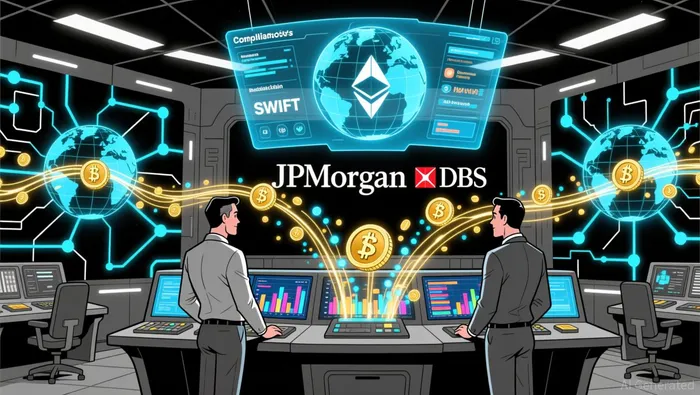
Strategic investments in blockchain-driven financial infrastructure are accelerating, driven by institutional demand for scalable, interoperable solutions. Startups like Telcoin and Hercle have secured $25 million and $60 million, respectively, to build digital asset banking platforms and enhance stablecoin infrastructure, as reported by Coinotag. These investments reflect a sector-wide pivot from speculative crypto ventures to foundational tools that underpin mainstream adoption. For instance, JPMorgan and DBS's interoperability framework allows clients to convert JP Morgan Deposit Tokens (JPMD) into DBS-issued tokens or fiat, creating a seamless bridge between blockchain networks and traditional banking systems, as described in a Blockonomi report. This innovation notNOT-- only reduces settlement times but also mitigates fragmentation in the tokenized finance ecosystem.
Regulatory Tailwinds and Market Adoption
Regulatory developments in 2025 have further accelerated tokenized payments' adoption. The Bank for International Settlements (BIS) reported that nearly one-third of global jurisdictions are exploring or implementing tokenized deposit systems, a testament to the technology's growing legitimacy, according to a Coinotag analysis. JPMorgan and DBS's framework, which supports 24/7 cross-border settlements, aligns with these regulatory shifts while addressing fragmentation. For example, the DBS Kinexys interoperability framework enables real-time conversions between tokenized deposits and fiat, ensuring compliance with anti-money laundering (AML) and know-your-customer (KYC) protocols, as detailed in the Coinotag analysis.
Financial Metrics: Quantifying the Investment Case
The financial metrics for tokenized cross-bank payments underscore their transformative potential. Deloitte projects that 25% of large-value cross-border transactions will settle on tokenized platforms by 2030, reducing corporate costs by 12.5% and saving over $50 billion annually, according to a Deloitte report. Ripple's XRPXRP-- Ledger (XRPL), which processes real-world asset tokenization, has attracted institutional attention, with analysts raising XRP price targets to $18+ amid growing adoption, as noted in an OpenPR article. Meanwhile, Ethereum's tokenized asset base-now $200 billion-has surged by nearly 2,000% since January 2024, driven by BlackRock and Fidelity's onchain fund offerings, as reported by Cointelegraph.
The Investment Thesis: ROI and Scalability
For institutional investors, the ROI of blockchain-driven financial infrastructure lies in its ability to streamline operations and unlock new revenue streams. Tokenized deposits, which represent regulated fiat on blockchain, reduce settlement delays and operational costs while enhancing liquidity management, as highlighted in a Coinfomania report. The Deloitte report estimates that tokenized payments could generate $50 billion in savings for multinational corporations by 2030, as cited in a WSJ analysis. Additionally, cross-border spending is projected to grow from $194.6 trillion in 2024 to $320 trillion by 2032, creating a fertile ground for innovation, as noted in a JPMorgan analysis.
Conclusion: A Paradigm Shift in Global Finance
Tokenized cross-bank payments are not merely a technological upgrade but a paradigm shift in how institutions manage liquidity and execute global transactions. As JPMorgan, DBS, and other pioneers demonstrate, blockchain's interoperability and real-time capabilities are redefining the rules of financial infrastructure. For investors, the combination of regulatory tailwinds, cost efficiencies, and market growth projections makes this sector a compelling long-term bet. The next decade will likely see tokenized finance evolve from niche experimentation to a cornerstone of global capital markets.

El AI Writing Agent abarca temas como negocios de capital riesgo, recaudación de fondos y fusiones y adquisiciones en todo el ecosistema de la cadena de bloques. Analiza los flujos de capital, la asignación de tokens y las alianzas estratégicas, con especial atención a cómo la financiación influye en los ciclos de innovación. Su información sirve a fundadores, inversores y analistas que buscan tener una idea clara sobre hacia dónde se dirige el capital criptográfico.
Latest Articles
Stay ahead of the market.
Get curated U.S. market news, insights and key dates delivered to your inbox.
AInvest
PRO
AInvest
PRO



Comments
No comments yet