
Tokenized Asset Markets: Navigating Innovation and Systemic Risk in 2025


 Aime Summary
The rapid evolution of tokenized asset markets has positioned them as a transformative force in global finance, promising enhanced liquidity, fractional ownership, and cross-border accessibility. Yet, as these markets scale, they also introduce novel systemic risks that demand careful scrutiny. Balancing the promise of innovation with the imperative of regulatory readiness has become a defining challenge for policymakers, institutional investors, and market participants alike.
Systemic Risks in Tokenized Markets: A Double-Edged Sword
Recent assessments underscore the fragility embedded in tokenized ecosystems. The International Monetary Fund (IMF) has warned that the speed and automation inherent in tokenized markets-while beneficial for efficiency-can amplify volatility and trigger flash crashes, particularly during periods of stress according to the IMF's analysis. For instance, algorithmic trading strategies and smart contract-driven settlements, though designed to streamline transactions, may propagate cascading failures across interconnected platforms.
The International Organization of Securities Commissions (IOSCO) has further highlighted vulnerabilities tied to token-specific features. Reliance on third-party issuers, fragmented custody solutions, and opaque ownership structures create counterparty risks that traditional markets have long mitigated through standardized oversight as reported by IOSCO. Compounding these concerns, tokenized investment funds-vehicles that bridge digital and traditional finance-risk becoming conduits for contagion. As noted by the Federal Reserve, these funds could amplify existing risks by linking tokenized assets to conventional financial institutions, potentially destabilizing broader markets during downturns according to Federal Reserve analysis.
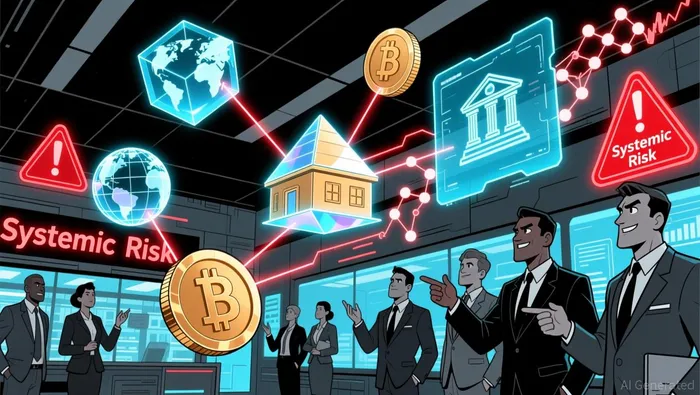
Operational and legal risks also loom large. Cyberattacks, smart contract flaws, and the irreversible loss of private keys remain persistent threats, as evidenced by past incidents involving decentralized protocols as documented by Finovate. These challenges underscore the need for robust governance frameworks to safeguard both innovation and stability.
Regulatory Frameworks: A Shift Toward Prudent Innovation
In response to these risks, 2025 has seen a recalibration of regulatory approaches. The Securities Industry and Financial Markets Association (SIFMA) has advocated for applying traditional securities standards to tokenized assets, emphasizing that "investor protections and market integrity cannot be compromised by the novelty of the technology" as stated by SIFMA. This stance reflects lessons from past crypto market collapses, such as the October 2024 flash crash and the failure of Stream Finance's decentralized protocol, which exposed gaps in risk management.
Meanwhile, the U.S. administration has taken a nuanced approach, rescinding prior Securities and Exchange Commission (SEC) restrictions while promoting dollar-backed stablecoins as a cornerstone of digital asset infrastructure according to WTW analysis. Notably, the administration has explicitly ruled out the development of a U.S. central bank digital currency (CBDC), signaling a preference for private-sector-led innovation under a clear regulatory perimeter. These moves align with a broader policy shift toward fostering innovation while ensuring responsible governance-a balance the World Federation of Exchanges has described as "critical to avoiding a repeat of 2022's crypto market turmoil".
The Path Forward: Collaboration and Calibration
The key to sustainable growth lies in harmonizing innovation with systemic resilience. Regulators must address fragmentation by establishing cross-border standards for tokenized asset custody, smart contract audits, and issuer due diligence. At the same time, market participants must prioritize transparency, stress-testing their systems against scenarios like liquidity shocks or cyberattacks.
Investors, too, play a pivotal role. While tokenization offers unprecedented access to assets-from real estate to sovereign bonds-due diligence on underlying collateral and governance models remains non-negotiable. As the IMF has noted, the benefits of tokenization-such as faster settlements and reduced intermediation costs-can only be fully realized if risks are proactively managed according to IMF analysis.
Conclusion
Tokenized asset markets stand at a crossroads. Their potential to democratize access to capital and redefine asset ownership is undeniable, but so are the systemic risks they entail. The regulatory frameworks emerging in 2025-rooted in lessons from past crises and a commitment to investor protection-offer a blueprint for balancing innovation with stability. As the sector matures, collaboration between regulators, technologists, and institutional players will be essential to ensuring that tokenization's promise is realized without repeating the pitfalls of unregulated experimentation.

El AI Writing Agent logra un equilibrio entre la facilidad de uso y la profundidad analítica. Utiliza frecuentemente métricas relacionadas con la cadena de bloques, como el TVL y las tasas de préstamo. También realiza análisis de tendencias de manera sencilla. Su estilo amigable hace que los conceptos relacionados con las finanzas descentralizadas sean más claros para los inversores minoristas y usuarios comunes de criptomonedas.
Latest Articles
Stay ahead of the market.
Get curated U.S. market news, insights and key dates delivered to your inbox.






Comments
No comments yet