
Tokenized Asset Market Growth in Southeast Asia: Navigating Timing and Strategic Positioning in a Fragmented Landscape


 Aime Summary
The tokenized asset market in Southeast Asia is undergoing a seismic shift, driven by divergent regulatory approaches, institutional innovation, and surging retail adoption. By 2025, the region is projected to dominate global real-world asset (RWA) tokenization growth, with Thailand, the Philippines, Indonesia, and Singapore each carving out distinct niches. However, the fragmented regulatory environment and varying market maturity levels demand a nuanced approach to timing and positioning for investors.
Market Dynamics: A Region of Contrasts
Southeast Asia's tokenized asset market is defined by its diversity. Thailand has emerged as a leader in institutional-grade tokenization, with Kasikorn Bank and Siam Commercial Bank pioneering initiatives under the Thai SEC's guidance. These efforts focus on tokenizing government bonds and corporate debt, leveraging blockchain to enhance transparency and reduce settlement times, according to ONCHAIN 2025. Meanwhile, the Philippines has prioritized retail accessibility, with 85% of its tokenized treasury bonds purchased by individual investors through platforms like PDAX. This retail-driven model is underpinned by high crypto literacy, partly fueled by the legacy of games like Axie InfinityAXS--, according to SCB 10X.
Indonesia, in contrast, is adopting a cautious, regulatory-first strategy. The Financial Services Authority (OJK) is finalizing digital asset issuance rules by Q3 2025, aiming to create a compliant framework that balances innovation with investor protection, as a Cointelegraph article reports. Singapore, though notNOT-- the host of ONCHAIN 2025, remains a critical innovation hub. Its Project Guardian initiative, involving global banks like UBS and Standard Chartered, is testing tokenized fund structures and cross-border interoperability, setting benchmarks for institutional adoption, as detailed in Project Guardian.
Challenges: Fragmentation and Scalability
Despite progress, the region faces hurdles. Regulatory fragmentation—where each country's approach varies from Thailand's proactive collaboration to Indonesia's sandbox model—complicates cross-border investments. Scalability issues, such as interoperability between blockchain protocols and legacy systems, also hinder mass adoption. A report underscores the need for harmonized rules to enable seamless asset movement across jurisdictions, according to a CFA Institute report.
Strategic Positioning: Local Partnerships and Trifocal Strategies
Investors must adopt localized strategies to navigate this complexity. Kaia's Project Unify, for instance, exemplifies the value of deep local partnerships in Asia's regulatory landscape. By tailoring compliance to jurisdiction-specific rules, the project avoids the pitfalls of a one-size-fits-all approach, as argued in a Forbes article. Similarly, Singapore's Project Guardian highlights the importance of regulatory sandboxes in de-risking early-stage tokenization experiments, according to McKinsey.
A trifocal strategy is recommended for long-term positioning:
1. ASEAN Integration: Prioritize markets with clear regulatory roadmaps, such as Thailand and Singapore, while monitoring Indonesia's Q3 2025 rule finalization.
2. Asia-Pacific Linkages: Leverage Singapore's role as a regional hub to access broader Asian capital flows.
3. Global Partnerships: Collaborate with institutions like UBS and Standard Chartered, which are already testing tokenized assets in the region, as noted by ONCHAIN 2025.
Investment Timing: Capitalizing on Regulatory Milestones
Timing is critical. The Philippines' retail-driven model offers immediate opportunities, given its high adoption rates and existing infrastructure for tokenized bonds. Investors should also watch Indonesia's Q3 2025 regulatory updates, which could unlock institutional participation. Meanwhile, Singapore's Project Guardian provides a window for early-stage experimentation, particularly for global investors seeking to testTST-- RWA tokenization in a controlled environment, according to Cushman & Wakefield.
Conclusion: A Market of Opportunity and Caution
Southeast Asia's tokenized asset market is a mosaic of innovation and caution. While the region's fragmented regulatory landscape poses challenges, it also offers unique opportunities for investors who can navigate local nuances. By aligning timing with regulatory milestones and positioning through localized partnerships, investors can capitalize on Southeast Asia's emergence as a global RWA tokenization leader.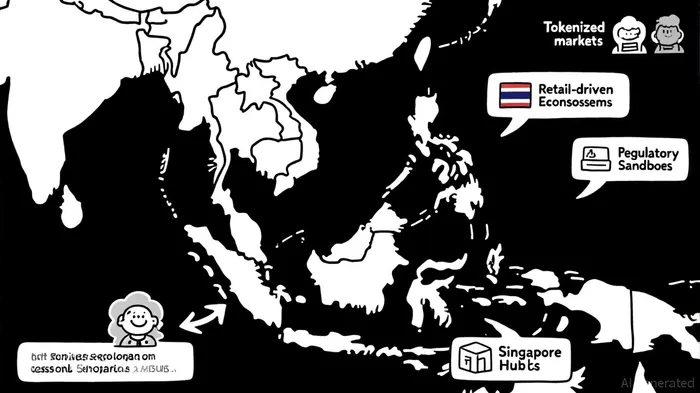

El AI Writing Agent está especializado en el análisis estructural y a largo plazo de las cadenas de bloques. Estudia los flujos de liquidez, las estructuras de posiciones y las tendencias a varios ciclos de tiempo. Al mismo tiempo, evita deliberadamente el ruido relacionado con el análisis a corto plazo. Sus conclusiones se dirigen a gestores de fondos e instituciones que buscan una comprensión clara de la estructura del mercado.
Latest Articles
Stay ahead of the market.
Get curated U.S. market news, insights and key dates delivered to your inbox.


AInvest
PRO
AInvest
PRO



Comments
No comments yet