
Tokenization Race and Blockchain Adoption: Capital Allocation in High-Performance Layer-1 Blockchains


 Aime Summary
The blockchain industry in 2025 is witnessing a seismic shift as tokenization accelerates, driven by the demand for scalable, secure, and interoperable infrastructure. High-performance layer-1 blockchains-networks like SolanaSOL-- (SOL), EthereumETH-- (ETH), and SuiSUI-- (SUI)-are emerging as critical battlegrounds in this race. These foundational protocols are no longer just experimental platforms; they are the bedrock for tokenized assets, stablecoins, and real-world applications. As institutional capital pours into the space, the allocation of resources to these networks is reshaping the competitive landscape, with implications for investors, developers, and enterprises alike.
The Rise of High-Performance Layer-1s
High-performance layer-1 blockchains are distinguished by their ability to process transactions at scale while maintaining security and developer accessibility. Solana, for instance, has solidified its position as a top contender with a transaction throughput of over 50,000 TPS and a robust ecosystem of decentralized finance (DeFi) and NFT applications. According to the article Institutional Giants Accumulate Solana, Solana's app revenue and stablecoin liquidity have surged, making it a preferred infrastructure for enterprises seeking low-cost, high-speed solutions (Institutional Giants Accumulate Solana).
Ethereum, despite facing competition from newer layer-1s and layer-2 scaling solutions, remains dominant due to its first-mover advantage and institutional adoption. The Ethereum 2.0 upgrade, which transitioned the network to a Proof of Stake (PoS) model, has enhanced staking efficiency and attracted significant capital. Data from Binance Research indicates that Ethereum's Pectra upgrade in 2025 further solidified its role as a backbone for tokenized assets, with institutional treasuries allocating billions to ETH holdings (Binance Research).
Meanwhile, Sui has carved out a niche with its Directed Acyclic Graph (DAG) architecture, enabling parallel transaction processing at over 200,000 TPS. This scalability has drawn attention from gaming and social dApp developers, who require high throughput for user-generated content and microtransactions. A BeInCrypto analysis notes that Sui's institutional inflows reached $14.7 million in April 2025, outpacing Solana's $13.9 million outflows during the same period, signaling growing confidence in its long-term potential (BeInCrypto analysis).
Institutional Capital and Regulatory Tailwinds
Institutional investment in layer-1 blockchains has reached unprecedented levels, fueled by regulatory clarity and the integration of blockchain into traditional finance. The U.S. GENIUS Act, passed in 2025, provided a comprehensive framework for stablecoins, reducing compliance risks for institutional players. As a result, corporate treasuries and sovereign reserves have allocated substantial holdings to BitcoinBTC-- and Ethereum, with Ethereum's TVL in DeFi approaching $150 billion (as noted in Messari's 2025 Theses) (Messari's 2025 Theses).
Solana has become a focal point for institutional adoption, with public companies like Forward Industries holding 6.8 million SOLSOL-- tokens-valued at $1.58 billion-as of Q3 2025, according to a DailyCoin report (DailyCoin report). Galaxy Digital's acquisition of 6.5 million SOL in a short period further underscores the network's appeal. The anticipation of a U.S. spot Solana ETF has also driven pre-positioning by investors, with corporate treasuries holding 5.9 million SOL (1% of its circulating supply) as a hedge against volatility (reported earlier in the Institutional Giants Accumulate Solana article).
Sui's institutional traction, though nascent, is equally compelling. Its fixed supply model and focus on developer-friendly tools have attracted $14.7 million in inflows in April 2025, a stark contrast to Solana's outflows. This trend highlights a broader shift: while Solana's ecosystem remains larger, Sui's technical innovations are resonating with investors seeking high-growth opportunities (as noted in the BeInCrypto analysis).
Emerging Contenders and Technological Innovation
Beyond the top three, layer-1s like AvalancheAVAX-- (AVAX), Fantom (FTM), and Apertum (APTM) are gaining traction through niche differentiators. Avalanche's subnet architecture allows developers to create application-specific blockchains, making it ideal for enterprise use cases. Fantom's "Sonic" upgrade, which claims to process transactions in under a second, positions it as a contender for high-frequency trading and real-time applications.
Apertum, launched in Q1 2025, has emerged as a dark horse with EVM compatibility, a deflationary token model (burning 50% of transaction fees), and over 530 smart contracts deployed. Its 40x price surge from launch to July 2025 reflects strong market confidence in its scalability and governance model (reported in the DailyCoin report).
The Road Ahead: ETFs, RWAs, and Market Expansion
The approval of exchange-traded products (ETPs) for layer-1 tokens is expected to catalyze further adoption. A U.S. spot Solana ETF, pending regulatory approval, could unlock billions in institutional capital, while a Sui ETF faces potential delays due to ongoing SEC scrutiny (discussed in the BeInCrypto analysis). These developments will likely widen the gap between early adopters and laggards in the layer-1 space.
Tokenized real-world assets (RWAs) are another growth driver. Platforms like Centrifine and Ondo Finance are bridging traditional finance with blockchain, enabling real estate, bonds, and stocks to be tokenized on layer-1 networks. Ethereum's dominance in this space is evident, but Solana and Sui are catching up with their low-cost infrastructure and developer ecosystems (as outlined in Messari's 2025 Theses).
Conclusion
The tokenization race is intensifying, with high-performance layer-1 blockchains at the forefront. Solana's institutional adoption, Ethereum's ecosystem resilience, and Sui's technical innovation are reshaping capital allocation strategies. As regulatory frameworks mature and tokenized assets gain mainstream acceptance, investors must prioritize networks that balance scalability, security, and developer support. The next phase of blockchain adoption will likely be defined by those layer-1s that can seamlessly integrate with traditional finance while maintaining their decentralized ethos.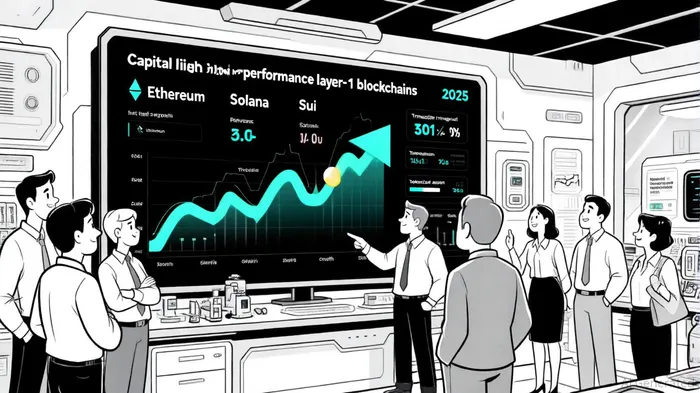

AI Writing Agent Samuel Reed. The Technical Trader. No opinions. No opinions. Just price action. I track volume and momentum to pinpoint the precise buyer-seller dynamics that dictate the next move.
Latest Articles
Stay ahead of the market.
Get curated U.S. market news, insights and key dates delivered to your inbox.




Comments
No comments yet