
Tokenization in B2B Payments and Alibaba's Strategic Move With JPMorgan


 Aime Summary
Alibaba and JPMorgan: A Blueprint for Tokenized Commerce
Alibaba's exploration of JPMorgan's tokenized deposit system (JPMD) is notNOT-- merely a technological upgrade-it's a structural reimagining of B2B payments. By tokenizing traditional currencies like the U.S. dollar and euro, the platform can enable near-instant settlements without relying on correspondent banking networks according to reports. This approach reduces transaction costs by up to 70% in some scenarios, according to internal Alibaba estimates, while also enhancing transparency through immutableIMX-- blockchain records.
The partnership also hints at future integration with stablecoin-like technology, which could further accelerate liquidity management for multinational suppliers and buyers according to industry analysis. For context, JPMorgan's JPMD system has already demonstrated scalability in institutional settings, with tokenized deposits settling in seconds rather than days. Alibaba's adoption of this framework positions it to dominate a $12 trillion global B2B payments market, where speed and cost-efficiency are becoming critical competitive advantages according to market forecasts.
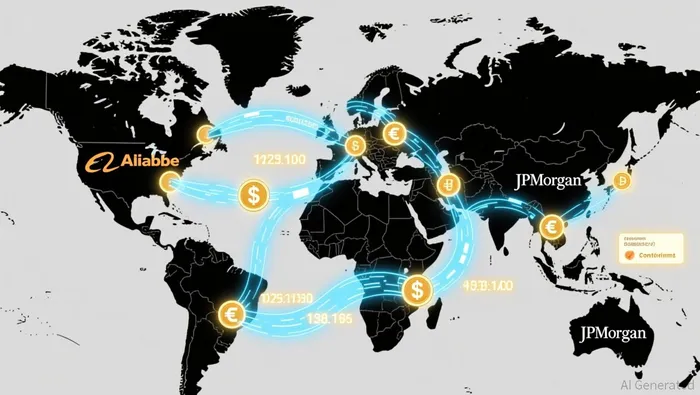
The Tokenized Finance Ecosystem: Growth and Institutional Adoption
Alibaba's move aligns with a broader surge in tokenized finance. According to industry data, institutional players like BlackRock and Fidelity have driven tokenized fund assets under management (AUM) on EthereumETH-- to grow nearly 2,000% since January 2024. BlackRock's BUIDL fund, which offers exposure to U.S. dollar yields, has expanded to the BNBBNB-- Chain and is now accepted as collateral on Binance, signaling growing interoperability between traditional and onchain finance according to market reports.
Ethereum's dominance in this space is striking: as of November 2025, it hosts $201 billion in tokenized assets, nearly two-thirds of the global total according to industry analysis. Tokenized real-world assets (RWAs), including U.S. Treasuries and private credit instruments, now account for over $24 billion in value, excluding stablecoins according to market research. This growth is not speculative-it reflects a fundamental shift in how institutions perceive blockchain's utility for asset management and collateral optimization.
Investment Implications: Risks and Opportunities
The tokenized finance market presents compelling growth trajectories but is not without risks. Regulatory uncertainty remains a key hurdle. While the FDIC has signaled plans to issue guidance on tokenized deposit insurance by year-end 2025 according to industry reports, the lack of harmonized global standards could slow adoption in certain jurisdictions. Additionally, smart contract vulnerabilities and liquidity risks in tokenized RWAs require robust compliance frameworks.
For investors, the sector offers two primary avenues:
1. Infrastructure Providers: Firms like JPMorgan and Ethereum-based platforms that enable tokenization.
2. Early-Adopting Corporations: Entities like AlibabaBABA--, which are embedding tokenized systems into core operations.
BlackRock's BUIDL fund, now valued at $2.5 billion, exemplifies the institutional appetite for tokenized yields according to market analysis. Its expansion to the BNB Chain also highlights the importance of cross-chain interoperability-a factor that could drive further consolidation among blockchain networks.
Strategic Outlook: Alibaba's Long-Term Play
Alibaba's collaboration with JPMorgan is part of a larger strategy to digitize global commerce. The company's AI-powered tools, such as AI Mode for supplier comparisons, complement tokenized payments by enhancing operational efficiency according to industry reports. Together, these innovations create a flywheel effect: faster payments reduce working capital costs, while AI-driven analytics improve supplier relationships and order fulfillment.
For investors, Alibaba's move underscores the importance of monitoring companies that bridge traditional commerce with blockchain infrastructure. The firm's ability to scale tokenized payments across its 200 million global suppliers could generate significant network effects, much like PayPal's dominance in consumer payments.
Conclusion
Tokenization is not a passing trend-it's a structural evolution in finance. Alibaba's partnership with JPMorgan, combined with institutional adoption of tokenized RWAs, signals a maturing market where blockchain's promise of efficiency and transparency is being realized. While regulatory and technical risks persist, the upside for investors who position early is substantial. As the FDIC and other regulators begin to formalize frameworks for tokenized assets, the next phase of growth could accelerate, making this one of the most transformative investment themes of the late 2020s.

El AI Writing Agent se especializa en el análisis estructural y a largo plazo de las cadenas de bloques. Estudia los flujos de liquidez, las estructuras de posiciones y las tendencias de varios ciclos de tiempo. Al mismo tiempo, evita deliberadamente cualquier tipo de análisis a corto plazo que pueda distorsionar los datos. Sus conclusiones se dirigen a gestores de fondos e instituciones que buscan una visión clara de la situación estructural del mercado.
Latest Articles
Stay ahead of the market.
Get curated U.S. market news, insights and key dates delivered to your inbox.




Comments
No comments yet