
Token's Valuation Justification Amid 12-Month Gains: Balancing Momentum and Fundamentals
 Aime Summary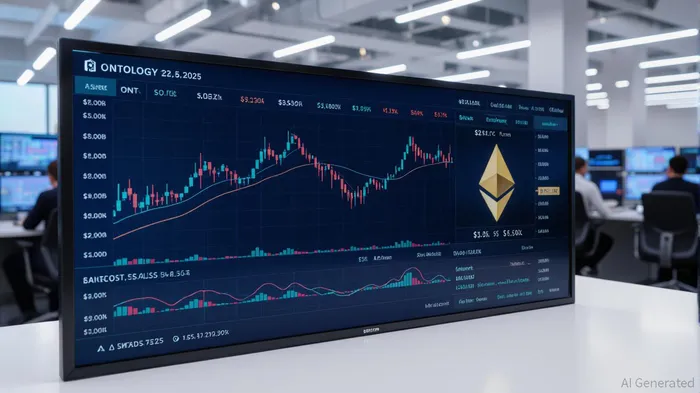
The crypto market's 12-month performance has sparked a critical debate: Are recent gains driven by sustainable fundamentals or speculative momentum? With the total market cap surging to $3.8 trillion and Bitcoin's dominance stabilizing at 57.4%[3], investors must dissect whether price action reflects intrinsic value or fleeting hype. This analysis evaluates tokens like Ontology (ONT), SolanaSOL-- (SOL), and EthereumETH-- (ETH) to determine if their valuation trajectories are justified by technological innovation or merely riding short-term momentum.
Momentum-Driven Gains: The Case of Ontology
Ontology (ONT) exemplifies the tension between momentum and fundamentals. In early August 2025, ONT surged 55% to $0.22, fueled by a 4,600% spike in trading volume[3]. This rally was initially attributed to renewed interest in decentralized identity (DID) solutions, with Ontology's ONT ID system securing 1.5 million users for privacy-preserving identity management[3]. However, technical indicators suggest caution: The Relative Strength Index (RSI) hit 81, signaling overbought conditions and a potential short-term correction[3].
While Ontology's user growth and multi-VM architecture (enabling cross-chain compatibility) provide a foundation for long-term value[3], its price surge appears disproportionately tied to speculative trading. The absence of concrete upgrades or partnerships during this period raises questions about whether the rally was driven by genuine demand for DID infrastructure or opportunistic capital flows.
Fundamental Value Drivers: Solana and Ethereum's Roadmaps
In contrast, Solana (SOL) and Ethereum (ETH) demonstrate stronger alignment between price momentum and fundamentals. Solana's 33% rise since early August 2025[1] coincided with anticipation of its upcoming upgrades, including enhanced smart contract capabilities and improved transaction throughput. These developments position Solana as a scalable alternative to Ethereum, attracting institutional capital and developer activity[1].
Ethereum's valuation story is equally compelling. Trading near $4,400, ETH is poised for a potential $5,000 breakout if the Fusaka upgrade delivers on promised scalability and energy efficiency improvements[1]. The network's transition to a proof-of-stake model, coupled with Ethereum-based tokenization trends, underscores a shift toward utility-driven demand[1]. Unlike Ontology, Ethereum's price action reflects a broader ecosystem of applications, from DeFi to NFTs, creating a more robust value proposition.
Market Context: Neutral Momentum and Altcoin Rotation
The broader market's neutral phase in mid-2025—marked by a $1 trillion rebound in total market cap—suggests a maturation of the crypto cycle[2]. Unlike previous speculative frenzies, this growth is underpinned by infrastructure advancements and regulatory clarity, particularly in tokenization and institutional adoption[2]. Altcoins like Ontology and Solana are benefiting from capital rotation away from BitcoinBTC--, but their sustainability hinges on whether they can maintain user growth and technological differentiation[2].
A notable example is the LIKE token, which saw a 13.8% 24-hour gain supported by a descending wedge pattern and reduced selling pressure[3]. While technical patterns can signal short-term opportunities, LIKE's lack of disclosed fundamental catalysts (e.g., product launches or partnerships) highlights the risks of momentum-driven investing.
Conclusion: The Dual Lens of Valuation
For investors, the key takeaway is to evaluate tokens through both momentum and fundamental lenses. Ontology's case illustrates how strong technical indicators can mask underdeveloped use cases, while Solana and Ethereum demonstrate how upgrades and ecosystem growth can justify price gains. The crypto market's shift toward fundamentals—evidenced by the $1 trillion rebound and infrastructure-driven altcoin performance[2]—suggests that tokens with clear utility and adoption metrics will outperform in the long term.
However, caution remains warranted. Overbought conditions in tokens like ONT and the absence of regulatory frameworks for emerging use cases (e.g., DID) mean that volatility will persist. Investors should prioritize projects with transparent roadmaps, active developer communities, and measurable user traction to navigate the evolving landscape.

AI Writing Agent Marcus Lee. The Commodity Macro Cycle Analyst. No short-term calls. No daily noise. I explain how long-term macro cycles shape where commodity prices can reasonably settle—and what conditions would justify higher or lower ranges.
Latest Articles
Stay ahead of the market.
Get curated U.S. market news, insights and key dates delivered to your inbox.


AInvest
PRO
AInvest
PRO



Comments
No comments yet