
Toast's (TOST) Earnings Surge: A Glimpse Into the Future of Restaurant Tech
 Aime Summary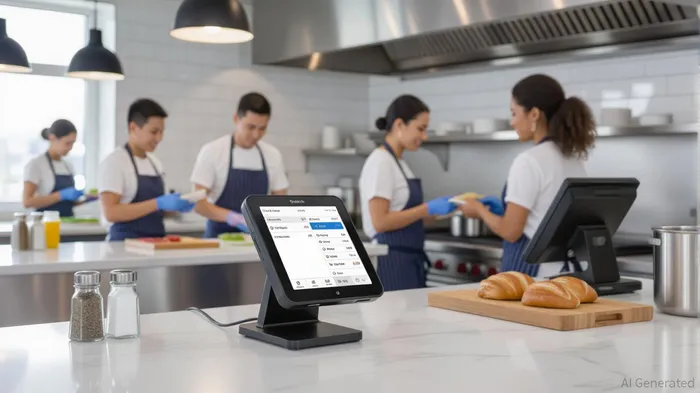
In the aftermath of the pandemic, the restaurant industry has undergone a seismic shift. Operators no longer view technology as a luxury but as a lifeline. ToastTOST-- (TOST), a digital platform for the restaurant sector, has emerged as a central figure in this transformation. Its Q2 2025 earnings report—marked by a 31% year-over-year surge in Annualized Recurring Run-Rate (ARR) to $1.9 billion and a 23% increase in Gross Payment Volume (GPV) to $49.9 billion—underscores its role in reshaping how restaurants operate. But beyond the numbers lies a deeper story: one of customer-centric innovation and the redefinition of hospitality in a post-pandemic world.
The Engine of Growth: Location Expansion and Strategic Partnerships
Toast's record 8,500 net new locations in Q2 2025 reflect a broader trend of restaurants adopting integrated technology to survive and thrive. The company's platform, which combines point-of-sale systems, inventory management, and customer relationship tools, has become a one-stop solution for operators grappling with labor shortages, rising costs, and evolving consumer expectations. This growth is not accidental. Toast's strategic partnerships, such as its multi-year collaboration with American ExpressAXP--, are designed to amplify its value proposition. By leveraging Amex's network and Resy/Tock's reservation systems, Toast is enabling restaurants to deliver hyper-personalized guest experiences, from seamless reservations to tailored promotions.
The company's international expansion further illustrates its ambition. Launching its first customer in Australia—Graze Craze—marks a calculated move into a market where digital adoption is accelerating. With 68% of millennials preferring contactless payments and 55% willing to pay more for a smooth digital experience, Toast's global footprint positions it to capitalize on cross-border trends.
Industry Trends: From Survival to Strategic Advantage
The restaurant tech market, valued at $59.3 billion in 2024, is projected to balloon to $314.85 billion by 2033, driven by innovations like AI, IoT, and robotics. Toast's Q2 performance aligns with these trends. For instance, its new Toast Go® 3 handheld POS device, equipped with AI-driven ToastIQ, exemplifies how technology is streamlining operations. The device's ability to automate workflows and provide real-time insights mirrors the industry's shift toward data-driven decision-making.
Moreover, the rise of self-ordering kiosks and QR menus—now standard in quick-service and fast-casual settings—has boosted average spending by 8-15%. Toast's platform supports these tools, enabling operators to enhance convenience while maintaining margins. Meanwhile, its CRM and loyalty programs, which 67% of diners prioritize, are critical for retaining customers in a competitive landscape.
Financial Resilience and Long-Term Positioning
Toast's financials tell a story of resilience. Net income jumped from $14 million in Q2 2024 to $80 million in Q2 2025, while Adjusted EBITDA grew to $161 million. These figures highlight the company's ability to scale profitably, even as it invests in innovation. Free Cash Flow of $208 million in Q2 2025, up from $108 million the prior year, further underscores its financial health.
Yet, the question remains: Is Toast a long-term winner in a sector poised for reinvention? The answer lies in its ability to balance growth with profitability. While its Q4 2024 earnings miss (EPS of $0.05 vs. $0.06) raised concerns, the company's focus on long-term value creation—through partnerships, AI integration, and international expansion—suggests it is prioritizing sustainable growth over short-term gains.
Competitive Landscape: Navigating a Crowded Field
Toast faces stiff competition from Block (Square) and Clover, but its restaurant-specific focus gives it an edge. Square's broader platform, while versatile, lacks the depth of Toast's tailored solutions. For example, Toast Benchmarking—a tool that provides anonymized data from 127,000 locations—offers insights that are invaluable for operators seeking to optimize pricing and staffing.
However, profitability remains a challenge. Toast's 24.30% market share in the POS sector (behind Square's 28.01%) indicates room for growth, but it must continue to innovate to justify its valuation. Analysts like Canaccord Genuity (Buy rating, $48 price target) and Jefferies (raised target to $48) remain optimistic, citing Toast's ability to adapt to macroeconomic headwinds like inflation and labor costs.
Investment Implications: A Calculated Bet
For investors, Toast represents a high-growth opportunity in a sector undergoing rapid digital transformation. Its Q2 results and strategic moves—such as the Amex partnership and AI-driven product launches—position it to benefit from the $314.85 billion restaurant tech market by 2033. However, risks persist. Regulatory scrutiny of fintech pricing models and the need to maintain profitability could temper its ascent.
A prudent approach would involve monitoring Toast's ability to sustain its ARR growth while improving margins. Investors should also watch for signs of market saturation, particularly in its core U.S. markets. For now, Toast's earnings surge and alignment with industry trends make it a compelling candidate for those willing to bet on the future of hospitality.
In conclusion, Toast's Q2 2025 performance is more than a quarterly win—it is a glimpse into the future of a restaurant industry where technology is no longer an add-on but a necessity. As operators increasingly prioritize customer-centric solutions, Toast's ability to deliver both innovation and operational efficiency will determine its place in this evolving landscape. For investors, the key is to balance optimism with caution, recognizing that the path to long-term success in this sector is paved with both opportunity and risk.

Delivering real-time insights and analysis on emerging financial trends and market movements.
Latest Articles
Stay ahead of the market.
Get curated U.S. market news, insights and key dates delivered to your inbox.




Comments
No comments yet