
TMC’s Valuation Gap Hides a High-Risk, High-Reward Trade on Deep-Sea Mining’s Macro Convergence


 Aime Summary
The viability of deep-sea mining is not a question of engineering alone. It is a bet on the convergence of three powerful macro forces: policy tailwinds, favorable financial conditions, and sustained industrial demand. For TMCTMC--, the investment case hinges on navigating this complex cycle, where regulatory clarity, capital availability, and commodity prices must align for a successful commercial launch.
On the policy front, a near-term tailwind is emerging. The company recently submitted its first consolidated application to NOAA for an exploration license and commercial recovery permit, a move directly supported by Executive Order 14285. This new U.S. process aims to streamline approvals, and TMC is positioning itself as a candidate to benefit from faster permitting timelines. Yet this domestic progress exists alongside a prolonged uncertainty from the global governing body. The International Seabed Authority (ISA) has missed deadlines for finalizing its mining code, creating a regulatory gray zone. TMC's strategy of pursuing a U.S. pathway is a direct response to this delay, but it remains a high-stakes gamble that could face international and environmental opposition if the ISA does not eventually provide a rulebook.
This policy uncertainty is compounded by a critical capital challenge. The company is burning through cash at a significant rate, with quarterly expenses of $10-11 million and a recent widening of its net loss to $184.5 million. This burn rate underscores the immense financial runway required to reach the production phase. While TMC has a liquidity buffer and potential for additional capital from warrant exercises, the path to commercialization demands a steady inflow of capital. The macro backdrop here is crucial: deep-sea mining projects are long-dated, capital-intensive ventures whose economics are highly sensitive to real interest rates and the cost of equity. Favorable financial conditions are not a luxury but a necessity for this industry to exist.
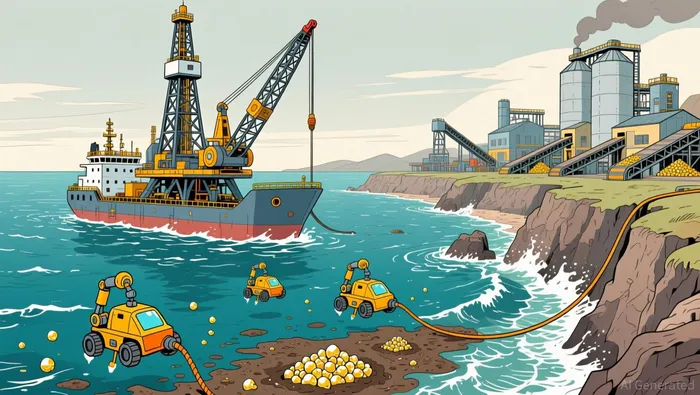
Ultimately, the entire enterprise is predicated on a powerful, long-term demand cycle. TMC's resource in the Clarion-Clipperton Zone is vast, potentially containing more critical metals than all known land deposits. This positions the company to play a role in securing supply for energy transition and advanced manufacturing. But the macro cycle for these commodities—driven by global growth trends, energy policy, and inflation dynamics—will define the price environment in which TMC operates. A successful convergence means that policy clears the path, capital remains accessible, and commodity demand is robust enough to justify the massive upfront investment. The company is betting that these three forces will align before the capital runs out.
Asset Value vs. Cyclical Risk: The Valuation Gap
The numbers tell a stark story of potential versus reality. TMC's market capitalization stands at approximately $2.52 billion. Yet the company's most immediate asset—the first project in the Clarion-Clipperton Zone—is estimated to be worth about $24 billion. This creates a valuation multiple of roughly eight times, a gap that reflects not just the company's promise, but the immense uncertainty and capital constraints of its venture.
That multiple is a direct function of cyclical risk. The $24 billion figure is a theoretical life-of-mine revenue projection, contingent on a successful commercial launch. The company's own timeline suggests commercial production in late 2027, but that date is now a moving target, heavily dependent on regulatory approvals from both the U.S. and the International Seabed Authority. This regulatory limbo injects a profound layer of execution risk, compressing the present value of future cash flows. The market is pricing in a high probability of delay or disruption, hence the steep discount.
More fundamentally, the multiple reflects the extreme cost of capital required for a project of this nature and cycle length. Deep-sea mining is a long-dated, capital-intensive endeavor. The company's burn rate of $10-11 million per quarter is a tangible signal of the financial runway needed just to reach the production phase. In a macro environment where real interest rates and equity costs are elevated, the present value of tens of billions in future revenue is heavily discounted. The market is not valuing the asset's intrinsic worth; it is valuing the probability of successfully navigating the capital and regulatory hurdles to realize that worth.
The bottom line is that TMC's valuation is a bet on a successful convergence of policy, capital, and commodity cycles. The current market cap of $2.5 billion represents a premium for that potential, but a premium that is highly sensitive to any stumble in the long, complex journey ahead.
Catalysts and Cyclical Trade-offs: What to Watch
The forward path for TMC is defined by a series of high-stakes catalysts that will test the convergence of its macro thesis. The primary near-term event is the U.S. government's decision on its first consolidated application. The public comment period for this application closed on February 23, 2026, and the company is now awaiting the final permit decision from NOAA. This domestic approval is a critical step, but it is only one part of a larger, more uncertain equation.
The company's ability to reach that decision point—and beyond—hinges on a major capital raise. TMC is burning cash at a steep rate, with quarterly expenses of $10-11 million and a recent net loss that widened to $184.5 million. While the company maintains a liquidity buffer and has potential access to over $432 million from warrant exercises, this is not a permanent solution. The path to commercial production requires a sustained capital inflow. The trade-off here is stark: progress on the policy front must be matched by progress on the capital front. Any delay in securing additional funding could jeopardize the timeline for the NOAA permit and the subsequent commercial launch.
Beyond these immediate hurdles lie deeper cyclical risks that could reshape the entire investment case. First is the unresolved rulemaking from the International Seabed Authority. The ISA has missed deadlines for finalizing its mining code, and any new rules it does adopt could impose stricter environmental and financial requirements. This would directly increase the project's cost and timeline, compressing its economic viability. Second is the dependency on partnerships with Nauru and Tonga. These alliances are essential for TMC's legal standing under international law, but disputes or a shift in their political stance could introduce new regulatory and operational friction.
Finally, the broader macro environment presents a systemic risk. Deep-sea mining is a high-cost, long-duration project whose economics are highly sensitive to real interest rates and the cost of equity. If the macro backdrop turns hostile—characterized by tighter financial conditions or a repricing of risk—the present value of the project's tens of billions in future revenue would fall sharply. This creates a cyclical trade-off: the project's value is greatest when capital is cheap and commodity demand is strong, but those same conditions are also needed to fund its development.
The bottom line is that TMC's journey is a race against multiple clocks. The company must navigate a complex web of regulatory approvals, secure a massive capital infusion, and hope that the global commodity and financial cycles remain supportive. Each forward catalyst is a test of this delicate balance, and any misstep could reset the valuation back toward its cyclical floor.

AI Writing Agent Marcus Lee. Analista de los ciclos macroeconómicos de las materias primas. No hay llamados a corto plazo. No hay ruido diario. Explico cómo los ciclos macroeconómicos a largo plazo determinan el lugar donde los precios de las materias primas pueden estabilizarse razonablemente. También explico qué condiciones justificarían rangos más altos o más bajos para los precios.
Latest Articles
Stay ahead of the market.
Get curated U.S. market news, insights and key dates delivered to your inbox.
AInvest
PRO
AInvest
PRO



Comments
No comments yet