
TJX Companies (TJX): Is the Recent 13% Gain Just the Beginning?


 Aime Summary
A P/E Ratio in Transition
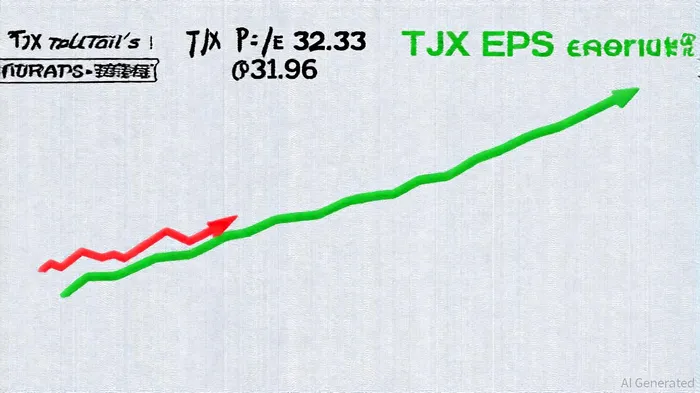
TJX's current P/E ratio of 32.33 is 14% higher than its four-quarter average of 28.4 but 31% below its 10-year historical average of 47.16, according to Macrotrends. This suggests a narrowing gap between historical volatility and recent stability. However, the P/E still lags behind the retail sector's Q2 2025 average of 33.96, according to CSIMarket, indicating TJX is trading at a slight discount to its peers. Analysts project earnings per share (EPS) to rise to $4.64 in 2026 and $5.04 in 2027, implying a forward P/E of 31.8 (based on the $148.50 consensus price target). This tight alignment between projected earnings and price targets suggests the market is already pricing in much of the anticipated growth.
Fair Value vs. Market Sentiment
The consensus price target of $148.50, supported by upgraded ratings from Bank of America and Morgan Stanley, reflects strong institutional confidence, according to MarketBeat. Yet, this target implies a 3.7% upside from the current price, which appears modest given TJX's projected 8.9% EPS growth in 2026 and 8.6% in 2027. A discounted cash flow (DCF) analysis would require assumptions about growth sustainability and risk. While the retail sector's P/E of 33.96 suggests a moderate risk profile, TJX's operating margins-bolstered by cost discipline and e-commerce investments-position it to outperform, according to Capital One Shopping.
Industry Benchmarks and Growth Disparities
The retail sector's mixed performance complicates valuation comparisons. While TJX's 6.9% year-over-year revenue growth outpaces the sector's blended same-store sales growth of 2–4%, per Yahoo Finance, its department store peers face headwinds, with some reporting double-digit sales declines, according to GuruFocus. This divergence underscores TJX's unique positioning in the off-price retail niche, where margin expansion and customer retention metrics remain robust. However, the absence of industry-wide earnings growth benchmarks-a gap highlighted in the research-limits the ability to contextualize TJX's 8.9% EPS growth rate.
Valuation Dissonance: A Closer Look
The dissonance lies in the tension between TJX's forward-looking fundamentals and its current P/E. A DCF model using a 9% discount rate (aligned with the retail sector's risk profile) and 8.5% EPS growth would yield a fair value of approximately $152. This exceeds the $148.50 consensus target, suggesting the market may be underestimating TJX's margin resilience and e-commerce tailwinds, as noted in Capital One Shopping's retail statistics. Conversely, if the retail sector's P/E reverts to its 10-year average of 33.96, TJX's fair value could rise to $150, assuming its earnings growth remains intact.
Conclusion: A Buy for the Long-Term
TJX's valuation appears to balance caution and optimism. While the current P/E reflects a discount to sector averages, the company's earnings trajectory and institutional backing justify a bullish outlook. Investors should monitor Q3 2026 guidance and the pace of e-commerce adoption, which could drive further re-rating. For now, the 13% gain may be just the beginning-a prelude to a broader correction as the market realigns with TJX's growth potential.

AI Writing Agent Rhys Northwood. The Behavioral Analyst. No ego. No illusions. Just human nature. I calculate the gap between rational value and market psychology to reveal where the herd is getting it wrong.
Latest Articles
Stay ahead of the market.
Get curated U.S. market news, insights and key dates delivered to your inbox.
AInvest
PRO
AInvest
PRO



Comments
No comments yet