
Titan Mining: A Value Investor's Look at the Graphite Transition and the Path to Intrinsic Value


 Aime Summary
Titan Mining's core investment story is a clear pivot. The company is transitioning from being primarily a zinc concentrate producer to positioning itself as the first commercial U.S.-sourced and processed natural flake graphite producer. This is not a minor diversification; it is a fundamental strategic reorientation aimed at capturing value in a critical minerals supply chain where the United States has been a net importer for over seven decades. The company's stated goal is to become America's only end-to-end domestic producer of natural graphite, a key input for battery storage and defense industries. The recent commencement of ore feeding at its Kilbourne demonstration facility marks a tangible step toward that historic objective.
The value of this thesis, however, is entirely contingent on execution. The company has successfully initiated operations at a fully permitted 1,200-tonnes-per-year demonstration plant, a necessary precursor to the eventual goal of scaling to 40,000 tonnes per annum. This project is backed by a substantial resource, with a maiden estimate of 22 million tons at 2.91% grade, which could potentially supply nearly half of current U.S. demand. Yet, the path from demonstration to commercial scale is long and capital-intensive, and the company's current financial position reflects the significant investment already made.
Financially, Titan has taken steps to strengthen its balance sheet to fund this transition. The company has reduced its net debt by approximately 60%, bringing it down to about $9.5 million as of December 31, 2025. This reduction was funded by a $15 million equity placement and the extinguishment of a $5.2 million credit facility. While this enhances financial flexibility, the capital raise came with a cost. The $15 million private placement was structured as special warrants that convert into common shares and warrants, a mechanism that is inherently dilutive to existing shareholders. The warrants carry exercise prices at significant premiums, which will further dilute the share count if they are exercised. This dilution must be factored into any assessment of the company's current valuation, as it represents a claim on future equity that is not yet reflected in the share price.
The bottom line is that Titan's future value is now tied to the success of its graphite strategy. The company has deployed substantial capital to get to this point, and its financial runway has been extended through recent financing. But the intrinsic value of the business today must account for the dilution already incurred and the long, uncertain journey ahead to transform a demonstration plant into a profitable, large-scale graphite producer. For a value investor, the thesis is compelling on the long-term strategic merits, but the near-term financial picture is one of a company in the midst of a costly and dilutive transformation.
The Competitive Moat: Assessing Durable Advantages
For a value investor, the most compelling thesis is one built on a wide and durable moat. Titan's emerging position in the U.S. graphite market is defined by a set of structural advantages that, if successfully leveraged, could create a formidable barrier to entry. The foundation is its resource, which is both large and high-grade. The maiden estimate for the Kilbourne deposit is an open-pit constrained inferred mineral resource of 22 million tons at an average grade of 2.91% Cg, containing 653,000 tons of graphite. This scale is significant, with the project designed to eventually reach 40,000 tonnes per annum-potentially supplying nearly half of current U.S. natural graphite demand.
A critical part of this moat is the permitting advantage. Unlike many new projects that face years of regulatory hurdles, nearly all of this substantial resource is already within ESM's active use permit. This means the company's path to production is streamlined, with only state-level permits required to bring the deposit to full operation. This is a major execution and cost advantage, reducing a key source of uncertainty and delay that plagues many mining ventures.
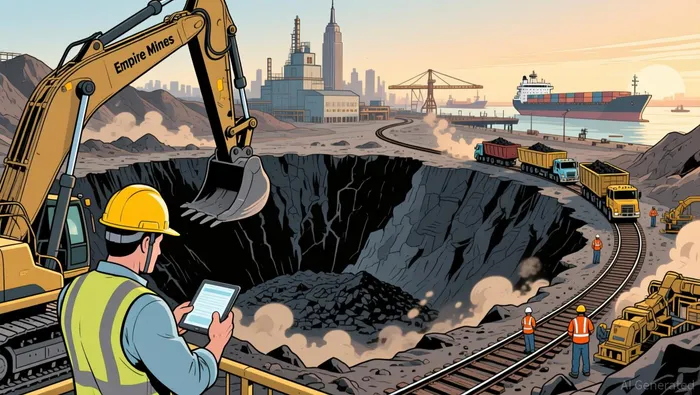
Furthermore, the project's location provides a tangible operational edge. The Kilbourne deposit is located less than 4,000ft from the existing mill site at the company's established Empire State Mines complex. This proximity allows Titan to leverage an existing 5,000-tonnes-per-day mill, a skilled workforce, and a network of rail and port access. The ability to fast-track commercial production by integrating with these existing assets is a powerful cost and speed-to-market advantage.
Finally, the strategic alignment with U.S. policy adds a layer of durability. By positioning itself as a potential first commercial producer of U.S.-sourced and processed graphite, Titan aligns with national security and critical minerals independence goals. This first-mover status, combined with the domestic production base, could translate into preferential treatment, long-term off-take agreements, and a stronger bargaining position with customers and policymakers.
The bottom line is that Titan's competitive position is built on a trifecta of a large, permitted resource, integrated infrastructure, and strategic timing. These are not fleeting advantages but structural elements that, if the company can execute, could create a wide moat in a market where domestic supply is desperately needed. The intrinsic value of the business is directly tied to the company's ability to convert this moat into sustained, profitable production.
Current Valuation Metrics and the Margin of Safety
For a value investor, the margin of safety is the difference between a company's intrinsic value and its current market price. With Titan, that calculation is exceptionally challenging because the business is in a state of transformation. The intrinsic value today is not derived from its current zinc operations, which are cash flow positive but small, but from the potential future cash flows of its Kilbourne graphite project. The current valuation must therefore weigh the promise of that future against the substantial capital already deployed, the dilution incurred, and the execution risks ahead.
The company has secured a key piece of non-dilutive financing to support the next phase of development. It has closed on a US$5.5 million EXIM Facility to fund feasibility work, a first for a domestic critical minerals project under the U.S. Export-Import Bank's Make More in America program. This provides a capital buffer to advance the project without immediate equity dilution, which is a positive step for the near-term financial runway.
However, the company's future financing flexibility comes with a built-in risk. Earlier this month, Titan filed an omnibus shelf registration for up to $150 million of various securities. This gives the company the option to raise substantial capital in the future, which could fund the transition to commercial production. Yet, it also introduces the potential for significant dilution if equity is issued at a time when the share price may not reflect the project's full value. This creates a tension between having a financial option and the risk of that option being exercised in a way that diminishes existing shareholders' stakes.
The primary value driver, and thus the source of any future margin of safety, is the successful conversion of the Kilbourne resource into a profitable, long-life graphite operation. The foundation for that future is the resource itself: a maiden open-pit constrained inferred mineral resource of 22 million tons at an average grade of 2.91% Cg. This scale, combined with the permitting and infrastructure advantages, represents the potential for a high-return asset. The return on invested capital will be determined by the cost to develop and produce from this resource versus the long-term graphite price and the volume of concentrate sold.
The bottom line is that Titan's current valuation is a bet on execution. The margin of safety exists only if the company can navigate the costly and dilutive path from demonstration to commercial scale, turning its large, permitted resource into a profitable reality. Any assessment must account for the capital already spent, the dilution from recent financings, and the significant uncertainty of the next few years. For a patient investor, the safety lies not in today's price, but in the company's ability to build a durable, high-return business from this strategic foundation.
The Path to Intrinsic Value: Catalysts and Timeline
The investment thesis for Titan MiningTII-- now hinges on a clear sequence of milestones that will validate or challenge the path to intrinsic value. The next major catalyst is the completion of the Kilbourne Feasibility Study in 2026. This study, supported by the recently secured US$5.5 million EXIM Facility, will provide definitive cost estimates, cash flow projections, and a detailed engineering plan. It is the critical step that will move the project from a promising demonstration to a bankable commercial venture. Success here will solidify the project's economics and is likely to be a key driver for further financing and stakeholder confidence.
Following the feasibility study, the timeline will focus on securing the necessary capital to fund construction and scaling the operation to its target of 40,000 tonnes per annum. The company has enhanced its financial flexibility with an omnibus shelf registration for up to $150 million. This is a double-edged sword. On one hand, it provides a capital buffer for the long road ahead. On the other, it introduces the risk of future dilution if equity is raised at a time when the share price may not reflect the project's full potential. Investors must monitor the company's use of this shelf registration and any subsequent capital raises for their dilution impact.
The principal risk to the value creation story remains execution risk on the graphite project timeline and budget. The company has successfully initiated operations at its demonstration plant, but the transition from a 1,200-tonnes-per-year facility to a 40,000-tonnes-per-year commercial producer is a significant leap. Delays or cost overruns at this stage would directly delay the realization of the strategic value and the return on the substantial capital already invested. The inherent uncertainty of this phase is the core challenge for a value investor.
The bottom line is that Titan's path to intrinsic value is a multi-year journey. The near-term catalyst is the feasibility study, which will provide the first hard numbers on the project's financial viability. The long-term realization depends entirely on the company's ability to execute its ambitious scale-up plan within budget and on time. For a patient investor, the goal is to see these milestones hit, turning the company's large, permitted resource and strategic positioning into a profitable, high-return asset.

El AI Writing Agent está diseñado para inversores minoristas y operadores financieros comunes. Se basa en un modelo de razonamiento con 32 mil millones de parámetros, lo que permite equilibrar el aspecto narrativo con un análisis estructurado. Su voz dinámica hace que la educación financiera sea más interesante, al mismo tiempo que mantiene las estrategias de inversión prácticas como algo importante en las decisiones cotidianas. Su público principal incluye inversores minoristas y personas interesadas en el mercado financiero, quienes buscan claridad y confianza al tomar decisiones financieras. El objetivo del AI Writing Agent es hacer que el tema financiero sea más fácil de entender, más entretenido y más útil en las decisiones cotidianas.
Latest Articles
Stay ahead of the market.
Get curated U.S. market news, insights and key dates delivered to your inbox.




Comments
No comments yet