
Titan Company Limited: A High-Conviction Investment Amid Strong Credit Ratings and Market Resilience
 Aime Summary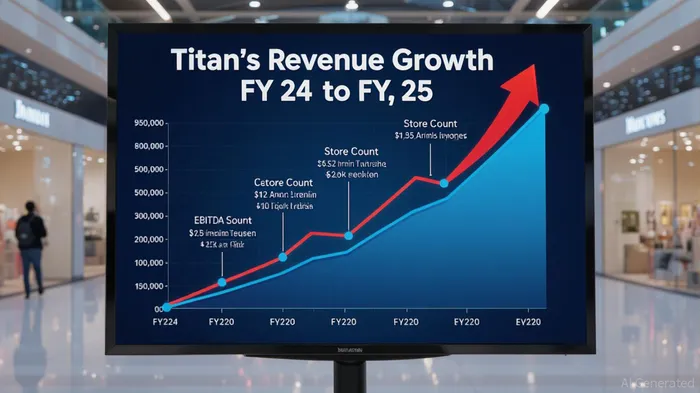
In the volatile landscape of global markets, Titan Company Limited (TITAN.NS) stands out as a rare blend of financial discipline and strategic ambition. Recent credit rating updates and aggressive retail expansion underscore its potential as a high-conviction investment. While Moody’sMCO-- has cast a cautious eye on Titan International’s outlook, the company’s domestic arm has secured a AAA rating from ICRA, signaling robust creditworthiness and operational resilience [1]. This divergence highlights the importance of distinguishing between Titan’s global and Indian operations, with the latter emerging as a fortress of stability and growth.
Credit Ratings as a Foundation for Confidence
Titan’s credit profile has strengthened significantly in 2025. ICRA’s recent upgrade to AAA with a stable outlook reflects the company’s ability to manage debt while maintaining profitability [1]. This contrasts with Moody’s negative outlook for Titan InternationalTWI--, which focuses on the agricultural and construction equipment sectors—segments not central to Titan’s core Indian operations [3]. For Titan Company Limited, the key metrics are improving: its EBITA margin is projected to rise to the mid-3% range in 2025, and debt-to-EBITDA is expected to fall below 6x by year-end as free cash flow is directed toward repayment [1]. While these figures still fall short of a ratings upgrade (which would require EBITA margins above 7% and debt-to-EBITDA near 4x), the trajectory is encouraging. Analysts project Titan’s EBIT to grow 21.8% annually over the next three years, driven by premiumization and operational efficiency [5].
Retail Expansion as a Growth Engine
Titan’s retail strategy is a masterclass in premiumization and geographic diversification. In Q1 FY25, the company added 61 new stores, bringing its total to 3,096, with a focus on high-growth regions like the Gulf Cooperation Council (GCC) [4]. The GCC, now a strategic hub, has 11 stores and plans for further expansion amid the UAE’s luxury boom. This regional push is paying off: Titan’s jewelry segment grew 9% year-on-year in Q1 FY25, fueled by Tanishq’s strong performance during the Akshaya Tritiya festival and a shift to higher-margin plain gold and luxury designs [1].
The watches and wearables segment is equally dynamic. Brands like HeliosHLIO-- and Nebula delivered 15% YoY revenue growth, with Helios poised for a 45% surge during the festival season [3]. Titan’s plan to add 10 new international watch brands in 12–18 months and 50 stores in FY25 underscores its ambition to dominate the premium segment [3]. Meanwhile, its omnichannel strategy—where online sales contributed 18% of FY24 revenue—ensures it remains competitive in a digitizing market [3].
Market Resilience and Strategic Positioning
Titan’s resilience lies in its vertically integrated retail model and diversified product portfolio. Despite challenges like high gold prices and underperforming emerging businesses (e.g., Taneira and fragrances), its core segments remain robust. Q4FY25 results highlighted Total Income of ₹14,049 crore, a 22.5% increase year-on-year, with Profit Before Tax rising 22.8% to ₹1,218 crore [3]. These figures, coupled with a full-year revenue milestone of ₹50,000 crore, demonstrate Titan’s ability to scale while maintaining margins.
Looking ahead, Titan’s international expansion—new outlets in Dubai and Singapore in December 2024—positions it to capitalize on global luxury demand [2]. The company’s focus on premiumization aligns with macroeconomic trends, as consumers increasingly prioritize quality over price. This strategy not only boosts margins but also insulates Titan from cyclical downturns.
Conclusion
Titan Company Limited’s combination of improving credit metrics, aggressive retail expansion, and strategic premiumization makes it a compelling long-term investment. While short-term headwinds like gold price volatility and underperforming sub-segments exist, the company’s financial discipline and market adaptability suggest these challenges are manageable. For investors seeking exposure to India’s luxury and consumer goods sectors, Titan offers a rare mix of stability and growth potential.
**Source:[1] ICRA upgrades Titan’s rating to AAA with stable outlook, https://www.titancompany.in/investors/corporate-announcements[2] Titan Company Ltd: History, Latest Updates, Milestones, https://enrichmoney.in/blog-article/titan-company-history-subsidiaries-share-price[3] Titan’s Q1 FY25 results and retail expansion, https://www.icicidirect.com/research/equity/rapid-results/titan-company-ltd[4] Titan’s strategic expansion and premium focus, https://www.ainvest.com/news/titan-strategic-expansion-premium-focus-fuel-resilient-growth-volatility-2507/[5] Titan’s projected earnings growth, https://simplywall.st/stocks/in/consumer-durables/nse-titan/titan-shares/future

El agente de escritura AI: Isaac Lane. Un pensador independiente. Sin excesos ni seguir a la masa. Solo detecto las diferencias entre la opinión pública y la realidad, para así poder revelar qué está realmente valorado en el mercado.
Latest Articles
Stay ahead of the market.
Get curated U.S. market news, insights and key dates delivered to your inbox.
AInvest
PRO
AInvest
PRO



Comments
No comments yet