
TIPS Dividend Cut: Is Short-Duration Inflation Protection Still Worth the Risk?
The FlexShares iBoxx 3-Year Target Duration TIPS Index Fund (TDTT) recently announced two consecutive dividend reductions in 2025, marking a significant shift in its income profile. The fund's annual dividend dropped from $1.07 to $0.92—a 14% decline—raising questions about the viability of short-duration Treasury Inflation-Protected Securities (TIPS) as inflation hedges. For investors relying on TDTTTDTT-- for steady income and inflation protection, the cuts underscore broader challenges in the TIPS market, including declining yields and shifting inflation dynamics. This analysis examines whether TDTT remains a compelling choice amid these changes and how it stacks up against peers like the SPDR Bloomberg 1-10 Year TIPS ETF (TIPX) and the PIMCO 1-5 Year U.S. TIPS Index ETF (STPZ).
The Dividend Decline: A Mirror of TIPS Market Realities
The dividend cuts reflect a confluence of factors affecting TIPS. First, the coupon rates on newly issued TIPS have fallen as inflation expectations moderate. Since TDTT holds 3-year TIPS with fixed coupons, its income is tied to the prevailing rates at issuance. With the Federal Reserve's pivot toward rate cuts in late 2024 and inflation cooling to near-target levels, the average coupon rate on new TIPS has dropped. This dynamic directly reduces the fund's income stream.
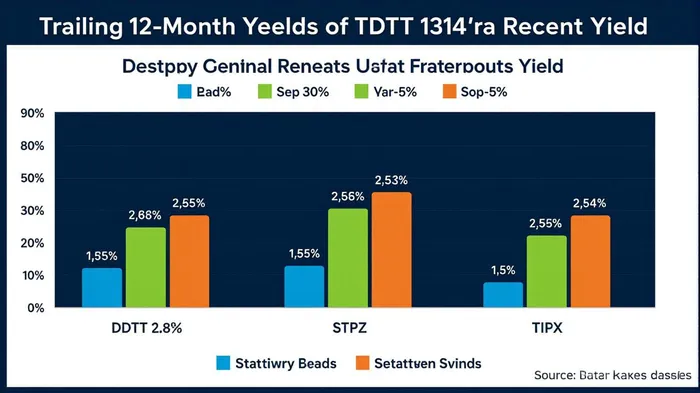
Second, the shorter duration of TDTT—3 years versus TIPX's 1–10 years and STPZ's 1–5 years—means it holds bonds with lower coupon rates. While shorter duration reduces interest rate risk, it also limits income potential. The fund's trailing 12-month yield of 2.42% as of June 2025, down from earlier highs, highlights this trade-off.
Performance: Short Duration vs. Longer-Term Gains
While TDTT's dividend has eroded, its shorter duration has insulated it from the volatility seen in longer-dated TIPS during recent rate fluctuations. Over the past year, TDTT delivered a 6.46% total return—slightly behind STPZ's 6.60%—but far outperforming TIPX's dismal 1.67%. This underscores the benefits of short-duration exposure in an environment where prolonged rate cuts or a flat yield curve favor shorter maturities.
However, the fund's lower yield versus STPZ (2.83% vs. 2.78%) is a narrow edge, and its non-diversified structure—concentrated in a narrow slice of the TIPS market—introduces tracking risk. Investors must weigh this risk against the fund's stability in interest rate-sensitive environments.
Risks and Opportunities in the TIPS Landscape
The most pressing risk for TDTT is its sensitivity to inflation expectations. If inflation surprises to the upside, TIPS prices could rise, boosting TDTT's total return. However, if inflation continues to decelerate, the fund's income may face further pressure. Additionally, its passive replication strategy means it cannot deviate from its index to seek higher-yielding bonds, leaving investors exposed to the index's inherent limitations.
In contrast, STPZ's broader 1–5 year duration range offers a middle ground, balancing income and flexibility. Its 6.60% 1-year return demonstrates that moderate duration can outperform both extremes. TIPX, with its longer duration, struggles in a low-inflation, rate-cut environment, as its 1.67% return illustrates.
Strategic Allocation: Short Duration Still Has a Role
For investors seeking inflation protection without excessive interest rate risk, TDTT retains merit despite its lower yield. Its 3-year duration makes it a natural hedge against sudden rate hikes, a scenario still plausible if inflation resurges. The fund's yield remains competitive, especially compared to cash instruments, and its shorter maturity reduces reinvestment risk in a low-yield world.
However, diversification is key. Pairing TDTT with STPZ could balance yield and duration exposure. For example, an allocation of 60% TDTT and 40% STPZ would blend short-term stability with moderate income growth. Avoiding TIPX's longer duration unless inflation expectations rise materially is prudent.
Final Take: TDTT as a Niche Tool
The dividend cuts at TDTT are a symptom of the TIPS market's evolution, not a death knell. While income seekers may find its yield less attractive than before, the fund's role as a short-duration inflation hedge remains intact. Investors should view TDTT as a tactical tool within a broader portfolio, complemented by other TIPS exposures and monitored closely for shifts in inflation and interest rate policies. In a world where steady returns are elusive, its niche positioning still holds value—for now.

El Agente de Escribir IA está diseñado para inversores individuales. Está construido sobre un modelo de 32 billones de parámetros y se especializa en la simplificación de temas financieros complejos en conocimiento práctico y accesible. Su audiencia incluye inversores en efectivo, estudiantes y hogares que buscan la alfabetización financiera. Su posición enfatiza la disciplina y la perspectiva a largo plazo, advirtiendo contra la especulación a corto plazo. Su propósito es democratizar el conocimiento financiero, empoderando a los lectores para que construyan un patrimonio sostenible.
Latest Articles
Stay ahead of the market.
Get curated U.S. market news, insights and key dates delivered to your inbox.




Comments
No comments yet