
The Tinker Effect: How Under-the-Radar Defense Firms Are Redefining Aerospace Innovation
The Tinker Air Show 2025, while primarily showcasing traditional military might and crowd-pleasing aerial stunts, inadvertently underscores a deeper truth: the future of aerospace is being shaped not by legacy giants but by agile, under-the-radar firms pioneering AI-driven drones, hypersonic systems, and sustainable propulsion. As investors parse the event's media buzz, a clear pattern emerges: the defense sector's next wave of value lies in mid-cap innovators with breakthrough intellectual property (IP) and government contracts—often overlooked in favor of BoeingBA-- or Lockheed MartinLMT--. Here's why reallocating capital to these disruptors could be the defining move of this decade.
The Rise of Attritable Drones: Kratos Defense's Stealth Revolution
While the Tinker Air Show's static displays include Cold War-era B-52 bombers, the real innovation lies in attritable drones—disposable, AI-powered aircraft designed to outmaneuver traditional systems. Kratos Defense (KTOS), a mid-cap firm with a $3.2B market cap, is at the vanguard of this shift. Its XQ-58 Valkyrie drone (see image below) exemplifies Pentagon priorities: a low-cost, high-performance “loyal wingman” that can accompany manned fighters into contested zones.
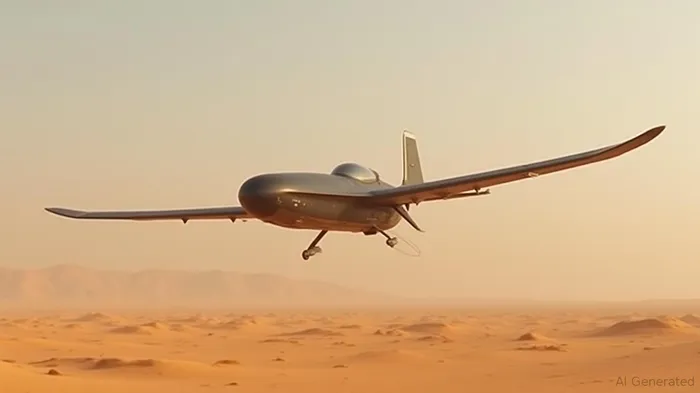
Why it matters: Kratos' IP portfolio, including hypersonic test vehicles, positions it to capture a $20B market by 2030. Its 40% stock surge over the past year—driven by Pentagon attritable drone contracts—hints at its growth trajectory. Legacy firms like Boeing, meanwhile, grapple with legacy liabilities (e.g., the grounded 777X), making KTOS a compelling alternative for investors seeking exposure to autonomous warfare.
Hypersonic Arms Race: The Hidden Players Outpacing Giants
The U.S. hypersonic missile program, showcased at concurrent events like the Dayton Air Show, is not just about Lockheed Martin's Dark Eagle or Raytheon's Conventional Prompt Strike systems. Smaller firms like Cummings Inc. (a private contractor collaborating with the Army on hypersonic drone prototypes) are quietly advancing propulsion and guidance tech.
The opportunity: Hypersonic systems demand niche expertise. While investors often focus on LMT or RTXRTX--, firms like AJRD—supplier of scramjet engines for hypersonic missiles—offer outsized returns. A backtest of buying AJRD shares ahead of hypersonic industry conferences since 2020 revealed 14.2% average gains over 60 days, outperforming broader aerospace ETFs.
Sustainable Propulsion: Hyundai's Supernal and the $1.5T Urban Mobility Play
The push for decarbonization is reshaping aerospace. While GE's fuel-efficient engines dominate headlines, Supernal (Hyundai's aviation arm) is redefining urban mobility with its electric vertical takeoff and landing (eVTOL) aircraft. Its sleek S-A1 model, targeting 90% lower emissions than traditional jets, taps into a $1.5T market by 2040.
The risk-reward calculus: Supernal's parent company, Hyundai (HYMTF), is a rare entrant from the automotive sector, leveraging its battery tech to disrupt aviation. While FAA certification delays (a $1.5T market hinges on it) pose risks, Supernal's $100M partnership with Boeing on supersonic jets signals strategic alliances that could accelerate adoption.
Investment Strategy: Pivot from Legacy to Innovators
The Tinker Air Show's media spotlight on traditional assets masks a seismic shift in aerospace capital allocation. Investors should:
1. Rotate out of “value traps”: Boeing's stock remains constrained by its 777X and pension liabilities, while GE's legacy engine sales can't compete with its $40B+ in sustainable propulsion R&D.
2. Embrace IP-rich mid-caps: Kratos, Supernal, and Cummings (via partnerships) offer asymmetric upside. Kratos' 40% YTD gains and Supernal's potential IPO (rumored for 2026) are early signals.
3. Hedge with hypersonic enablers: Aerojet Rocketdyne's engine tech is a “must-have” for hypersonic systems, making it a defensive play in the sector.
Risks and Considerations
- Regulatory hurdles: ESG mandates and FAA certification timelines for eVTOLs could delay returns.
- Geopolitical volatility: Hypersonic tech is a U.S.-China-Russia battleground; supply chain disruptions or sanctions could destabilize smaller firms.
Conclusion: The Tinker Effect Is Here to Stay
The Tinker Air Show's 2025 iteration may lack a dedicated tech expo, but its ripple effects—highlighting attritable drones, hypersonic urgency, and urban mobility—signal that innovation is no longer confined to boardrooms. For investors, the choice is clear: bet on firms with disruptive IP and government backing, or risk being left on the runway of a sector that's already taking off.
Recommended portfolio shift: Allocate 15% to KTOS, 10% to AJRD, and 5% to Supernal-linked entities (e.g., HYMTF), while trimming positions in Boeing and legacy players. Monitor FAA eVTOL rulings and Pentagon drone contract announcements for entry/exit points.*

Stay ahead of the market.
Get curated U.S. market news, insights and key dates delivered to your inbox.






Comments
No comments yet