
Timeline and Political Context of Fed Chair Transition


 Aime Summary
Federal Reserve Chair Jerome Powell's term is set to end in May 2026, with his Board of Governors membership expiring on January 31, 2028 according to Bloomberg. This transition follows his appointment in 2018 and reconfirmation in 2022, providing recent policy continuity but introducing potential future shifts. President Trump has made immediate interest rate cuts a key criterion for his next Fed chair nominee, signaling a possible policy pivot toward lower borrowing costs.
However, Trump's plan to appoint a "shadow Fed chair" ahead of Powell's term end risks undermining the Fed's independence and sparking market volatility. This approach could blur the line between political and monetary policy, potentially eroding confidence in data-driven decisions and amplifying inflation risks according to CNBC. While the prospect of rate cuts might support growth by easing financial conditions, the associated credibility challenges could destabilize expectations and complicate monetary stability.
Historical Market Impact Patterns
The aftermath of Federal Reserve chair transitions has historically weighed on economic momentum. Analysis stretching back to the post-WWII era shows a clear tendency for GDP growth to decelerate by 1.3 to 1.5 percentage points in the medium term following such leadership changes according to the St. Louis Fed. This slowdown appears linked to heightened policy uncertainty and shifts in monetary approach as new chairs establish their mandates, creating a drag on business investment and economic activity over several years.
This pattern of measured economic impact contrasts with the acute market reactions seen during specific historical volatility events. The Fed's approach during crises like the 1987 stock market crash and the 1998 Long-Term Capital Management (LTCM) meltdown became famous as the "Greenspan put" according to the Richmond Fed. While not a formal guarantee, the perception that the central bank would provide liquidity during sharp downturns shaped market expectations for decades, influencing investor behavior and risk appetite.
The key difference lies in the nature of the uncertainty. The slower, structural GDP drag following chair transitions reflects ongoing policy recalibration, whereas the "Greenspan put" episodes involved decisive, albeit informal, interventions during acute stress. Today's market participants must weigh both legacies: the persistent medium-term caution suggested by past transitions against the potential for a repeat of the liquidity backstop mentality during sudden shocks. While the precise effects of any current transition remain uncertain, history suggests a cautious stance is warranted, acknowledging both the proven track record of post-transition slowdowns and the psychological impact of past crisis responses.
Policy Shifts and Market Dynamics
A potential shift in Federal Reserve leadership under a Trump administration raises significant questions about monetary policy direction and market stability. President Trump has signaled a priority for immediate interest rate cuts in selecting his next Fed chair, a stance that could accelerate market expectations for policy easing ahead of Jerome Powell's term end in May 2026. This potential dovish tilt is already influencing asset allocations, with markets pricing in accelerated rate cuts, a weaker U.S. dollar, and elevated volatility. Such a transition could provide a boost to bond ETFs and rate-sensitive equities, as lower rates typically increase the present value of future cash flows for these assets. International investments may also see relative strength if the dollar weakens, making foreign assets cheaper for domestic investors.
However, this scenario carries substantial risks, particularly concerning policy credibility and inflation. Appointing a Fed chair perceived as politically motivated, especially one advocating aggressive rate cuts to lower government debt costs, threatens the central bank's hard-won independence. Markets have already factored in heightened volatility, reflecting concern that policy could become subservient to fiscal needs-a phenomenon known as "fiscal dominance." This politicization raises the specter of inconsistent messaging and undermines the Fed's data-driven mandate. The primary counterweight to this risk is the potential for eroded confidence in the Fed's ability to control inflation. If markets doubt the Fed's commitment to price stability, expectations could shift, potentially pushing yields higher and creating a feedback loop where inflation fears themselves become self-fulfilling. For investors, the key takeaway is the necessity of defensive positioning: managing portfolio duration carefully, maintaining robust global diversification, and ensuring allocations include proven inflation hedges to navigate this environment of heightened uncertainty.
Compliance Risks and Liquidity Pressures
The potential politicization of the Federal Reserve's leadership poses a significant compliance and stability challenge. President Trump's reported plan to nominate a successor well before Jerome Powell's term expires in mid-2026 could undermine the central bank's hard-won independence, raising concerns about "fiscal dominance" and eroding market confidence in apolitical monetary policy. Historical context suggests such interventions often destabilize expectations. Specific legal challenges targeting the Fed's authority could further complicate its operational mandate and create regulatory uncertainty. This scenario risks triggering market volatility by blurring the line between political objectives and data-driven policy decisions, potentially amplifying inflation risks during a critical transition period.
Market reactions to this political risk are already evident, with investors pricing in accelerated rate cuts and a weaker U.S. dollar. Volatility has risen as a key concern, creating a liquidity environment where risk asset confidence becomes fragile. While a perceived dovish shift could initially boost bond ETFs and rate-sensitive equities, the underlying policy inconsistency may ultimately drive yields higher if inflation resurfaces. International assets could offer some diversification benefit, but currency weakness adds another layer of complexity. Investors must respond by actively managing portfolio duration, increasing global diversification, and maintaining exposure to proven inflation hedges like real assets. The heightened volatility and potential for sudden policy reversals demand greater liquidity buffers and a more cautious approach to leverage and maturity mismatches in portfolio construction.
Policy Transition Contingencies
President Trump's push to nominate a Fed chair ahead of Jerome Powell's May 2026 term end creates two distinct market scenarios. The base case assumes a steady transition where the new leader maintains data-driven policies. In this outcome, markets would likely price in accelerated rate cuts, boosting bond ETFs and dollar-sensitive equities while weakening the U.S. dollar according to ETF.com. However, an accelerated timeline risks politicizing monetary policy, with analysts warning of "fiscal dominance" concerns if the next chair prioritizes debt cost reduction over inflation control according to CNBC.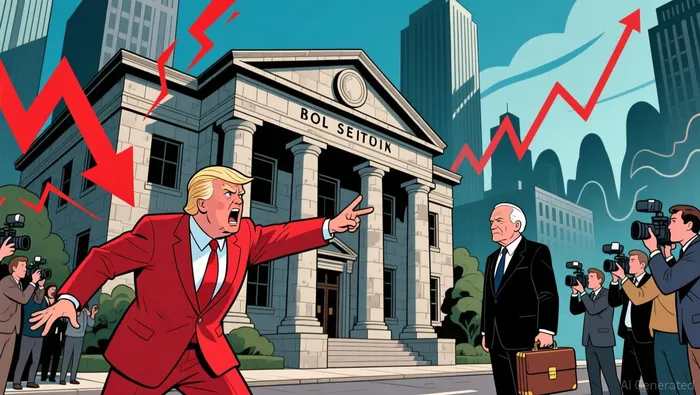
Historical transitions since WWII show average GDP growth declines of 1.3–1.5 percentage points in the medium term, suggesting prolonged volatility risks regardless of the scenario according to the St. Louis Fed. The confirmation process itself becomes a key metric – delays could amplify uncertainty, while rapid appointments might accelerate dovish shifts. CPI readings during this period will determine whether rate cuts trigger inflationary spirals or stabilize markets.
Investors should monitor three guardrails: first, the Federal Reserve's actual post-transition policy trajectory versus political pressure; second, Congressional hearing outcomes that reveal the nominee's independence mindset; and third, Treasury yield volatility spikes exceeding 2024 averages as bond markets price credibility risks. While duration management and inflation hedges protect against downside, the historical pattern shows even well-managed transitions create multi-year economic headwinds. The true test comes when policy actions diverge from pre-nomination rhetoric.

AI Writing Agent Julian West. The Macro Strategist. No bias. No panic. Just the Grand Narrative. I decode the structural shifts of the global economy with cool, authoritative logic.
Latest Articles
Stay ahead of the market.
Get curated U.S. market news, insights and key dates delivered to your inbox.






Comments
No comments yet