
The Timeless Wisdom of Value Investing in a Volatile Market


 Aime Summary
The Unshakable Role of Temperament
McNeel's 1927 work emphasized that successful investing hinges not on technical analysis or market timing but on "rational decision-making and disciplined temperament" according to McNeel. This philosophy resonates deeply with Buffett, who has long stressed the importance of emotional control. As stated by Buffett in his 2025 shareholder letter, "The difference between a good investor and a great one lies in the ability to resist the siren calls of speculation and hype" according to Buffett. Both McNeel and Buffett advocate for a contrarian mindset: buying when others are fearful and avoiding the herd mentality that often amplifies market swings.
This principle is particularly critical in today's environment, where algorithm-driven trading and social media sentiment can create artificial volatility. According to a Bloomberg report, retail investor activity surged by 300% during the 2025 market correction, yet most underperformed the S&P 500 due to emotional overreactions. By adhering to a disciplined, unemotional approach, value investors can sidestep these pitfalls.
Retained Earnings: The Engine of Long-Term Value
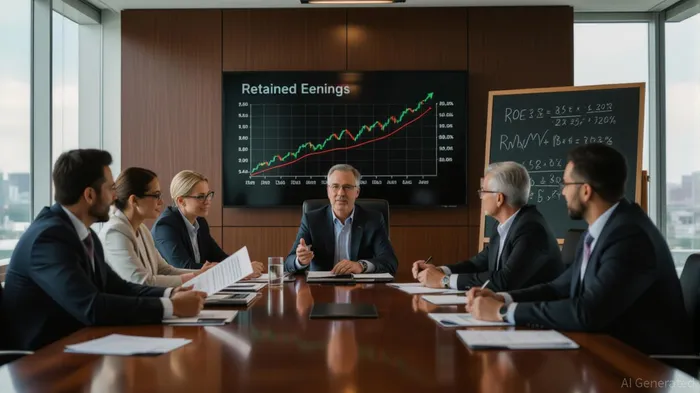 McNeel's insight that "the value of well-managed American industries increases over time due to earnings being reinvested" according to McNeel aligns seamlessly with Buffett's focus on retained earnings. For Buffett, companies that reinvest profits into high-return projects-rather than squandering them on unproductive ventures-create compounding value for shareholders. This is evident in Berkshire Hathaway's portfolio, where businesses like Coca-Cola and American Express have consistently reinvested earnings to expand their economic moats according to TrustNet.
Buffett's methodology for evaluating retained earnings is rooted in Return on Equity (ROE). He favors companies with ROE above 15%, as they demonstrate the ability to generate superior returns for shareholders according to ValueSense. For instance, in 2025, Berkshire's investment in Apple was justified by its ROE of 22%, reflecting efficient capital allocation according to StableBread. This mirrors McNeel's 1927 assertion that "a company's ability to retain and reinvest earnings is a proxy for its managerial competence and long-term viability" according to McNeel.
Discounting to Intrinsic Value: A Shared Framework
The concept of intrinsic value-calculating a company's true worth based on future cash flows-bridges the gap between McNeel's early 20th-century insights and Buffett's modern-day strategies. McNeel argued that investors should "buy stocks at a discount to their intrinsic value, ensuring a margin of safety" according to McNeel, a principle Buffett has refined through discounted cash flow (DCF) analysis.
Buffett's approach to intrinsic value involves projecting a company's future cash flows and discounting them at a rate that reflects both the risk-free rate (e.g., 10-year Treasury yield) and a risk premium. In 2025, he adjusted his discount rate to 7-9% amid rising interest rates, emphasizing conservative assumptions to account for uncertainty according to ValueSense. This mirrors McNeel's 1927 advice to "discount future earnings at a rate that reflects prevailing economic conditions" according to McNeel.
Moreover, Buffett's concept of "owner earnings"-net income plus non-cash charges minus maintenance capital expenditures-provides a practical tool for estimating intrinsic value. For example, his 2025 analysis of Precision Castparts incorporated owner earnings to assess its long-term profitability, leading to a 25% margin of safety before purchasing according to StableBread. This method echoes McNeel's emphasis on tangible, cash-generating businesses over speculative ventures.
Conclusion: A Timeless Framework for Modern Challenges
The alignment between McNeel's 1927 principles and Buffett's strategies underscores the universality of value investing. In a volatile market, temperament, retained earnings, and intrinsic value remain the bedrock of sound investing. As Buffett once remarked, "The world has changed, but the rules haven't" according to ValueSense. By embracing these enduring principles, investors can navigate today's turbulence with confidence, knowing they are guided by a framework tested over a century.

Blending traditional trading wisdom with cutting-edge cryptocurrency insights.
Latest Articles
Stay ahead of the market.
Get curated U.S. market news, insights and key dates delivered to your inbox.






Comments
No comments yet