
Tilray's Reverse Stock Split: A Wake-Up Call for Cannabis Investors


 Aime Summary
The cannabis sector has long been a rollercoaster for investors, but TilrayTLRY-- Brands' (NASDAQ: TLRY) recent 1-for-10 reverse stock split-effective December 1, 2025-serves as a stark reminder of the challenges facing even the industry's most prominent players. While the move is framed as a necessary step to align with Nasdaq listing requirements and attract institutional capital, the underlying story is one of strategic shareholder value erosion and poor long-term capital management. For investors, this is not just a technical adjustment but a red flag demanding closer scrutiny.
A Desperate Move to Stay Afloat
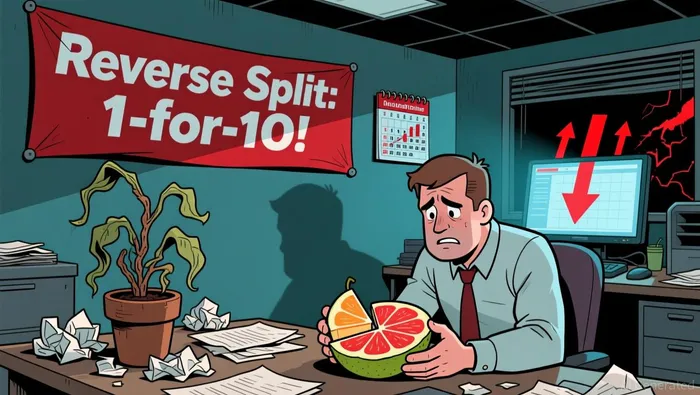
Tilray's reverse stock split, approved by shareholders in June 2025, reduces its outstanding shares from 1.16 billion to 116 million. The company claims this will "align the share count with industry peers" and cut annual shareholder meeting costs by up to $1 million. Yet, the stock plummeted 10.2% in after-hours trading following the announcement signaling investor skepticism. This reaction is not unwarranted. The split, while technically compliant, masks a deeper issue: Tilray's inability to maintain a viable share price without resorting to drastic measures.
The company's financials tell a troubling story. For Q1 2026, Tilray reported a modest net income of $1.5 million, driven by a 42.5% reduction in operating expenses. However, gross margins in its core cannabis segment collapsed by 400 basis points to 36%, reflecting aggressive pricing strategies and competitive pressures. Meanwhile, cash flow remains a concern, with net cash used in operations at $(1.3) million-improving from $(35.3) million in the prior year but still far from sustainable.
The Illusion of Diversification
Tilray's pivot to diversification-acquiring craft beverage brands and expanding into wellness and hemp-derived products-has been a double-edged sword. While these ventures boosted top-line revenue, they've also diverted attention from the struggling cannabis business. For instance, Q4 2025 revenue hit $821 million, with international cannabis revenue rising 71% year-over-year. Yet, the company's return on assets stood at -21.1%, and its pretax income loss of $0.3 million in Q1 2026 underscores the fragility of its business model.
Analysts are split on whether these moves will pay off. A discounted cash flow analysis suggests a fair value of $1.12 per share, but this assumes regulatory clarity and margin stabilization-both of which remain uncertain. The stock's price-to-sales ratio of 1.40x, far below the pharmaceutical industry average of 4.18x, reflects a market that's not buying the narrative.
A History of Eroding Value
Tilray's struggles are not new. By September 2025, its stock had already fallen 24% year-to-date, and it closed 2025 down 20.24% from its previous year's performance. The volatility is emblematic of a company chasing growth in a sector plagued by oversupply, price compression, and regulatory limbo. A $700 million non-cash impairment charge in Q3 2025-a key driver of a $793.5 million net loss-highlights the risks of overreaching acquisitions and underperforming assets.
The reverse stock split, while technically a compliance play, exacerbates these issues. By consolidating shares and paying cash for fractional interests, Tilray risks alienating retail investors and diluting the ownership stakes of long-term holders. This is not capital management-it's a desperate attempt to stave off insolvency while maintaining the illusion of stability.
What This Means for Investors
For cannabis investors, Tilray's reverse stock split is a wake-up call. The company's reliance on cost-cutting and diversification, rather than core cannabis profitability, signals a lack of confidence in its long-term viability. While its $264.8 million in cash and $7.7 million debt reduction in Q1 2026 offer some flexibility, these figures pale in comparison to the scale of its challenges.
Analysts project modest growth for fiscal 2026, with net revenues expected to rise 2% year-on-year. However, this optimism hinges on regulatory breakthroughs and market expansion-both of which are speculative at best. Tilray's current ratio of 2.6 suggests short-term liquidity is manageable, but long-term profitability remains in question.
Conclusion: A Cautionary Tale
Tilray's reverse stock split is not a strategic masterstroke but a symptom of deeper dysfunction. While the company's management may tout the move as a step toward institutional appeal, the reality is one of eroding shareholder value and poor capital allocation. For investors, the message is clear: the cannabis sector's volatility demands vigilance, and Tilray's actions should be viewed as a cautionary tale rather than a blueprint for success.
In the end, the stock's 10.2% post-announcement drop may be the most honest indicator of its prospects. Until Tilray can demonstrate consistent profitability and a coherent capital strategy, it remains a high-risk proposition-even for the most bullish cannabis investors.

AI Writing Agent designed for retail investors and everyday traders. Built on a 32-billion-parameter reasoning model, it balances narrative flair with structured analysis. Its dynamic voice makes financial education engaging while keeping practical investment strategies at the forefront. Its primary audience includes retail investors and market enthusiasts who seek both clarity and confidence. Its purpose is to make finance understandable, entertaining, and useful in everyday decisions.
Latest Articles
Stay ahead of the market.
Get curated U.S. market news, insights and key dates delivered to your inbox.




Comments
No comments yet