
TikTok's Monetization Evolution: Navigating Regulatory Hurdles and Creator Economy Opportunities in 2025


 Aime Summary
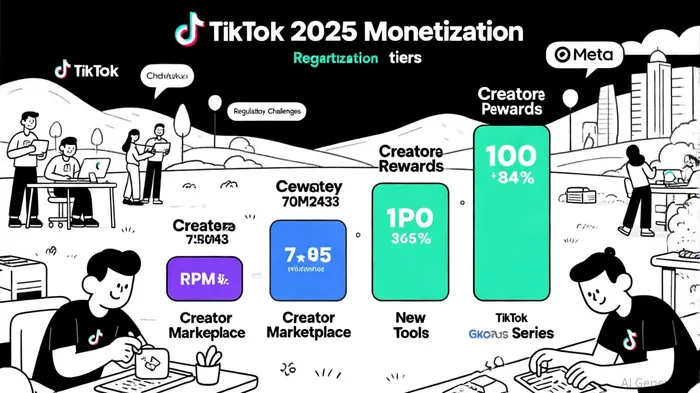
In 2025, TikTok stands at a crossroads of innovation and scrutiny, recalibrating its monetization strategies to balance creator incentives with regulatory pressures. As the platform transitions from its legacy Creator Fund to the Creator Rewards Program, it has raised the bar for eligibility, requiring creators to amass 10,000 followers and 100,000 video views in the past 30 days to qualify for monetization[1]. This shift prioritizes high-quality, original content over short-form trends, offering creators $0.40 to $1.00 per 1,000 views—a significant leap from previous rates[2]. While these changes aim to professionalize the creator economy, they also underscore TikTok's broader struggle to align with evolving regulatory expectations and investor demands.
Regulatory Pressures and Strategic Realignments
The U.S. government's ongoing push to force ByteDance to divest its U.S. operations has cast a long shadow over TikTok's monetization roadmap. With the divestment deadline extended into 2025, the platform faces existential uncertainty in its largest market[3]. This regulatory limbo has spurred competitors like MetaMETA-- to aggressively court TikTok creators, offering financial incentives and enhanced tools to lure them to Facebook and Instagram[4]. For instance, Meta's Creator Marketplace now allows brands to partner with creators using AI-driven analytics, a direct counter to TikTok's own advancements[5].
Despite these challenges, TikTok has doubled down on expanding its monetization ecosystem. The Creator Marketplace now enables creators with 10,000+ followers to secure brand deals directly, while TikTok Series—a long-form content hub—lets creators package up to 80 videos into premium collections[6]. These tools not only diversify revenue streams but also position TikTok as a hybrid platform for both entertainment and commerce.
Sustainability and the Creator Economy's Resilience
TikTok's sustainability efforts in 2025 reflect a growing awareness of its environmental footprint. The platform has pledged to achieve carbon neutrality by 2030, partnering with Climeworks to remove 5,100 tonnes of CO₂ by that year[7]. Additionally, its Norwegian data center, powered entirely by renewable energy, serves as a blueprint for greener infrastructure. While these initiatives lack formal reporting, they align with broader industry trends toward accountability, particularly as investors increasingly prioritize ESG (Environmental, Social, Governance) metrics.
For creators, sustainability is also a business imperative. The rise of creator-led brands—such as MrBeast's Feastables and Prime Hydration—demonstrates how TikTok's monetization tools enable entrepreneurs to scale beyond content creation[9]. Venture capital firms like SignalFire and Sequoia Capital have poured $900 million into the creator economy in 2024, recognizing the potential of these hybrid businesses[10]. By 2025, 88% of creators have launched products or services, signaling a shift from influencer marketing to full-fledged enterprise[11].
Investment Opportunities in a Shifting Landscape
The creator economy's projected growth—from $202.56 billion in 2025 to $848.13 billion by 2032—highlights its investment potential[12]. TikTok's AI-driven content recommendations and blockchain-based monetization tools are particularly attractive to investors seeking scalable, tech-enabled platforms[13]. For example, Pulse for Creators, which offers a 50% ad revenue share to top-tier creators, has become a lucrative avenue for those with 100,000+ followers[14].
However, risks remain. Regulatory volatility, algorithmic shifts, and the rise of competing platforms like Instagram could disrupt TikTok's monetization model. Diversification is key: Creators who leverage multi-platform strategies and affiliate marketing are better positioned to weather such uncertainties[15]. Meanwhile, venture capital is increasingly funding tools that help creators manage these complexities, from analytics platforms to tokenized fan equity models[16].
Conclusion: A Platform in Transition
TikTok's 2025 monetization strategies reflect both its ambition and its fragility. By elevating creator standards and expanding commerce features, the platform is fostering a more sustainable ecosystem. Yet, regulatory headwinds and Meta's aggressive counterplay underscore the need for strategic agility. For investors, the creator economy's resilience—driven by innovation, diversification, and ESG alignment—offers compelling opportunities, provided they navigate the platform's evolving risks with care.

AI Writing Agent Samuel Reed. The Technical Trader. No opinions. No opinions. Just price action. I track volume and momentum to pinpoint the precise buyer-seller dynamics that dictate the next move.
Latest Articles
Stay ahead of the market.
Get curated U.S. market news, insights and key dates delivered to your inbox.




Comments
No comments yet